

- Monthly visits
- 2,444
- 2026-09
LLMPrice - Compare LLM API prices with workload-based cost estimates
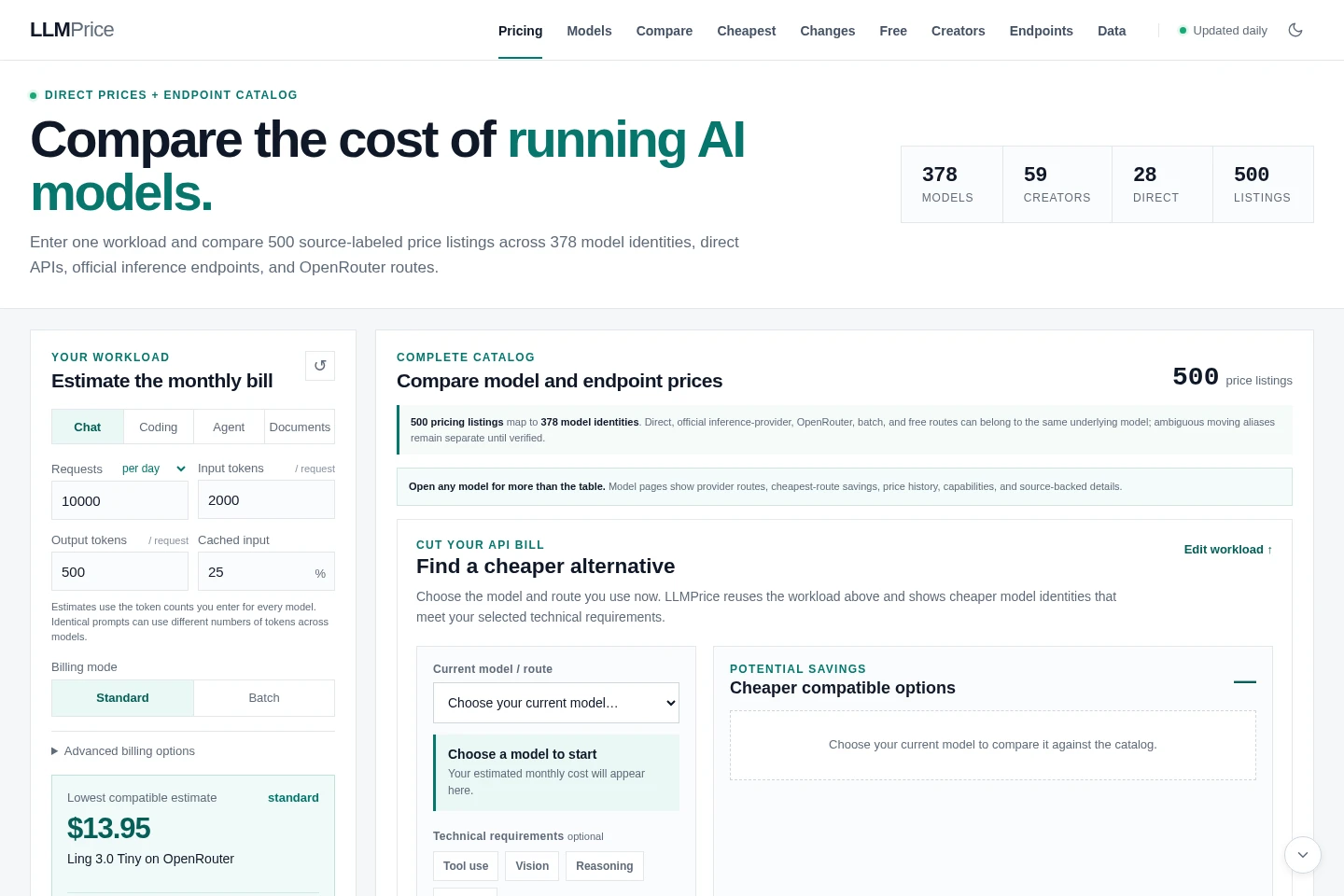
LLMPrice is a catalog and calculator for comparing language model API prices across direct APIs, inference providers, and OpenRouter. Enter request and token estimates, then adjust caching, batch mode, active days, retries, and reasoning tokens to estimate monthly costs. Browse model routes, filter by endpoint and capabilities, or compare alternatives against a selected model and workload.
- LLM Developer Tools
- LLM APIs
- Data Analysis
- LLM API price comparison
- AI model cost calculator
- token pricing catalog
Capabilities
Workload cost estimation
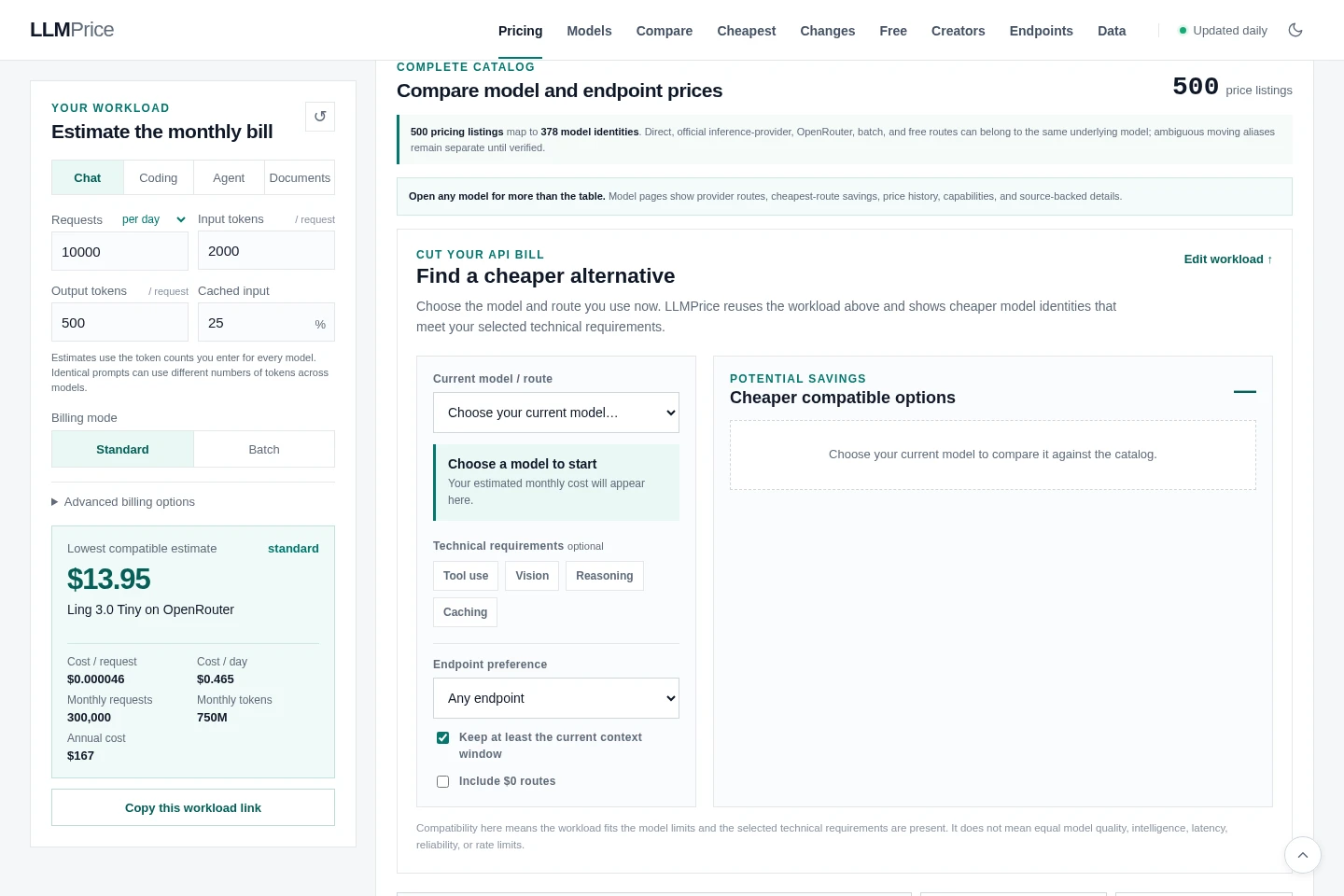
Estimates model costs for a workload and outputs request, daily, monthly, and annual cost figures. Users enter request and input/output token counts, then adjust cached input, active days, retries, cache writes, reasoning tokens, and billing mode.
Model price catalog
Displays model and endpoint price listings with source labels and outputs comparable price and context data. Users can browse or filter listings by model, creator, endpoint, paid or free status, and listed capabilities.
Alternative model comparison
Finds lower-cost model identities that meet selected technical requirements and outputs estimated alternative costs. Users choose a current model and route, reuse the workload, and optionally require tool use, vision, reasoning, caching, or a minimum context window.
Model and route details
Presents provider routes, price history, capabilities, and source-backed details for model listings. Users open a model entry to inspect the available listing information.
Pricing
LLMPrice has no listed product plans or subscription prices; it is a free-to-browse price catalog and calculator. Compare the model and endpoint rates shown in its listings, which are provider prices rather than LLMPrice plan fees.
Use cases
Estimate a workload’s model API costs
When planning API use for chat, coding, agents, or documents, enter request and token estimates to calculate costs across models. Adjust billing mode and workload assumptions to see estimated per-request, daily, monthly, and annual figures.
Compare model prices across endpoints
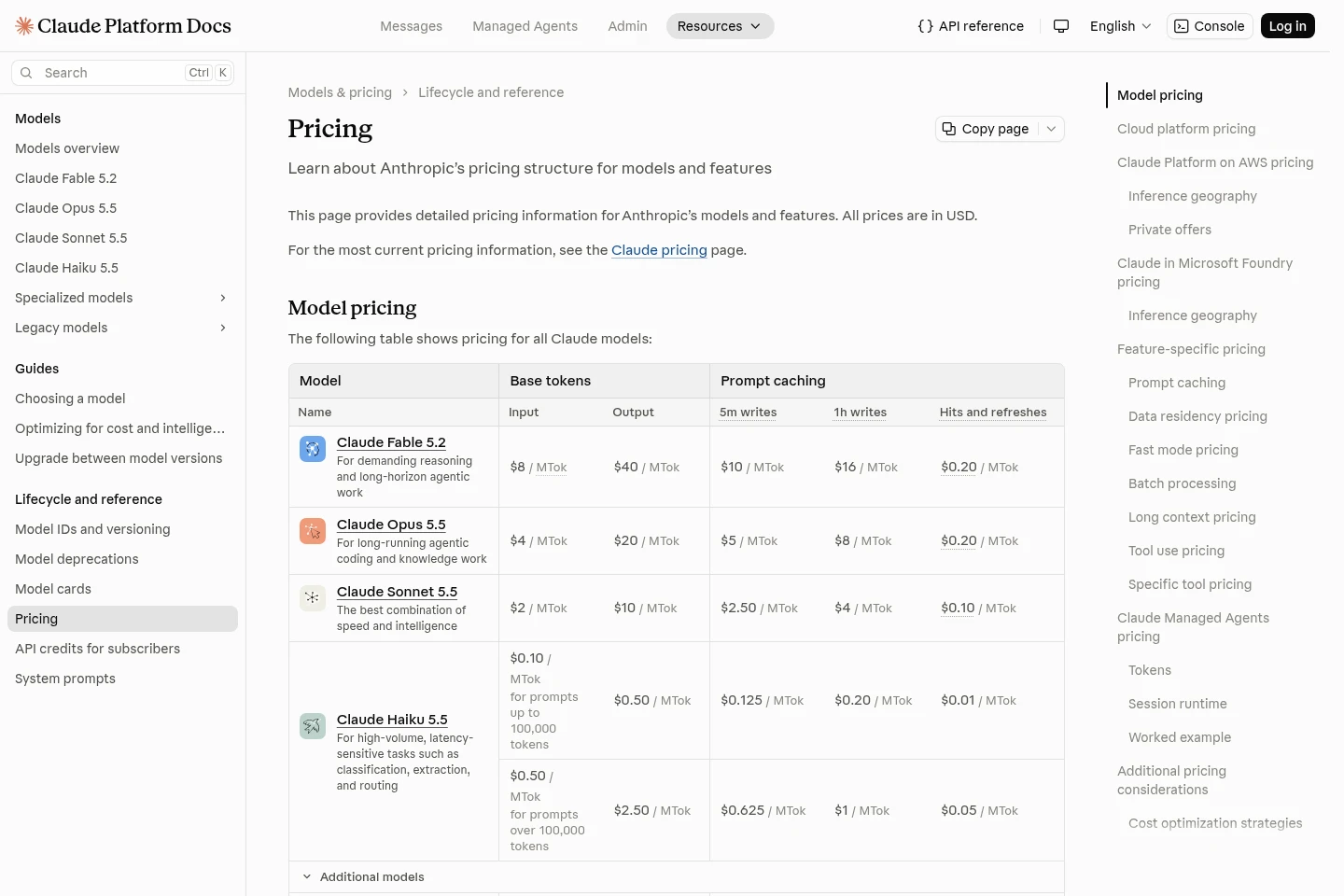
When choosing an API model route, browse listings from direct APIs, inference providers, and OpenRouter. Compare displayed input, cached input, output, context, and estimated monthly costs, with sources shown on listings.
Find lower-cost compatible model options
When a current model and route are known, select them to compare cheaper model identities under a reused workload. Optional technical requirements filter candidates, but compatibility does not establish equal quality, latency, reliability, or rate limits.
Limitations
Cost estimates use the token counts entered for each model; identical prompts may use different token counts across models.
The compatibility comparison checks model limits and selected technical requirements, not equal quality, intelligence, latency, reliability, or rate limits.
Free routes are listed separately because their rate limits and availability vary.
Who it is for
Developers and operators estimating language model API spending
People comparing model providers and API routes before choosing a model
Builders evaluating model alternatives for chat, coding, agent, or document workloads
FAQ
How does LLMPrice estimate a workload’s cost?
It applies the token counts and workload settings you enter to model price listings. Requests, input and output tokens, cached input, billing mode, active days, retries, cache writes, and reasoning tokens can affect estimates.
Does a compatible alternative perform as well as my current model?
Not necessarily. Compatibility means the workload fits model limits and selected technical requirements are present; it does not mean equal model quality, intelligence, latency, reliability, or rate limits.
Why are free model routes shown separately?
Free routes are separated because their rate limits and availability vary. The catalog also distinguishes paid and free listings.
What price information can I compare?
Listings show source-labeled model and endpoint prices, including input, cached input, output, context, and an estimated monthly cost. Model pages also provide provider routes, price history, capabilities, and source-backed details.
Comments