

- Monthly visits
- 4,357
- 2026-09
- Monthly growth -1.2%
TurboQuant Tools - A developer reference for TurboQuant, KV cache sizing, and inference memory planning
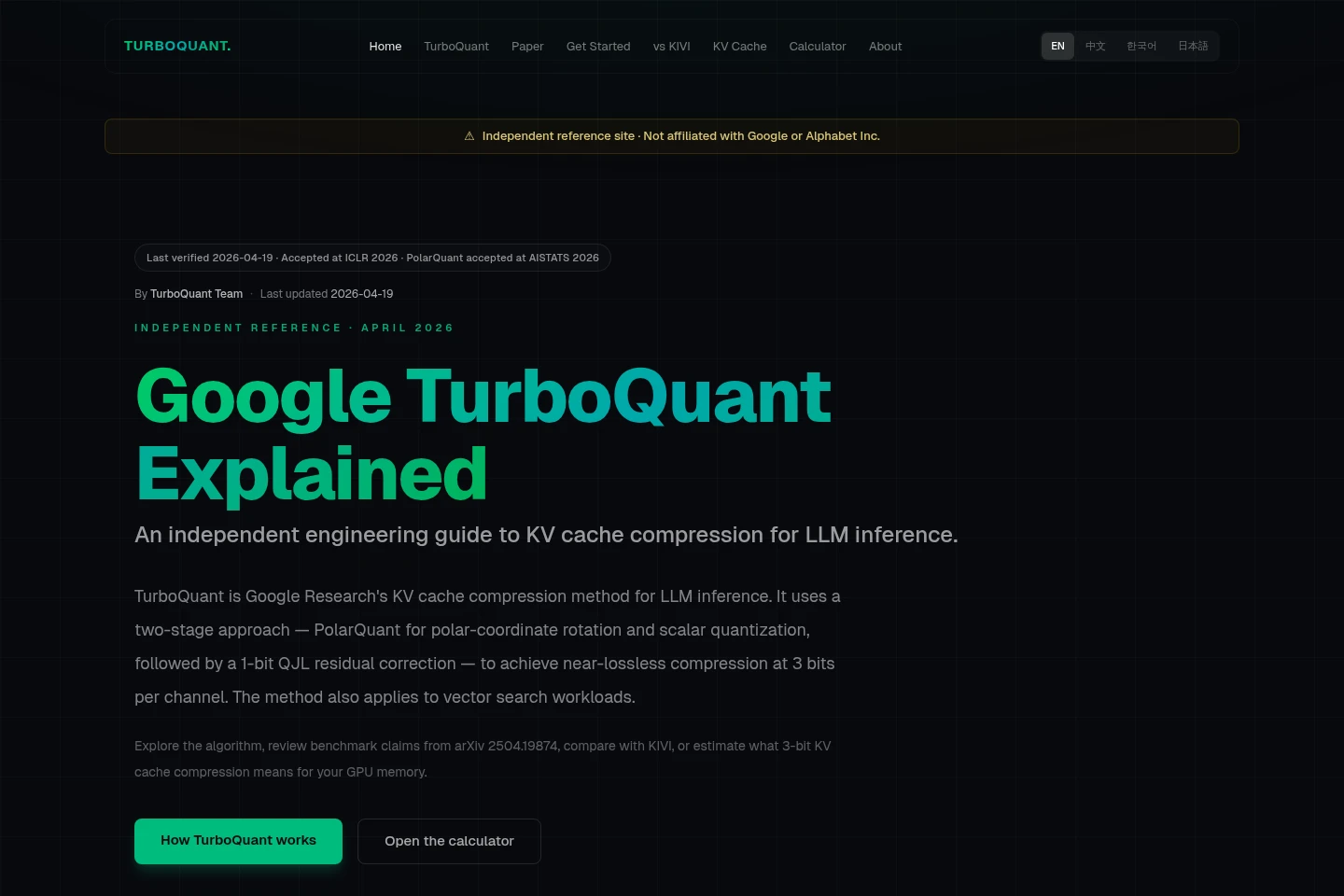
TurboQuant Tools is an independent reference site about Google Research’s TurboQuant method. It explains the PolarQuant and QJL compression stages, summarizes paper-reported benchmarks, compares TurboQuant with KIVI, and provides a KV cache calculator for MHA, GQA, and MQA model configurations. It also tracks community implementation status and links to papers and repositories.
- AI Business Tools
- Investment Research
- Data Analysis
- TurboQuant KV cache guide
- KV cache memory calculator
- LLM inference compression

Capabilities
TurboQuant technical explanations
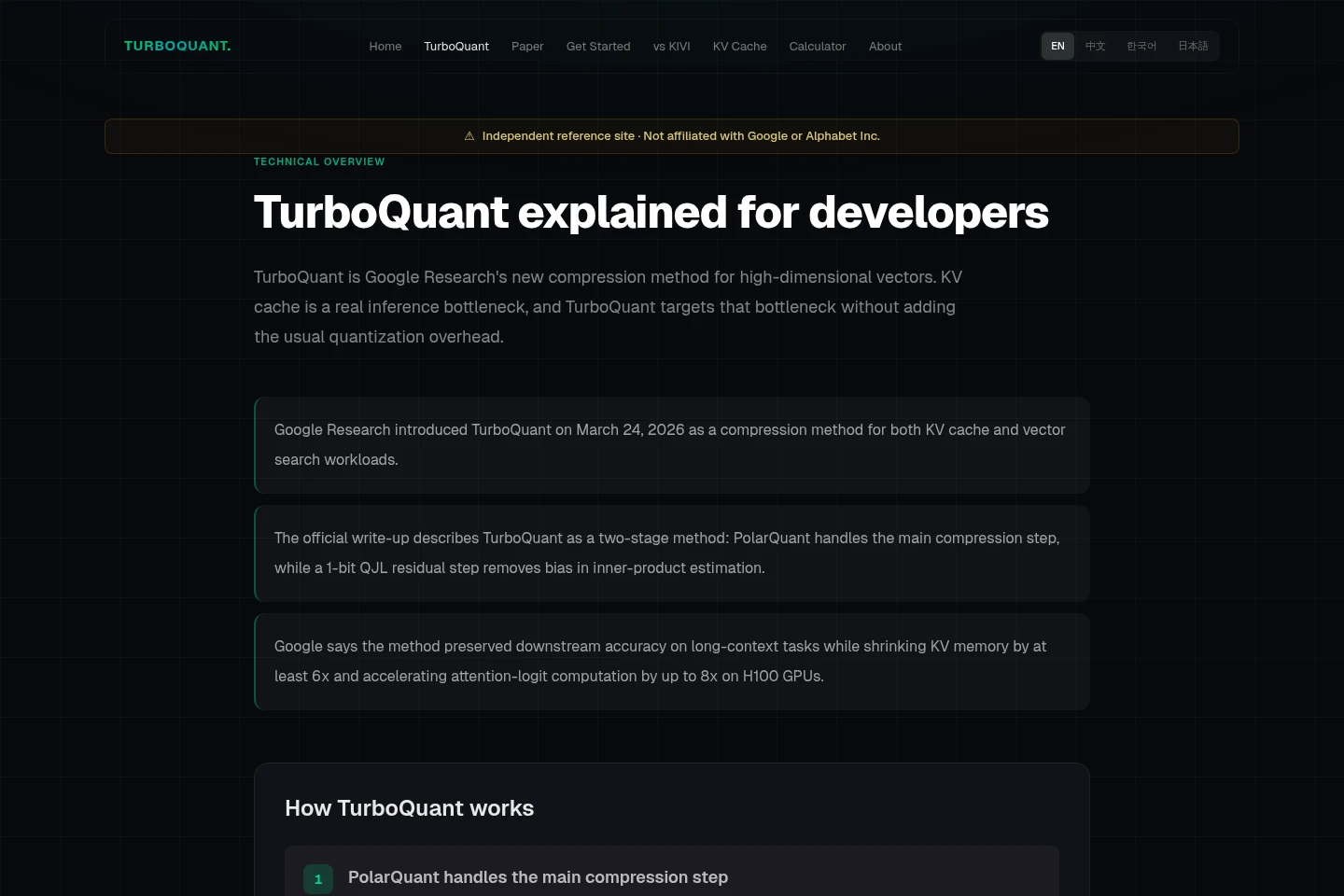
Explains TurboQuant’s two-stage KV cache compression method and its paper-reported benchmarks. It describes PolarQuant rotation and scalar quantization, QJL residual correction, and the conditions attached to reported results.
KV cache calculator
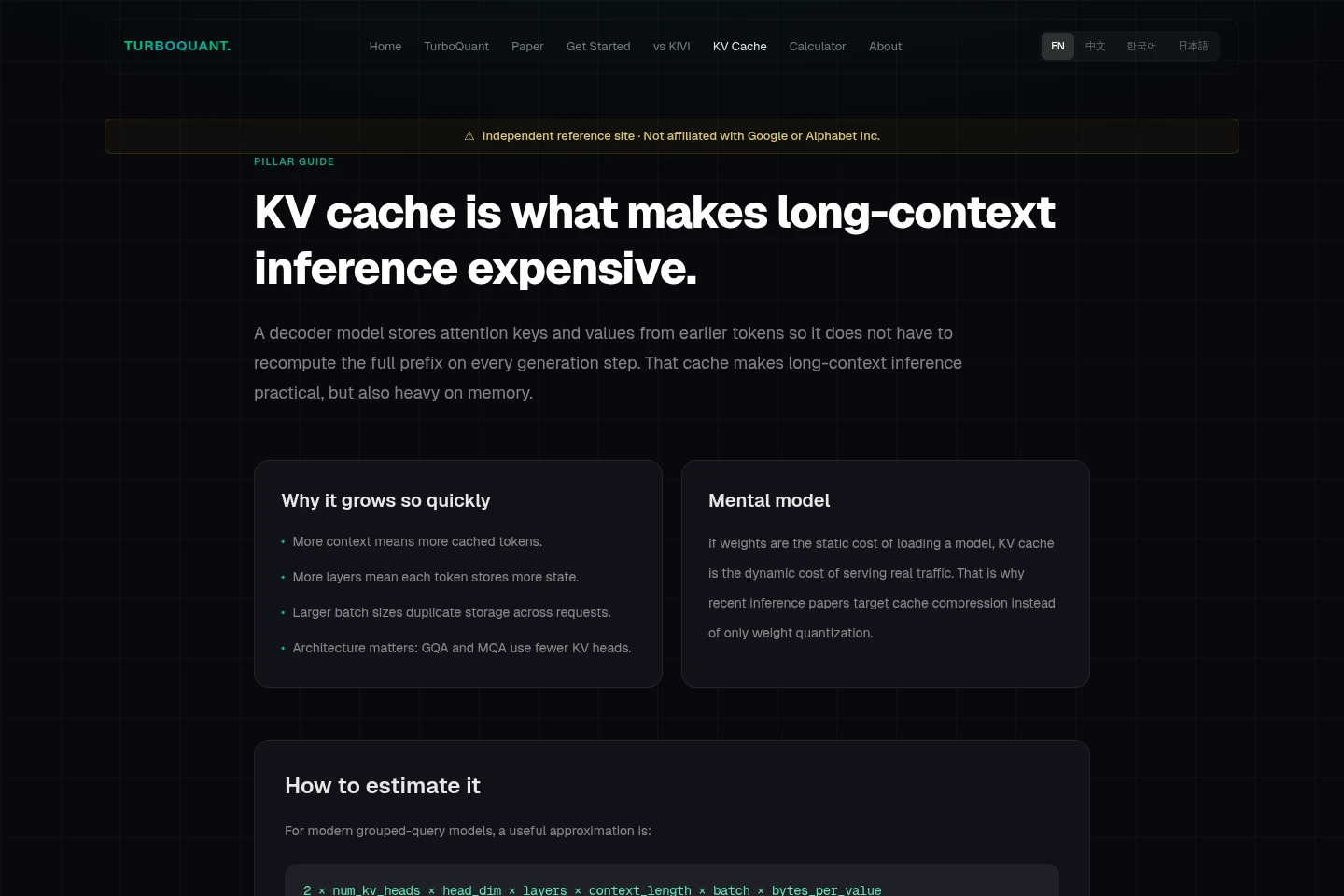
Estimates KV cache memory for model configurations using MHA, GQA, or MQA. Users enter model-shape and serving parameters to estimate memory needs for deployment or batch planning.
Compression method comparisons
Compares TurboQuant with KIVI and other cache or model compression approaches. The pages distinguish target, bit budget, training requirements, and tradeoffs using cited research claims.
Implementation status tracking
Summarizes community implementation and framework status for TurboQuant. It links to relevant issues, pull requests, and repositories, with status information identified by its verification date.
Pricing
The site is an informational reference with a calculator, and the supplied pages show no paid plans or billing. There are no plan prices or plan conditions to compare.
Use cases
Estimate KV cache memory for a model
When planning inference configurations, users enter or select model-shape parameters and serving settings in the calculator. It estimates KV cache memory for MHA, GQA, and MQA configurations to inform GPU-memory planning.
Compare KV cache compression methods
When choosing a cache-compression approach, developers review the TurboQuant and KIVI comparison and the technical explanations. The pages summarize reported quality, compression, and hardware conditions for evaluating the methods.
Check TurboQuant implementation status
When considering a framework integration, developers consult the status page and linked community discussions, issues, pull requests, and repositories. This provides a dated summary of reported implementation activity, not an official Google release.
Limitations
The site is an independent reference and states that it is not affiliated with Google Research, Alphabet Inc., or the projects and methods it covers.
Benchmark figures are presented as paper or Google Research claims; outcomes depend on model architecture, context length, batch size, hardware, and runtime stack.
As of the page’s stated check date, TurboQuant was not officially merged into vLLM or llama.cpp, and Google had not released an official reference implementation.
Who it is for
LLM inference engineers planning KV cache memory use and framework integration
Machine-learning researchers reviewing TurboQuant’s method and reported benchmarks
Developers estimating GPU memory for long-context or batched model serving
FAQ
What is TurboQuant?
TurboQuant is a two-stage KV cache quantization method from Google Research. It combines PolarQuant rotation and scalar quantization with a 1-bit QJL residual correction; the site explains the method and summarizes reported results.
Does TurboQuant require training or fine-tuning?
No training or fine-tuning is required according to the supplied page. It describes TurboQuant as data-oblivious and applied at inference time, without training data, calibration sets, or model-specific tuning.
How can I estimate KV cache memory?
Use the KV cache calculator with model architecture and serving parameters. It supports MHA, GQA, and MQA configurations; estimates depend on inputs such as context length and batch size.
Is TurboQuant available in vLLM or llama.cpp?
The site reports that it was not officially merged into vLLM or llama.cpp as of 2026-04-19. It points to community integration work and tracking issues or pull requests, and says Google had not released an official reference implementation.
Can TurboQuant be combined with weight quantization?
Yes. The site explains that TurboQuant targets the KV cache while methods such as GPTQ and AWQ target model weights, so they address different parts of memory use.
Comments