What Is sipsip.ai — And Why Does It Exist?
Have you ever found yourself staring at a YouTube video that's exactly what you need? A two-hour deep dive into AI trends, a 90-minute interview with someone brilliant, or a 45-minute tutorial that could solve your exact problem. You bookmark it, promise yourself you'll watch it later, and... it sits there. For days. Weeks. Maybe forever.
Yeah, me too.
That's exactly where sipsip.ai comes from. Founder Wendy Zhang was drowning in amazing long-form content on YouTube — the kind of stuff that could actually move the needle for her work — but there simply weren't enough hours in the day to watch it all. She wished there was something that could basically "watch for her" and just hand over the good parts.
So she built it.
In September 2025, Wendy released an open-source tool called AI Video Transcriber on GitHub. It combined OpenAI's Whisper for speech-to-text with LLMs for summarization — pretty elegant, honestly. Within two months, it hit 1,000 stars. By January 2026, over 2,000 developers and users had starred it. But here's the thing: most people who tried it didn't want to deploy it themselves. They wanted a product. A working service. Something they could just use.
Thus, sipsip.ai was born in March 2026.
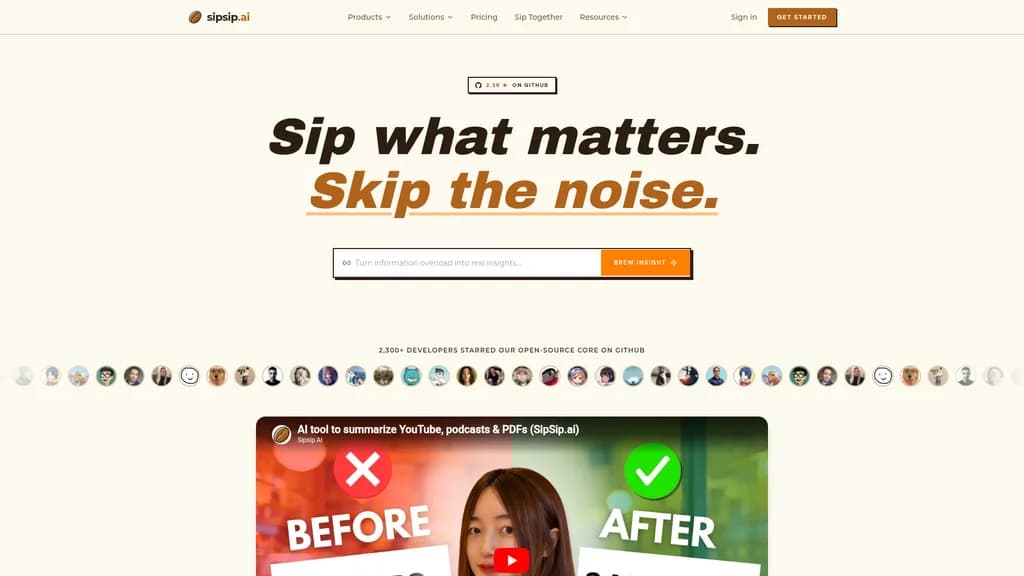
But this isn't just another AI summarizer. sipsip.ai is built on a genuinely different philosophy: the information should find you, not the other way around. Their tagline says it all — "Sip what matters. Skip the noise."
Think about how we currently consume content. We actively search, scroll, subscribe, and manually filter through endless feeds. sipsip.ai flips that model. You tell it what matters to you — specific channels, podcasts, topics — and it handles the rest. Every morning (or whenever you prefer), you get a clean, structured summary of everything new that dropped.
It's less about consuming more content and more about consuming *smarter*.
The team behind sipsip brings serious cross-industry cred. Wendy Zhang leads as Founder & CEO, with Jonathan Burk as Co-founder & CTO. Their backgrounds span Alibaba, Lockheed Martin, and Gala Games — so this isn't their first rodeo with complex, large-scale systems.
What really sets sipsip apart? It's the community-driven approach. With over 2,300 GitHub stars backing its open-source roots, sipsip has cultivated something special called "Sip Together" — a space where users share discoveries, showcase their taste, and surface content worth reading. It's built for people who care about signal over noise.
:::card{type="summary" title="TL;DR"}
- Open-source DNA: Built on 2,300+ GitHub stars, community-driven development
- Multi-format support: YouTube, podcasts, PDFs, EPUBs, articles, audio files — all in one place
- Daily AI Briefs: Subscribe to channels, get curated summaries delivered on your schedule
- 50+ language support: Translate and summarize content from around the world
- Sip Together Community: Share discoveries and find what smart people are reading
:::
Core Features That Actually Matter
Let's be real — most "AI productivity tools" are just glorified copy-paste interfaces wrapped around GPT. sipsip.ai feels different because the features actually solve problems you have, not imaginary ones.
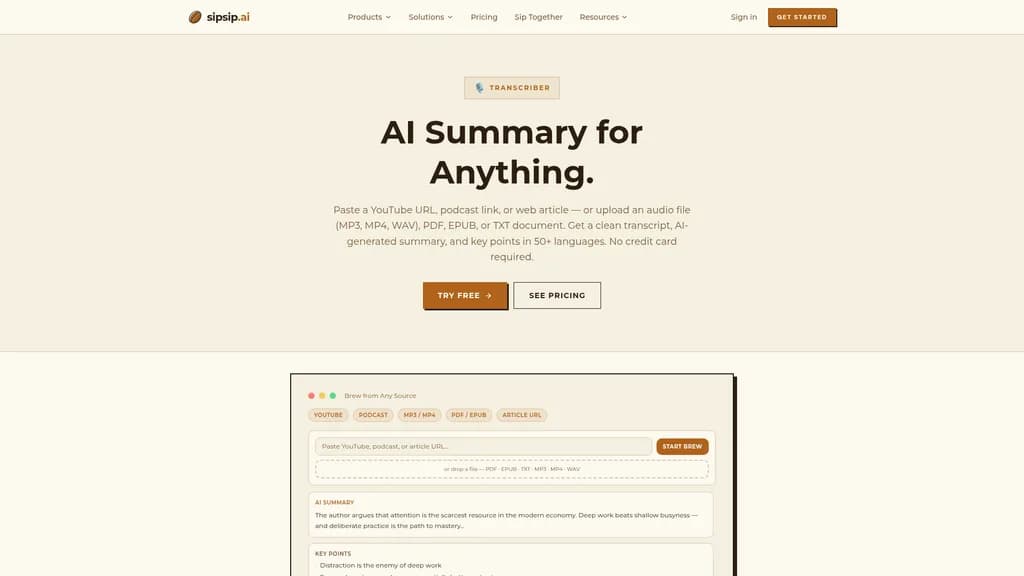
The AI Transcriber is where it starts. Picture this: you paste a YouTube URL, a podcast link, an article, or upload an audio file (MP3, WAV, MOV — all supported up to 50MB). Within minutes, you get back a full transcription plus an AI-generated summary (200-400 words) and 4-6 key takeaways. Researchers love this for handling academic papers and conference talks. Content creators use it to transform videos into blog posts, newsletters, or social content. The tech behind it? OpenAI Whisper handles speech-to-text with speaker-level accuracy via Deepgram AI, while the summarization pipeline uses LLM technology. Long content? No problem — the chunk-and-merge architecture processes everything without truncation.
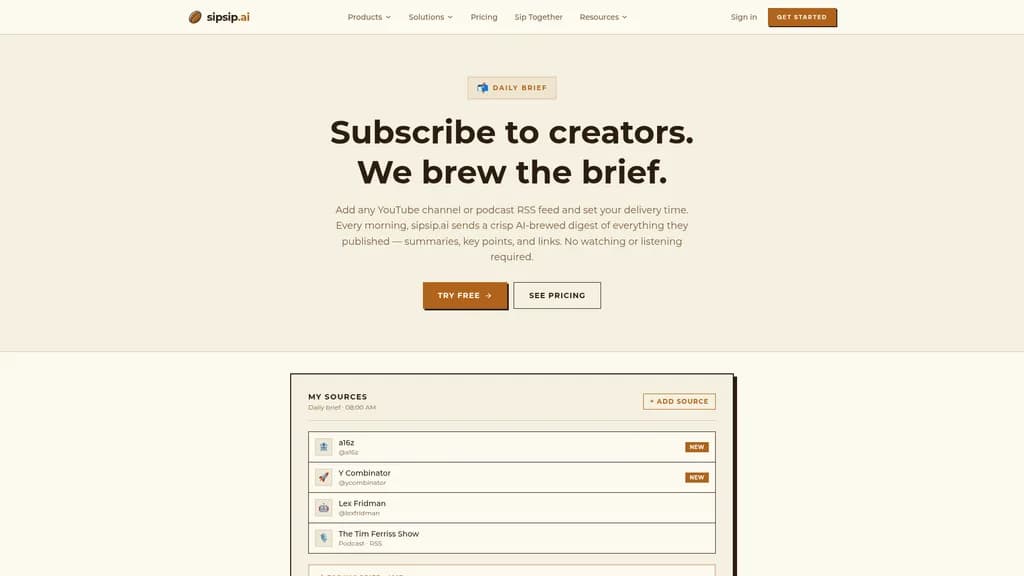
The Daily Brief is the feature that converts people from "interested" to "hooked." Instead of manually checking your 15 favorite YouTube channels and 8 podcast shows, you subscribe to them through sipsip. Every morning at 8 AM (customizable), you get an AI-curated brief with summaries of everything new. Investors track a16z and Y Combinator channels this way. Marketers monitor competitor content. The brief includes searchable archives, so you can always go back and find something from last week or last month.
Sip Together is where things get community-driven. Think of it as a curated discovery layer — people share their best summaries, you discover content you never would have found, and you build a reputation for having good taste. It's social bookmarking reimagined for the AI age.
Market Intelligence is for the data-hungry crowd. Currently on waitlist, this feature monitors Reddit, Twitter/X, and LinkedIn to track product feedback, competitor movements, and emerging trends. It's essentially social listening powered by AI that classifies signals (opportunity, competitor, trend, risk) and analyzes sentiment. Product managers, founders, and growth marketers are already signed up.
Free Tools for those just getting started: Audio Transcriber, Video Transcriber, Voice Recording Transcriber, Meeting Transcriber, PDF Summarizer, and YouTube Transcript Generator — all free to use without an account.
::::grid :::card{type="advantages"}
- Open-source transparency: 2,300+ GitHub stars, active Discord community, visible development process
- Community-driven: Sip Together lets users curate and share, creating a network effect of good content
- Multi-format versatility: One tool handles YouTube, podcasts, PDFs, EPUBs, articles, and audio — no switching between apps
:::
:::card{type="disadvantages"}
- Market Intelligence still on waitlist: The social listening feature isn't available yet, though you can join the waitlist
- No real-time processing: Daily Briefs process content nightly — if you need instant summaries, this might not work for urgent needs
:::
::::
Who's Actually Using sipsip.ai?
The honest answer? A surprisingly diverse mix of people who are all dealing with the same problem: too much good content, not enough time.
Content Consumers are probably the largest group. You've subscribed to 20+ YouTube channels and 10 podcasts that genuinely deliver value. But watching and listening to all of it? Impossible. So it piles up, guilt-inducing and unwatched. With sipsip, you subscribe to those channels through the Daily Brief, and every morning you get a crisp summary of what's new. You stay informed, skip the FOMO, and reclaim hours each week.
Researchers absolutely love this. Academic papers are dense. Conference presentations are 45 minutes of dense information. EPUB books are great but long. Instead of reading everything cover-to-cover, you upload the PDF or EPUB and get a structured summary. You can quickly decide: "This is worth my full attention" or "I get the gist, moving on." One researcher told us it cut their paper screening time by 75%.
Content Creators see the multiplier effect. You find one great 90-minute podcast interview. sipsip generates the summary. Now you have the seed for a newsletter article, a blog post, three tweets, and a LinkedIn carousel. One source, multiple outputs. That's the efficiency play creators need.
Knowledge Workers are probably the most relatable use case. You have weekly reports, industry analyses, meeting recordings, and long-form articles stacking up. By Friday, your "read later" folder is a graveyard. sipsip handles all of it — paste the URLs, upload the files, get structured key points. That 4-hour reading stack becomes 40 minutes of focused insight.
Investors and VCs have a specific need: track what matters for deal flow. They subscribe to channels like a16z, Y Combinator, and relevant podcasts. Before their first morning meeting, they've already absorbed the key takeaways from everything relevant that dropped overnight. They walk into conversations informed and ahead of the curve.
Journalists deal with two time sinks: interview recordings and article research. Instead of transcribing interviews manually (hours of work), they upload the audio and get a full transcription. Instead of reading 15 articles for background research, they paste URLs and get summaries. The time saved goes back into actual reporting and storytelling.
:::card{type="tip" title="💡 Choosing the Right Plan"} If you consume more than 3 YouTube channels or podcasts regularly, the Free plan's 20 transcriptions and 3 subscription slots will fill up fast. Start with the Hobby plan ($9/month) — 100 transcriptions and 10 subscription slots give you room to actually build a Daily Brief routine without watching your usage meter. :::
sipsip.ai Pricing — Let's Talk Numbers
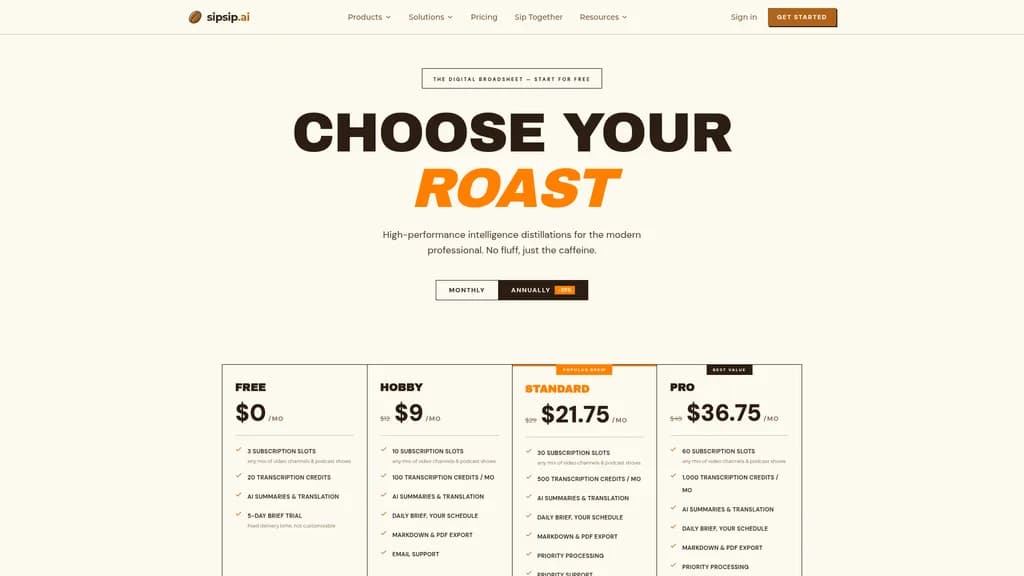
Here's the thing about pricing: it should make sense for how you actually work, not some idealized version of yourself. sipsip keeps this straightforward with four tiers that cover everyone from curious beginners to power users.
| Plan | Monthly | Annual (-25%) | Subscriptions | Transcriptions | Daily Brief | Extra Perks | |------|---------|---------------|---------------|----------------|-------------|-------------| | Free | $0 | $0 | 3 slots | 20 total | 5-day trial | AI summaries + translation | | Hobby | $9 | $12 | 10 slots | 100/month | Custom time | Markdown/PDF export, Email support | | Standard | $21.75 | $29 | 30 slots | 500/month | Custom time | Priority processing, Priority support | | Pro | $36.75 | $49 | 60 slots | 1,000/month | Custom time | Searchable brief archives |
The Free plan is genuinely useful for trying things out. You get 20 transcriptions (perfect for occasional PDFs or articles), 3 subscription slots (enough for one channel and two podcasts), and the core AI summarization plus translation. If you just want to test the waters, this works.
The Hobby plan ($9/month) is where most individual users land. 100 transcriptions per month covers heavy PDF usage, and 10 subscription slots let you build a real Daily Brief with several channels and shows. Markdown and PDF export means you can save summaries to your own knowledge base. Email support is there if you need help.
The Standard plan ($21.75/month) targets power users and professionals. 500 transcriptions is substantial — researchers, content creators, and knowledge workers who process lots of documents will appreciate this. 30 subscription slots cover a serious media diet. Priority processing means your summaries come back faster, and you get priority support when things go sideways.
The Pro plan ($36.75/month) is for professionals who rely on sipsip daily. 1,000 transcriptions per month is generous. 60 subscription slots cover extensive monitoring across many sources. The searchable brief archives are genuinely valuable — being able to search through weeks or months of your Daily Briefs to find that one insight you vaguely remember? That's gold.
Need more? Additional transcription credits are $5 for 200 units — they never expire and roll over. Extra subscription slots are $10 for 10 slots per month.
Subscription slots are flexible: mix and match between YouTube channels and podcasts, and reallocate anytime. No lock-in.
:::card{type="tip" title="💡 Annual vs. Monthly"} The annual discount is solid — you're saving 25% by prepaying. If you know you'll use sipsip for more than two months, the annual plans are a no-brainer. The Hobby plan drops from $9 to $12 per month (billed annually), and Pro goes from $36.75 to $49. The math is easy. :::
The Ecosystem — Where sipsip Fits In
Understanding where sipsip comes from and how it connects to the wider world matters.
The Open-Source Roots are real and substantial. The AI Video Transcriber project on GitHub has over 2,300 stars — that's not trivial. The codebase uses FastAPI for the backend, OpenAI Whisper for speech-to-text, and LangGraph & LangChain for the AI orchestration layer. If you're technical, you can self-host the original project. If you want a managed experience, sipsip.ai handles everything.
The Community is genuinely active. There's a Discord server where users share tips, request features, and help each other troubleshoot. The Sip Together feature on the platform itself creates a discovery layer powered by user curation. It feels less like using a corporate SaaS and more like being part of a community of information-hungry people.
Technical Stack Credibility: OpenAI Whisper handles transcription with high accuracy. Deepgram AI provides speaker-level differentiation — important for podcasts and interviews. LLM technology generates the summaries. LangGraph and LangChain power the enterprise-grade AI pipeline. This isn't a weekend project held together with duct tape — it's built on serious infrastructure.
Platform Recognition tells you this isn't flying under the radar. sipsip has been featured on Product Hunt and Startup Fame, plus 20+ other platform recommendations from sites like BestskyTools, TopFreeAITools, Findly.tools, and others. That's meaningful validation from the startup and AI tool communities.
Integration Roadmap: Currently, Daily Briefs deliver via email. But the roadmap includes Slack and WhatsApp integration for receiving briefs or team alerts. If you're a Slack-first team, this matters.
Social Presence: The team maintains active profiles on Facebook, Instagram, and LinkedIn. The GitHub repository remains active with community contributions.
Affiliate Program: 30% commission on referrals — significant for those who genuinely recommend sipsip to colleagues or audiences.
:::card{type="tip" title="💡 For Technical Users"} If your organization has compliance requirements or data sovereignty needs, the open-source foundation matters. You can self-host the AI Video Transcriber project using your own OpenAI and Deepgram API keys. sipsip.ai as a hosted service uses those APIs in the background — the architecture is transparent. :::
Common Questions
:::card{type="faq" title="What exactly is sipsip.ai?"} sipsip.ai is an AI-powered information intelligence platform that transforms the overwhelming amount of content around us into actionable insights. It supports YouTube videos, podcasts, PDFs, EPUBs, articles, and audio files — turning them into structured summaries so you can stay informed without spending hours consuming everything in full. :::
:::card{type="faq" title="How does the YouTube video transcriber work?"} Just paste a YouTube URL into sipsip. The system either pulls the auto-generated captions (if available) or runs OpenAI Whisper for transcription. Then AI generates a 200-400 word summary plus 4-6 key takeaways. The whole thing takes a few minutes for most videos. :::
:::card{type="faq" title="What's Sip Together?"} Sip Together is the community layer of sipsip. Users share summaries they found valuable, discover content curated by others, and build a reputation for quality recommendations. It's essentially a curated feed of "things smart people thought were worth reading" — way more useful than algorithmic social feeds. :::
:::card{type="faq" title="What content sources does sipsip support?"} YouTube videos and channels, podcast RSS feeds, PDF documents, EPUB ebooks, TXT files, web article URLs, and local audio/video files (MP3, MP4, M4A, WAV, MOV). The list covers most formats you'd actually use. :::
:::card{type="faq" title="Is there really a free plan?"} Yes. The Free plan gives you 3 subscription slots, 20 total transcriptions, AI summaries, and 5 days of Daily Brief trial. No credit card required to start. It's genuinely useful for trying the product and handling light usage. :::
:::card{type="faq" title="Where did sipsip.ai come from?"} It started as an open-source project called AI Video Transcriber, released by founder Wendy Zhang in September 2025. Within two months, it hit 1,000 GitHub stars. By January 2026, over 2,000 stars. Users kept asking for a managed version they could use without deploying it themselves, so sipsip.ai launched in March 2026. :::
:::card{type="faq" title="How are transcription credits counted?"} Each URL you paste or file you upload consumes one transcription credit, regardless of length (up to the 50MB file limit). Credits don't renew monthly — they're a pool that depletes as you use them. Any additional credits you purchase never expire and roll over. :::
:::card{type="faq" title="How do subscription slots work?"} Subscription slots are used for your Daily Brief — you assign them to YouTube channels or podcast RSS feeds. You can mix and match as you like. If you subscribe to 5 YouTube channels and 5 podcasts, that's 10 slots used. You can reallocate slots anytime without losing your subscriptions. :::
Ready to Start Sipping?
Information overload isn't going away. The volume of valuable content — podcasts, YouTube deep dives, research papers, industry reports — keeps growing. You can't watch or read it all. You shouldn't try.
sipsip.ai offers a different path: let the signal find you. Set up your Daily Brief, subscribe to the channels that matter, and wake up every morning with a clean summary of what's actually worth knowing.
The Free plan is waiting for you. No credit card, no commitment. Just three subscription slots and 20 transcriptions to see if this approach works for how you actually work.
[Start Free →](https://sipsip.ai)
Or, if you're past the experimentation phase and want to build a real information routine:
[Compare Plans →](https://sipsip.ai/pricing)
Either way — stop drowning in tabs and bookmarks. Start sipping what matters.




Comments