


SEObot - Autonomous AI SEO agent for content growth
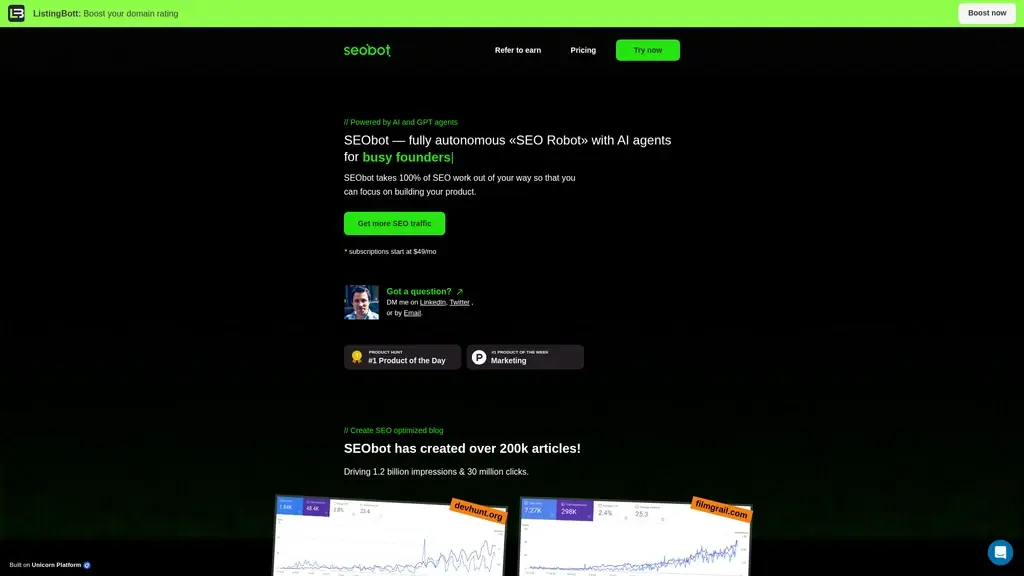
Launched on Aug 20, 2026Tired of outsourcing blog content and waiting months for organic traffic? SEObot is a fully autonomous AI SEO agent that researches, writes, links, and publishes SEO-optimized articles on autopilot. With 200,000+ articles created driving 1.2 billion impressions, it handles keyword research, fact-checking, internal linking, and even backlink building so founders can focus on their product.
What is SEObot
If you've ever tried to scale content marketing organically, you know the pain all too well. Content takes hours to research, days to write, and months to show ROI. Outsourcing to agencies costs thousands per month — often for articles that rank nowhere. And the founders who most need organic traffic are exactly the ones who have zero time to manage a content calendar.
That's the gap SEObot was built to close. SEObot is the world's first fully autonomous AI agent built specifically for blog SEO — a distinction it earned with a Product Hunt badge and has backed up with real-world results since.
Where traditional SEO tools help you plan content and human writers help you produce it, SEObot does the entire job end-to-end: research → strategy → writing → optimization → internal linking → publishing. On autopilot.
The story behind it matters. SEObot was built by John Rush, founder of MarsX and the creator of 11 SaaS projects and 20 directories. This isn't a tool built by marketers who outsource the thinking — it's a tool built by a founder who needed to scale his own SEO across more projects than he had hours in the day. John uses SEObot on all 11 of his SaaS products and 20 directory projects today.
The market proof is hard to ignore. SEObot has created over 200,000 articles, driving more than 1.2 billion impressions and 30 million clicks to date. Those aren't vanity metrics — that's compounding organic growth on a scale that would cost a full agency team hundreds of thousands of dollars to reproduce.
Fully autonomous: Runs SEO on 100% autopilot — from keyword research to publishing
End-to-end workflow: Handles research, writing, optimization, internal linking, and CMS publishing
Built by a founder: Created by John Rush (MarsX), who uses it daily across 11 SaaS projects and 20 directories
Proven at scale: 200,000+ articles created, 1.2 billion impressions, 30 million clicks
SEObot's Core Features
Every feature in SEObot is designed with a single objective: turn organic traffic into a predictable growth channel without adding headcount. Here's how each core feature maps to that goal.
Autonomous research & high-volume writing. SEObot's AI agents scrape Google and analyze your site, audience, and competitors to build a content strategy. The result? Articles averaging 3,000 words (up to 4,000 per piece) that target keywords your buyers actually search for. Because research is automated, you're not paying per keyword or per hour — you're paying a flat subscription for a compounding asset.
Built-in quality control. The worst enemy of AI content is hallucination — confident claims that don't hold up. SEObot runs an anti-hallucination reflection system with fact-checking and source citations. Agents execute hundreds of tasks per article, checking references and validating claims before anything goes live. This is the difference between content that builds topical authority and content that gets flagged.
Content richness that mirrors human writing. Articles come equipped with images, related YouTube video embeds, Google Image insertion, tables, and lists. The result: pages that hold readers, reduce bounce rate, and earn the dwell-time signals Google rewards.
Advanced growth modules. Beyond standard articles, SEObot includes programmatic SEO (data-driven templates published at scale), an AI news generator, YouTube video-to-article conversion, AI backlink building to grow Domain Rating, and custom SEO mini-tools (calculators, analyzers) that attract links and earn visitor trust.
Automated internal linking. SEObot continuously scans your content to identify anchor-text opportunities and link to your most important pages. As your content library grows, the linking graph optimizes itself — no manual link audits, no orphaned pages. Monthly re-linking keeps the structure fresh.
True autonomy: Runs the entire SEO workflow hands-off, freeing founders to build product
Scale without headcount: Flat subscription replaces agency retainers and per-article costs
Native CMS integration: Publish directly to WordPress, Webflow, Ghost, WIX, Shopify, Notion, HubSpot, Framer, Next.js, and more
Quality varies versus human writers: Per the FAQ, output sometimes matches average human quality, sometimes falls short, and occasionally exceeds it — it's continuously improving
NSFW/adult niches limited: LLM safety filters can refuse, soften, or generalize explicit content — full support for all adult niches isn't guaranteed
How SEObot Works: Your Autopilot SEO Workflow
The best way to understand SEObot is to follow the workflow from onboarding to publish. Here's what the entire automation pipeline looks like — and how little manual effort it requires from you.
Step 1: Fully automated onboarding. Enter your website URL and press "go." That's it. No configuration wizard, no 40-minute setup call, no technical hand-holding.
Step 2: Automated research. SEObot's AI agents study your site architecture, audience, content gaps, and keyword landscape. It scrapes Google to understand what's ranking and why, so its strategy is grounded in real search data — not guesswork.
Step 3: Content plan + weekly production. Based on that research, SEObot builds a content plan and starts producing articles every week. It runs on autopilot by default, generating a steady stream of long-form, optimized content without you lifting a finger.
Step 4: Optional moderation. Want editorial control? SEObot can email you lists of articles to approve, decline, or edit before they go live. You stay in the driver's seat without having to do the production work.
Step 5: Automated internal linking. SEObot links articles to one another and to your key service pages, building a connecting tissue across your site. As the library expands, the link graph continuously optimizes itself.
Underneath it all sit quality guardrails: anti-typo hallucination checks, fact-checking, and source citations that keep content accurate and defensible.
You have complete flexibility. Run 100% autopilot and let SEObot publish and link on its own — or opt into email moderation where SEObot sends you accept/decline lists before anything goes live. Most teams start with moderation, then switch to autopilot once they trust the output. Both paths are built-in at no extra cost.
Who Uses SEObot: Real Scenarios and Results
The most compelling evidence for any growth tool is who uses it and what happened afterward. Here are the scenarios that map most closely to how growth teams actually operate.
The SaaS founder scaling multiple products. John Rush runs 11 SaaS projects and 20 directories on SEObot simultaneously. This is the extreme case: multiple brands, multiple content libraries, one autopilot system. For founders juggling several products, SEObot functions as a distributed content team that never sleeps.
The side-project operator turning content into revenue. Santiago Poli hit an average of 500 clicks/day on a side project, attracted a 150-person waiting list, and spent roughly $1,000 on articles — then closed a $6,500 client before the business was even fully operative. This is the strongest ROI story in the library: a few hundred dollars in content costs produced five-figure revenue.
The platform/community owner building ranking traction. Akber Khan took his Unicorn Platform directory from a 50+ ranking to position 20 in just over six months. For directories and content hubs — where page count and topical coverage are everything — SEObot's volume advantage compounds quickly.
The e-commerce operator optimizing conversion. Ryan Niessen credited SEObot with boosting his Shopify store's conversion rate. For e-commerce, the value isn't just traffic — it's content that buyers actually read during the consideration stage and convert on.
The directory builder establishing a revenue base. Unicorn Platform generated 4 paid users from 300+ GPT-generated articles since May. It's a modest but meaningful number: proof that automated content can produce qualified, paying leads.
Given the full refund policy on the $49 plan — a full refund if you contact support after your first article and aren't satisfied — the smartest play is to start with the smallest plan, evaluate the content quality for one or two articles, and only then scale up. The founder himself notes that outcomes vary by niche: some highly competitive verticals are harder to crack. Validate before you commit.
SEObot's Pricing Plans
SEObot's pricing philosophy is blunt: "Perhaps the best ROI on the market." Subscriptions start at $49/month — often less than the cost of a single well-written article from an agency.
Here's how the plans stack up:
Plan | Price | Key Features | Best For |
|---|---|---|---|
Starter | $49/month | Articles up to 4,000 words, YouTube embeds, image generation, Google Image insertion, tables, lists, internal linking, full refund after first article if unsatisfied | Solo founders and small sites testing automated content |
Growth (higher tier) | Higher monthly rate | Everything in Starter, plus higher monthly article volumes | Teams scaling content output across multiple topics |
Scale/Pro (advanced tier) | Custom | Everything in Growth, plus advanced modules: programmatic SEO, news generation, AI backlink building, SEO mini-tools | Established sites, agencies, and multi-project operators |
Every plan includes the core workflow: automated research, content production, internal linking, and direct CMS publishing. What scales is volume and access to the advanced growth modules.
The full workflow is included across all plans — up to 4,000-word articles, YouTube video embeds, AI image generation, Google Image insertion, tables, and lists. You're not being upsold on basic features; you're scaling volume and power.
The refund guarantee removes the risk. If you're on the $49 plan and you contact support after your first article without being satisfied, you get a full refund. That's the strongest signal a SaaS can send that they believe in the product.
Compare $49/month against a single agency article at $150–$500. Even if SEObot produces 4–8 articles in your first month, your break-even is immediate. Most users report meaningful organic traffic within 60–90 days — and if the first article doesn't meet your bar, the refund guarantee means you've spent nothing. The financial downside is effectively zero; the upside is a compounding asset.
What Users Say
Numbers convince, but real users with real outcomes build trust. Here's what growth teams report after running SEObot — grouped by the outcomes that matter most.
Traffic growth.
Santiago Poli reported x15 and x3 increases in impressions in 20 days on his projects — then sustained an average of 500 clicks/day and closed a $6,500 client.
Jitesh Ghanchi says his impressions "skyrocketed" after switching on SEObot.
Dev Hunt reports SEO traffic "growing every week" since adopting the tool.
Ranking improvement.
Akber Khan moved from a 50+ ranking to position 20 in six-plus months using SEObot with a Unicorn Platform directory.
Alex trialed SEObot in November for Posterly and reports "positive results so far."
Revenue and retention.
Ryan Niessen — "Seobot is fucking gold" — credited the tool with boosting his Shopify store's conversion rate.
Unicorn Platform generated 4 paid users from 300+ articles since May.
Paul Zadie, a year-long user, calls it "the very last subscription I would ever cancel. Quality of content and overall value is insanely good."
Founder-tier endorsement. Joe Wilkinson puts it bluntly: "Best version of an agent that's out there. Better than OpenAI's versions and everyone else's."
The honest caveat. Founder John Rush himself notes it plainly: SEObot "works for most projects but not all — some niches are very competitive." That transparency matters. No tool wins every keyword; knowing where it works — and where it doesn't — is exactly the kind of honesty you want from a vendor before you commit.
Frequently Asked Questions
Yes. SEObot is a fully autonomous AI SEO agent that automates the entire organic growth workflow — keyword research, content optimization, internal linking, and backlink building. It's designed to handle the SEO work end-to-end so founders can focus on building their product.
Everything is automated and runs 100% autopilot by default. You can also assist by giving ideas, approving or declining articles, or taking full manual control if you prefer. The tool adapts to how involved you want to be.
SEObot supports 50+ languages, including English, Spanish, German, French, Portuguese, Japanese, Chinese, Korean, Arabic, Russian, and many more. The team is continuously adding additional languages.
Absolutely. You can ask SEObot to email you lists of articles to accept, decline, or edit before publishing to your CMS. This keeps you in full editorial control while SEObot handles the production volume.
SEObot publishes directly to Framer, Ghost, HubSpot, Notion, Shopify, Unicorn Platform, Webflow, Wix, WordPress, and Next.js. It also integrates via REST API, Webhooks, Zapier, Make, and NextJS for custom workflows.
SEObot automatically scans your content to identify relevant anchor-text opportunities and links to your most important pages. As your content library grows, it continuously updates and optimizes connections — no manual link audits required.
Yes to both. SEObot builds data-driven templates, collects data, and publishes at scale through your CMS for programmatic SEO. It also includes an AI news generator module that finds relevant stories, writes headlines and drafts, then publishes directly to your CMS.
You get a full refund on the $49 plan if you contact support after your first article and aren't satisfied with the results. The recommendation is to start with the smallest plan to test the quality before committing to larger volumes.
Crypto works with no special limitations. Adult/NSFW content is more restricted — the underlying LLMs have built-in safety filters, so for some explicit topics the models may refuse to generate, soften or generalize content, or skip details and keywords. Full support for all adult niches isn't guaranteed.
Related Content
Copy.ai Review 2026: AI Copywriting Made Easy
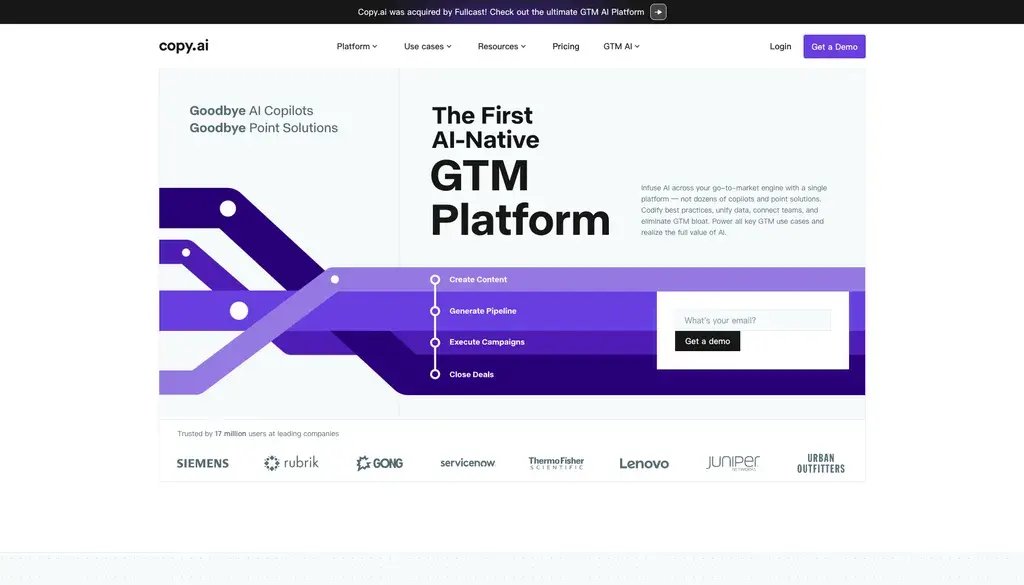
Our honest Copy.ai review for 2026. We test Content Agents, AI Workflows, pricing ($29-$249/mo), and compare it to Jasper and Writesonic. Find out if it's worth it for your marketing team.

Rytr Review 2026: Is This Budget AI Writer Worth It?
Our hands-on Rytr review for 2026. We test features, pricing, content quality, and compare it to Jasper & ChatGPT. Find out if Rytr is the best budget AI writing tool.

Word Changer - Free AI tool to rewrite and improve your writing instantly
Writing always using repetitive words or need to avoid plagiarism? Word Changer is a free AI writing assistant that instantly rewrites any text with richer vocabulary and appropriate tone. Get multiple versions with one click, adjust formality level, check readability - all for free!

Unite - AI-powered platform for romantic fantasies and dream couple moments
Explore romantic fantasies and create special moments for your dream couple. This AI-powered platform lets you generate personalized romantic content and experience exclusive AI-created romantic experiences.
Comments