

- Monthly visits
- 2,173
- 2026-09
- Monthly growth +16.5%
Orbit - Track AI feature costs, latency, and errors in production
Orbit is an AI observability product that collects runtime metadata through an SDK and shows cost, usage, latency, and errors for AI features. It groups calls into workflows and attributes costs to customers. The dashboard also provides model breakdowns, trends, environment filters, and error details. OpenAI, Anthropic, and Gemini are listed as supported integrations.
- LLM Developer Tools
- LLM Observability
- AI cost tracking
- AI feature analytics
- LLM observability
Capabilities
AI feature analytics
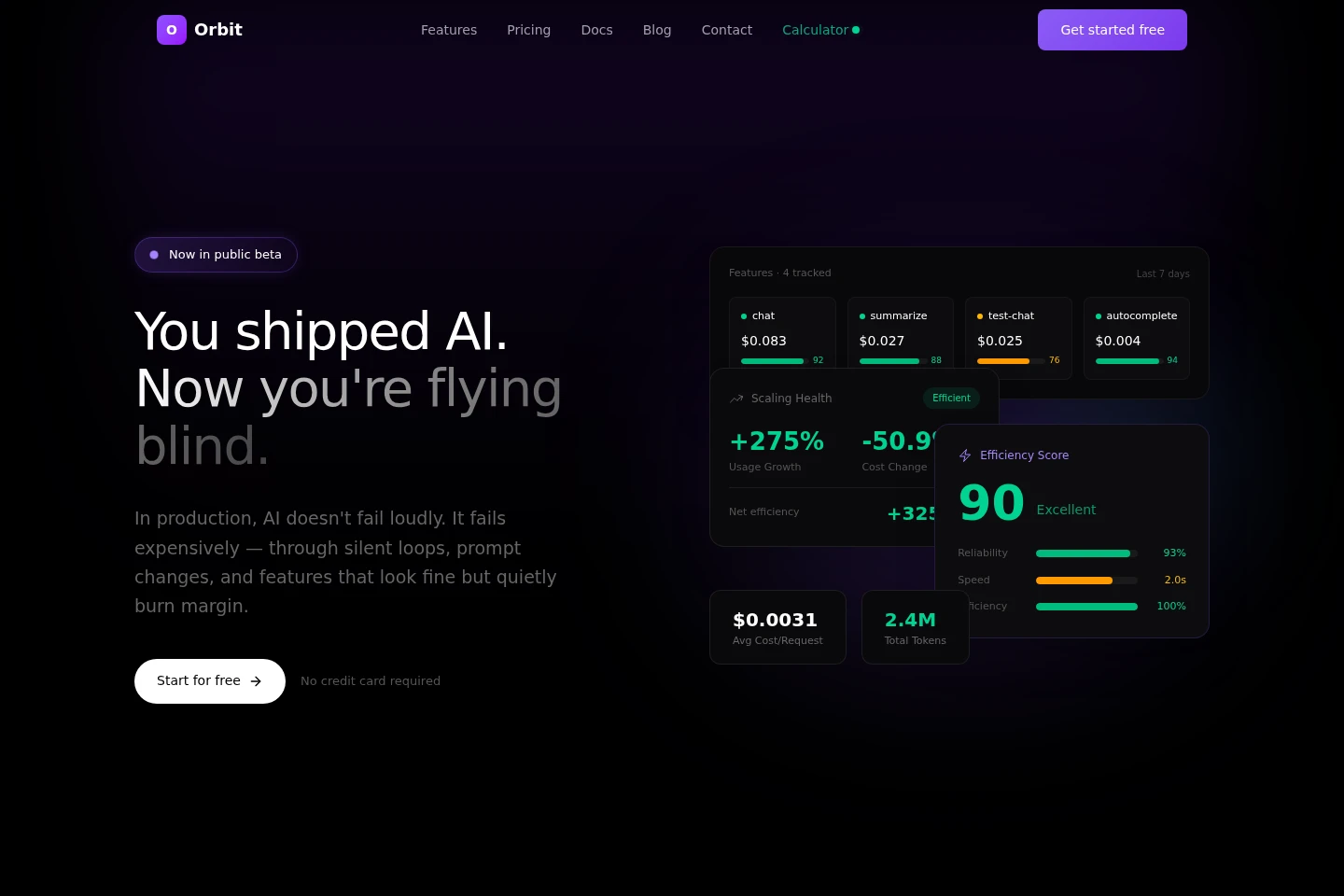
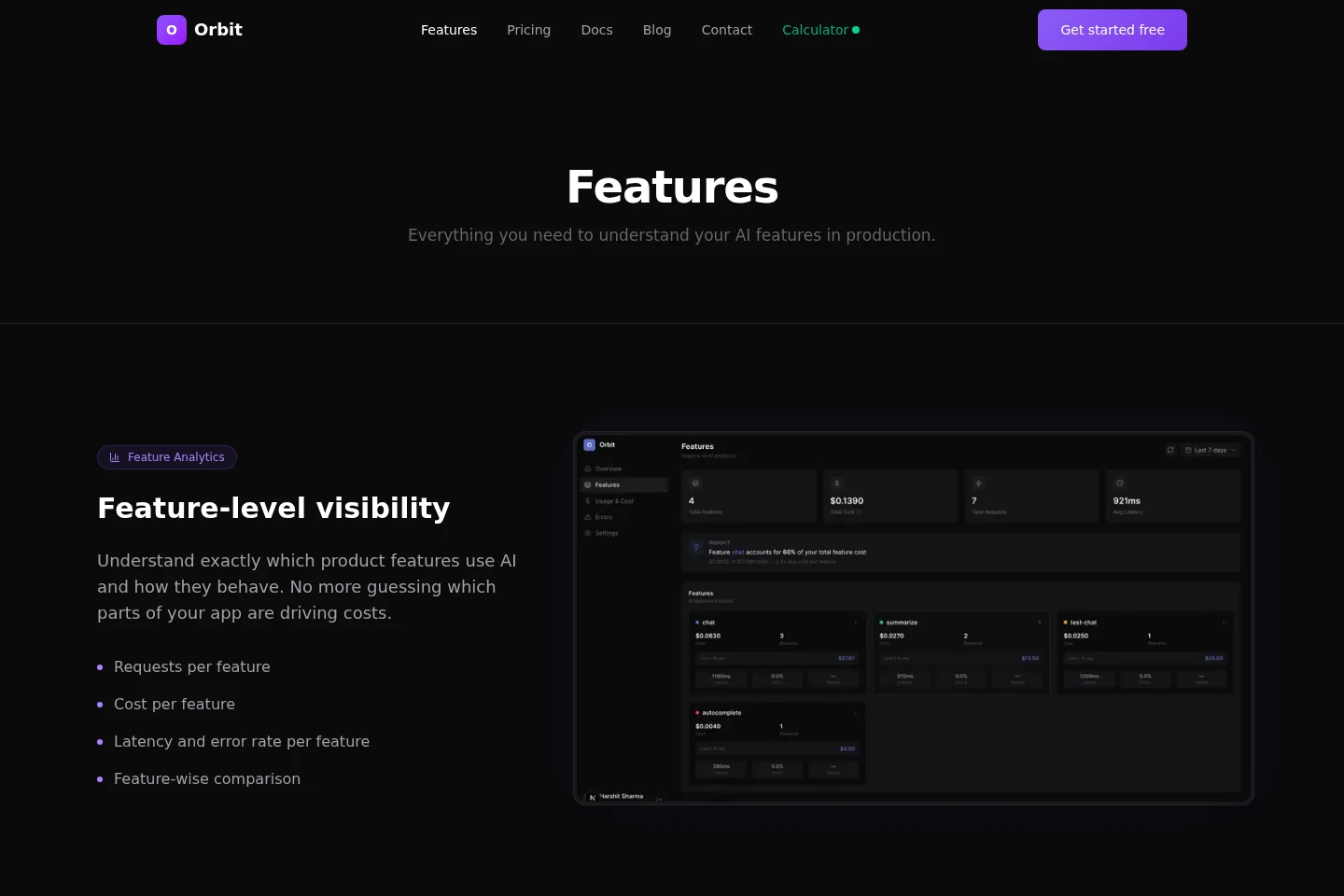
Shows requests, estimated cost, latency, and error rates for each instrumented product feature. The SDK collects runtime metadata, and the dashboard supports feature comparisons and filtering by environment and date range.
Workflow and customer attribution
Groups language-model calls into tasks and attributes their costs to customer IDs. It uses task and customer identifiers supplied through the instrumented workflow and displays call sequences, tokens, and total workflow cost.
Cost and usage analytics
Reports token usage, estimated request costs, model breakdowns, and cost trends. Calculations use model pricing and runtime request data; displayed cost estimates may differ slightly from provider bills.
AI error monitoring
Displays error rates by feature and model, error categories, recent error details, and trends. Runtime data helps identify failures such as invalid models, request errors, and rate limits.
Efficiency and scaling metrics
Compares usage growth with cost changes and calculates net efficiency and a weighted score using reliability, speed, and cost. Metrics are based on events collected from the application.
Pricing
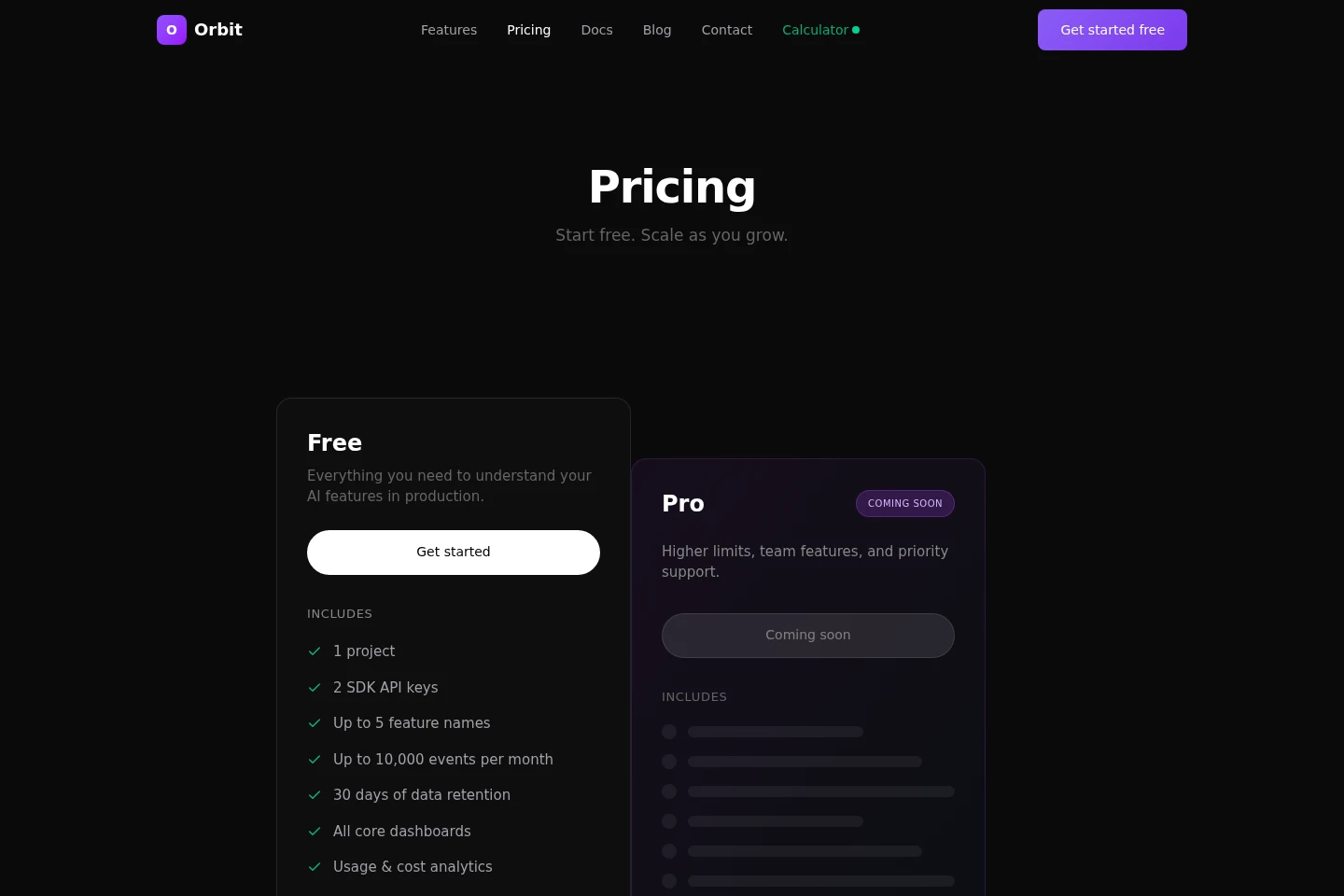
Orbit offers a free plan with no credit card required. Compare project and key limits, feature and event quotas, data retention, and included analytics; the Pro plan is marked Coming Soon.
| Plan | Price | Included features and limits |
|---|---|---|
| Free | Free; no credit card required |
|
| Pro | Price not stated; Coming Soon |
|
Use cases
Find which AI features drive application costs
When a product team needs to understand rising AI spend, it instruments application calls with the Orbit SDK and compares estimated costs, requests, and latency by feature. The dashboard identifies where tracked usage and costs are concentrated.
Attribute workflow costs to customers
When teams need customer-level AI cost data, they group calls by task and provide customer IDs in their instrumented workflows. Orbit displays call sequences and costs per task and customer, supporting analysis of customer usage and margins.
Investigate AI feature errors and regressions
When an AI feature starts failing or slowing down, teams inspect error rates by feature and model, recent error details, and latency metrics. Environment filters and date ranges help narrow the runtime data being reviewed.
Limitations
The Free plan allows one project, two SDK API keys, and up to five feature names; events beyond the plan limit are not tracked until the next billing cycle or an upgrade.
The Free plan includes up to 10,000 events per month and 30 days of data retention.
Orbit collects usage metadata rather than AI request content or provider API credentials.
Pro is marked Coming Soon on the pricing page, so its availability and price are not specified there.
Cost figures are estimates based on standard model pricing and token usage at request time and may differ slightly from provider bills.
Mistral, Groq, and DeepSeek are listed as coming soon; current supported integrations named on the homepage are OpenAI, Anthropic, and Gemini.
Who it is for
Product engineers instrumenting AI features in an application
AI product teams comparing feature costs, latency, and reliability
Teams reviewing customer-level AI spend and usage-based billing data
FAQ
What counts as an event in Orbit?
An event is one AI API call tracked by the SDK. Each request your application makes to an AI model through the Orbit SDK counts as one event.
What happens when the Free plan event limit is exceeded?
Orbit notifies you as you approach the limit. Events over the limit are not tracked until the next billing cycle or until you upgrade.
Can Orbit be used in production on the Free plan?
Yes. The pricing page says the Free plan is designed for production and includes the core features needed to monitor AI usage in real applications.
How are Orbit's cost estimates calculated?
Costs use standard model pricing at the time of the request and token usage. They are estimates and may differ slightly from the actual provider bill.
Does Orbit receive API keys or AI request content?
No. Orbit says its SDK-based collection receives usage metadata such as tokens, latency, and errors, not provider API keys or the actual request content.
How do I connect an application to Orbit?
Install the SDK, wrap an AI client, and Orbit tracks costs automatically. The pages name OpenAI, Anthropic, and Gemini as supported integrations.
Comments