

- Monthly visits
- 999
- 2026-09
- Monthly growth +113.5%
LatencyRadar - Test website and API latency from six global locations
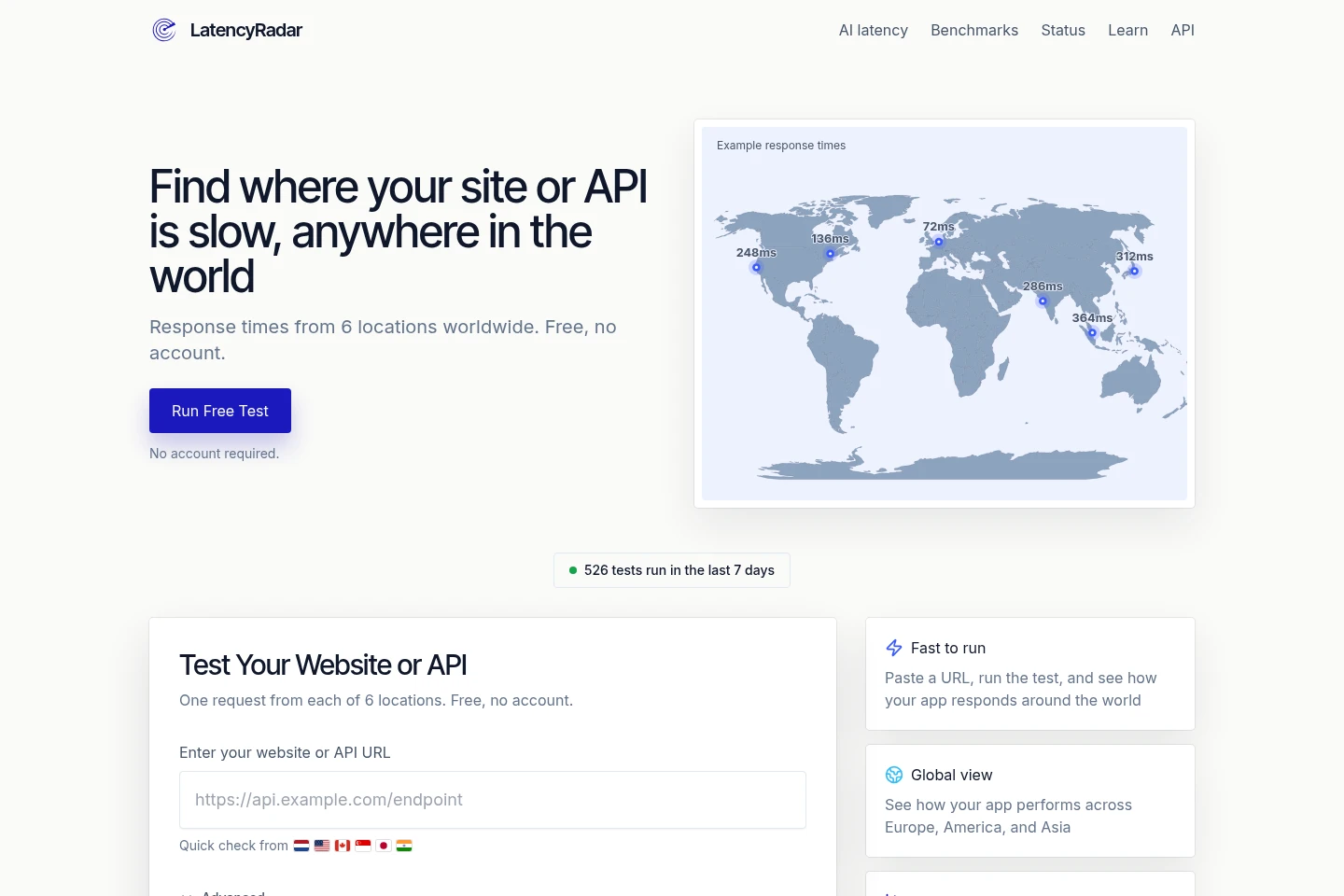
LatencyRadar measures website and API response times from six locations: Amsterdam, San Francisco, Montreal, Singapore, Tokyo, and Mumbai. Run free quick checks without an account, or use deeper checks for repeated samples, response-time percentiles, and protocol timing breakdowns. It also publishes daily benchmarks, AI API time-to-first-token measurements, and API status checks.
- AI Coding
- Uptime Monitoring
- Data Analysis
- global API latency test
- website response time checker
- AI API latency benchmarks
Capabilities
Global latency checks
Measure a website or API response from six worldwide locations and show the response times. Enter a URL, optionally add an HTTP method and headers, then run one request per location for a quick check.
Deeper latency diagnostics
Run repeated requests and report typical and slower response percentiles, plus a timing breakdown. The free deeper check sends 20 requests from each location and reports p50, p95, p99, DNS, TLS, connection, TTFB, and download timings.
Daily service benchmarks
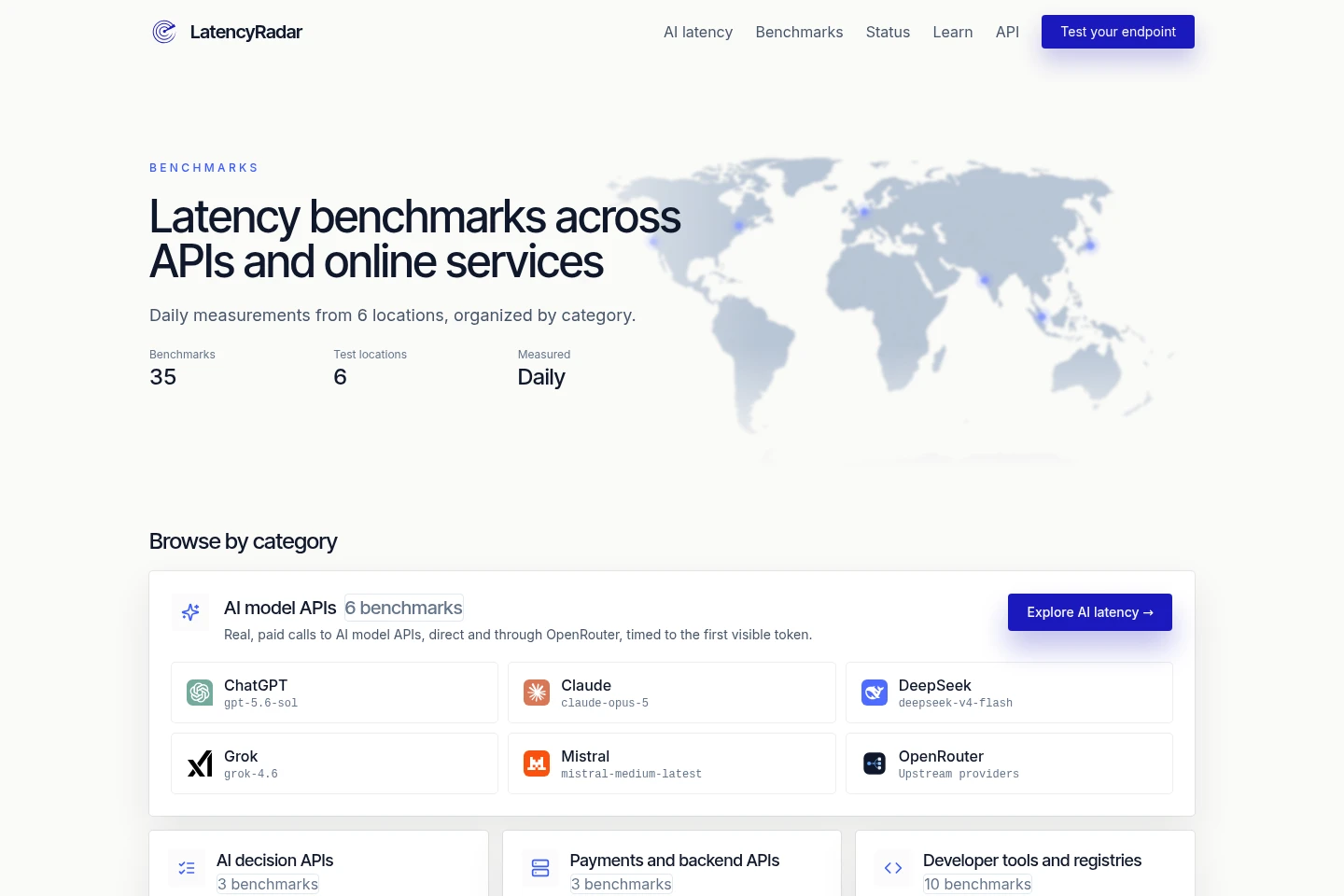
Show daily response-time measurements for listed APIs and online services across six locations. Browse benchmarks by category and inspect service-specific timing history and geographic differences.
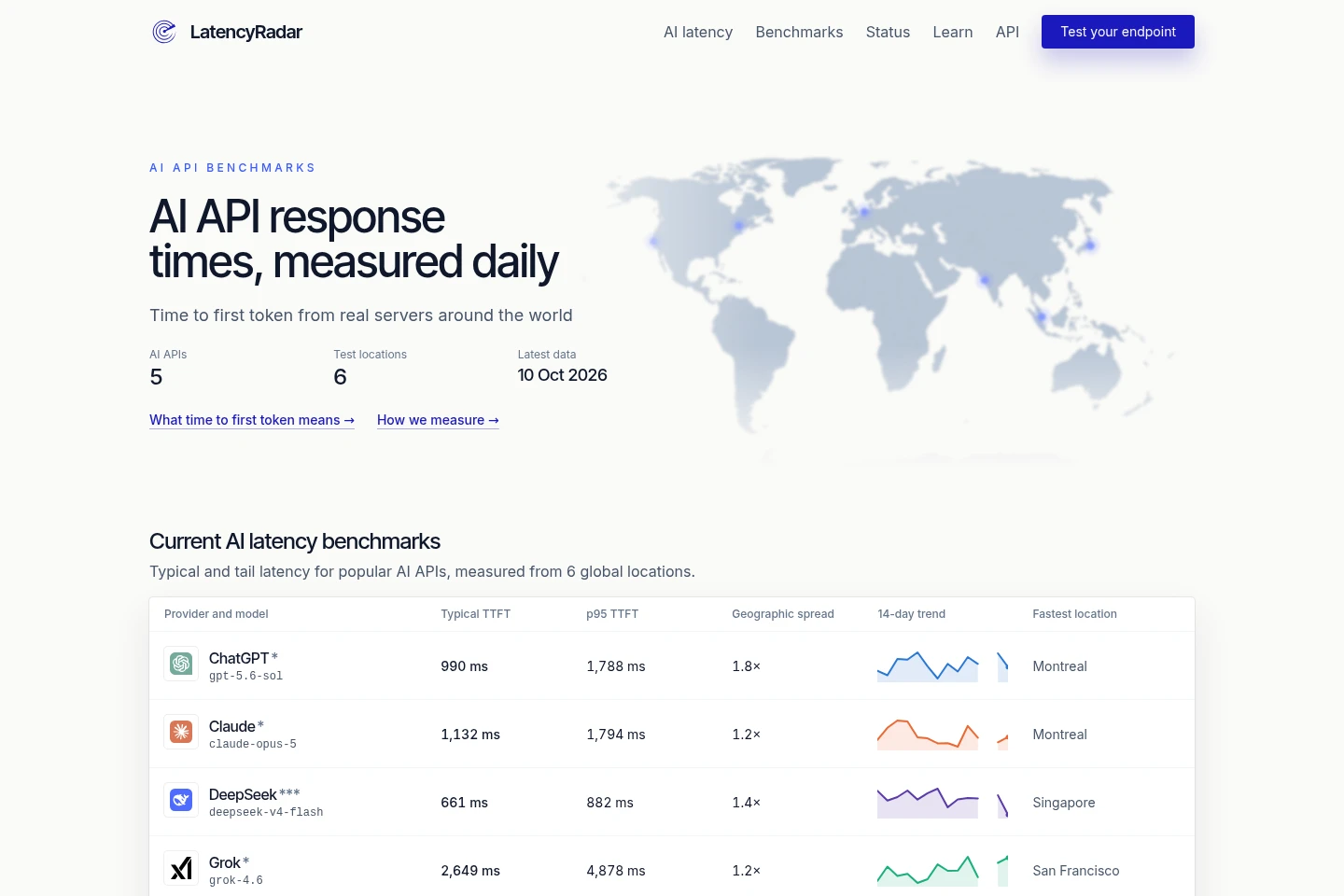
AI API benchmarks
Measure and compare AI API time to first token from six global locations. LatencyRadar publishes typical and p95 TTFT, geographic spread, and daily trends for listed providers, with different model settings noted where applicable.
API status checks
Display status checks for listed AI APIs from six cities, checked every 30 minutes. The status pages cover ChatGPT, Claude, DeepSeek, and Mistral.
Pricing
LatencyRadar is free to use, with no account required. Choose between a quick check and a deeper check based on whether you need a single regional sample or repeated measurements and timing percentiles.
| Plan | Price | Included features and limits |
|---|---|---|
| Free | Free; no charge |
|
Use cases
Check a website or API from several regions
When a website or API feels slow for users in different places, enter its URL and run a quick check. LatencyRadar sends a request from each of six locations and shows the response times, without requiring an account.
Investigate response-time percentiles and timing
When a single timing result is not enough to understand an endpoint, run the deeper check. It samples requests from each location and reports p50, p95, p99 and protocol-stage timings, subject to the daily visitor limit.
Compare published API latency benchmarks
When evaluating response times across providers or regions, browse the daily benchmark tables and provider pages. Compare reported timings, geographic spread, and trends for the services LatencyRadar measures.
Review AI API time-to-first-token data
When comparing the initial response speed of listed AI providers, inspect their TTFT measurements by location. The benchmark pages show typical and p95 timings and identify model settings that may prevent like-for-like comparisons.
Limitations
Deeper checks are limited to a few per day per visitor, and each check sends a limited number of requests with concurrency capped.
Latency checks measure response performance; the service is not a load- or stress-testing platform.
Private and internal IP ranges are blocked, and users must be authorized to test endpoints they provide.
Test data is retained only for a limited period for operational purposes; no exact retention period is specified.
The listed AI API benchmarks use different reasoning settings for some providers, so those timings are not always directly comparable.
The service provides no uptime guarantee or service-level agreement.
Who it is for
Website and API operators who need to check response times across regions
Developers and performance engineers investigating endpoint latency and protocol timing
People comparing the response speed of AI APIs across providers and locations
FAQ
What does LatencyRadar measure?
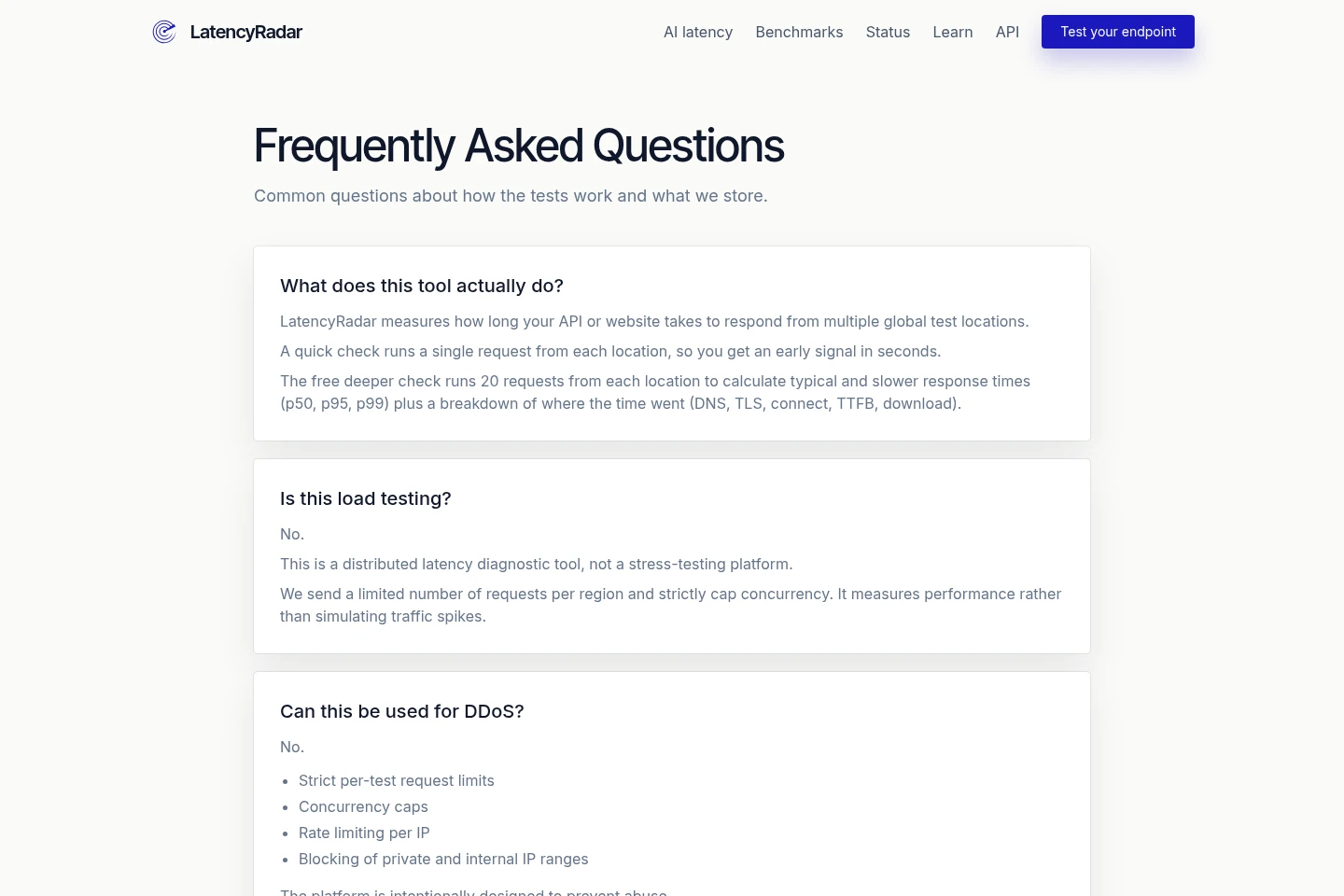
It measures how long a website or API takes to respond from multiple global test locations. Quick checks send one request per location; deeper checks use repeated requests and report percentiles and protocol timing breakdowns.
Is LatencyRadar a load-testing service?
No. It is a distributed latency diagnostic tool, not a stress-testing platform. Requests per region are limited and concurrency is capped.
Do I need an account, and what does it cost?
No account is required, and quick and deeper checks are free. Deeper checks are limited to a few per day per visitor.
Can I test an authenticated endpoint?
Yes. You can provide custom headers, such as an Authorization header, but you are responsible for having permission to test the endpoint.
What information does LatencyRadar store?
It stores the tested URL, timing metrics, status codes, and error types. It does not store response bodies, API credentials supplied in headers, or sensitive request data; test data is retained for a limited operational period.
Does LatencyRadar guarantee uptime?
No. The tool is provided as a diagnostic utility without uptime guarantees or service-level agreements.
Comments