

CiteGraph - Be found. Be cited. Get more customers via AI assistant recommendations.
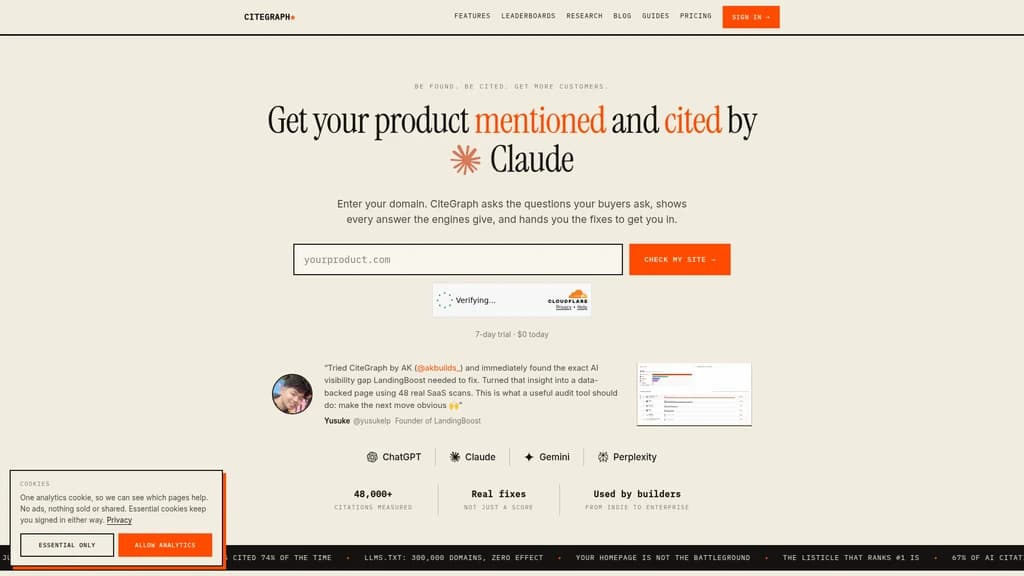
CiteGraph is an answer engine optimization (AEO) platform that helps product teams and marketers get their domains cited by top AI assistants including ChatGPT, Claude, Gemini, and Perplexity. It measures over 48,000 existing citations across engines, shows the exact answers your product is missing from, and delivers specific actionable fixes to improve your share of voice in AI-generated recommendations. The tool is built for indie builders, marketing teams, and enterprise users who want to grow organic discovery through AI search results.
- AI Marketing
- AI Search Optimization
- Image Editing
- Large Language Model
- SEO Optimization
- Claude
- GPT
231Views
Core Capabilities
CiteGraph runs scans using real buyer questions rather than generic keywords. Each question is written to match the exact terms potential customers use when searching for product recommendations, comparisons, alternatives, and use cases. Every scan sends each question multiple times to four major AI assistants through their official grounded-search APIs. The platform records every verbatim answer output by the engines, all cited source pages, and which competing products are named instead of yours. All measured rates are published with clear margin of error values, and a change is only flagged when it falls outside that error bar to avoid reporting noise as improvement.
Key Workflows
Input your domain to start your first scan. The platform automatically generates 10 buyer-focused questions tailored to your category and site.
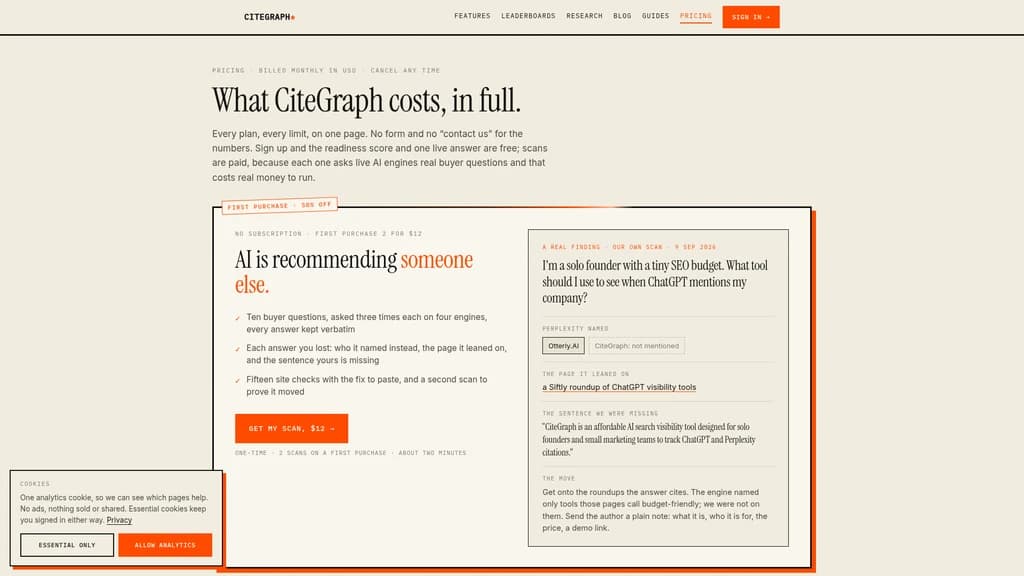
View the full dossier that maps exactly which answers your product is excluded from, which sources the engines used to build those answers, and which competitors are named in your place.
Receive specific actionable fixes including the exact missing claim that would qualify your product for the AI answer, and the recommended location to publish it on your site. Every suggested sentence is traced to existing source material so no generic content is invented.
Run follow-up scans to confirm that your changes moved your citation rate, with share of voice tracking for up to 10 selected competitors.
Use the built-in Ask assistant to query your scan results directly, or enable the included MCP server so coding agents in Claude, Cursor or VS Code can read your blind spots and apply fixes directly on your repo.
Available Plans
Free first scan: All users get one free initial scan per account.
No-subscription option: First purchase gives 2 full scans for $12, no recurring billing required.
Starter ($29/month): Weekly tracking for 2 domains, 30 written pages per month for lost questions, share of voice for up to 6 rivals, 1 user seat, and 7-day free trial with no upfront charge.
Growth ($69/month): Weekly tracking for 3 domains, 60 written pages per month, share of voice for up to 10 rivals, CSV export, up to 5 user seats, and fact sheets for writers.
Scale ($149/month): Weekly priority scans for 6 domains, 200 written pages per month, white-label public dossier links, unlimited user seats, and enterprise support options.
Public, Verified Positions
The platform states no paid ranking options are available on category leaderboards, and no sponsored or featured slots exist. It also confirms that llms.txt files produce no measurable improvement to citation rates, and that raw mention rate is a vanity metric while the mapped cited source pages are the only actionable data point for optimization.


Comments