


Ohm - AI-powered platform for engineering test labs
Launched on Feb 23, 2025Ohm by Byterat is an AI platform designed for scientists and engineers in testing laboratories. It helps hardware teams extract insights from collected test data and implement AI-native workflows for physical products across battery, automotive, aerospace, and life sciences industries.
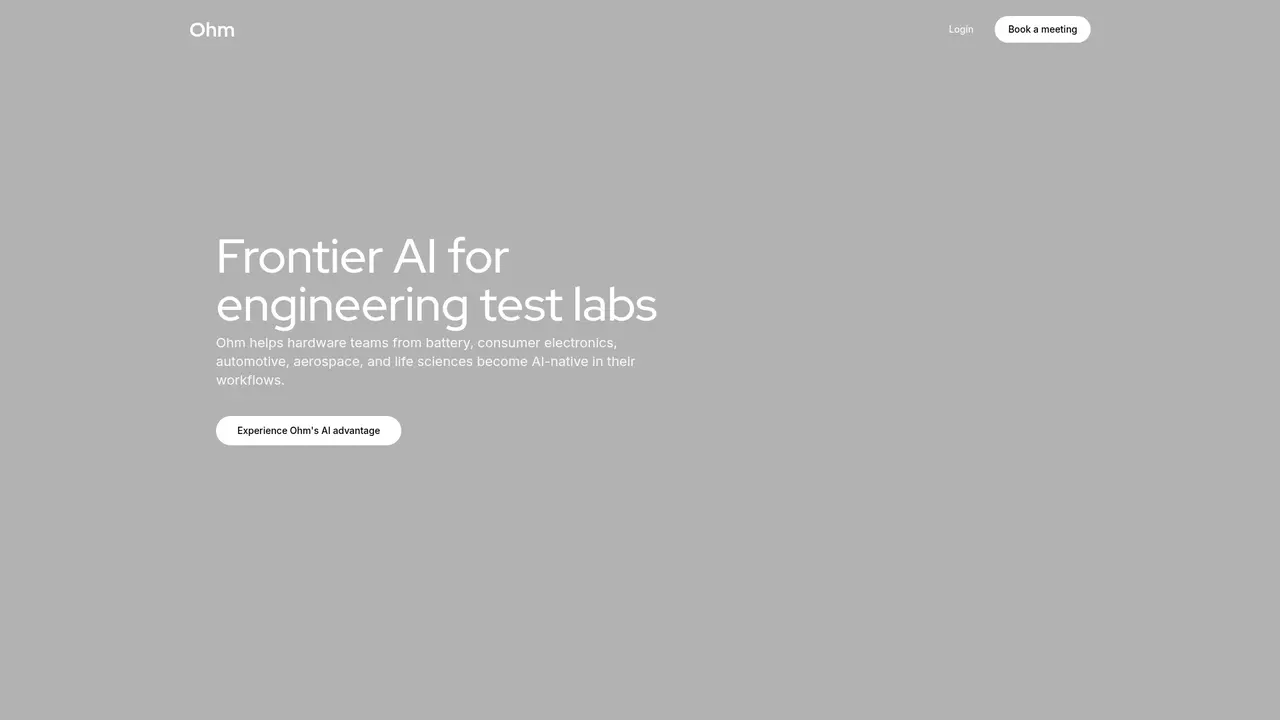
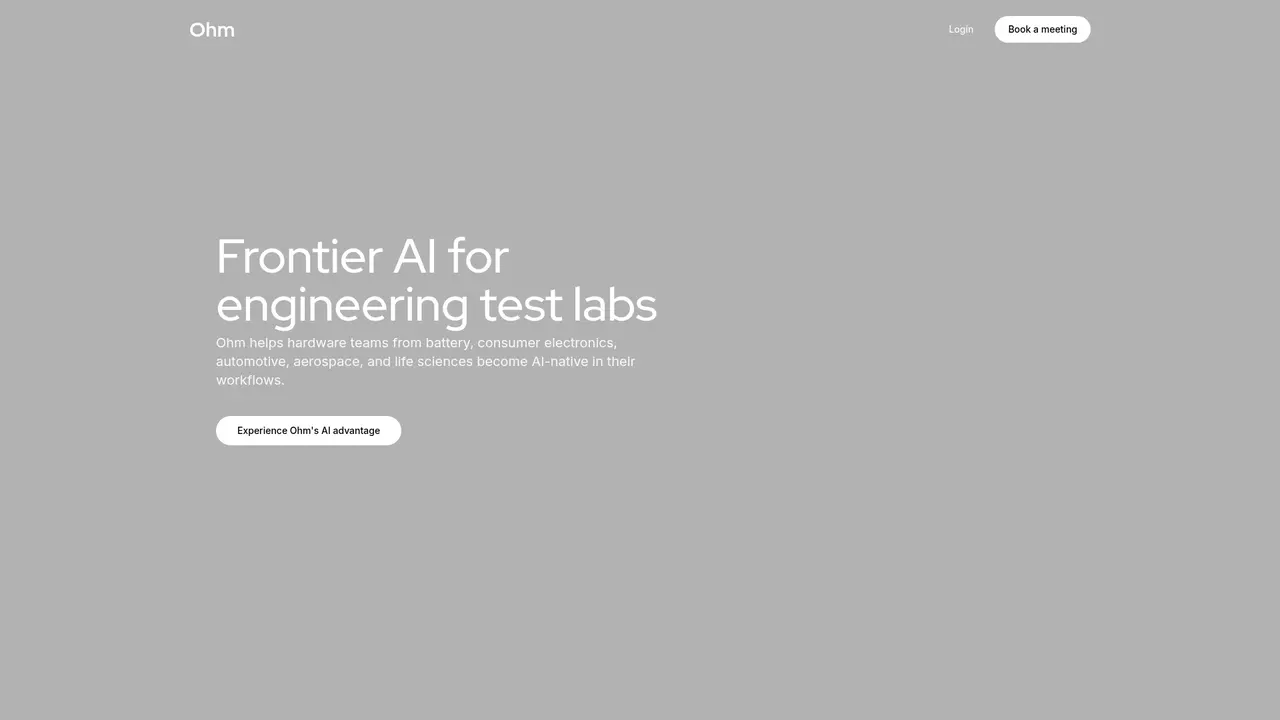
What is Ohm
If you've ever worked in an engineering test lab, you know the feeling—terabytes of test data piling up, scattered across different systems, and yet somehow the insights you need seem harder to extract than ever before. Your team spends more time hunting for files and manual data processing than actually analyzing results and making decisions. This is the reality for hardware teams across batteries, consumer electronics, automotive, aerospace, and life sciences. The data is there, but the insight isn't.
Ohm is an AI platform designed specifically for scientists and engineers who build physical products. Developed by Byterat, Inc., Ohm bridges the gap between artificial intelligence and engineering laboratories—the company exists to help teams working on hardware innovation become truly AI-native. The core promise is straightforward: turn the data you've already collected into the insights you need to innovate faster.
Unlike software-focused AI tools, Ohm is built for the physical world. Whether you're testing battery cells, validating consumer device prototypes, running aerospace component simulations, or conducting life science experiments, Ohm helps your team move from raw test data to actionable intelligence in a fraction of the time traditional methods require.
The mission behind Ohm is ambitious yet clear: to help scientists and engineers building physical products innovate faster than ever before. In an era where hardware development cycles are under intense pressure to accelerate, Ohm provides the data access and insight capabilities that separate teams struggling with information overload from those making breakthrough discoveries.
:::card{type="summary" title="TL;DR"}
- AI-native workflows: Transform how your hardware team integrates AI into existing processes
- Test data insights: Unlock deep understanding from the data you've already collected
- Physical product innovation: Accelerate design, development, and manufacturing with AI purpose-built for hardware :::
---
Core Features
What makes Ohm different is its focus on physical products rather than software. Most AI tools in the market target digital workflows, but hardware teams have fundamentally different needs—larger datasets, complex sensor readings, and the need to connect lab data to real-world performance. Ohm addresses these challenges head-on.
AI-Native Workflow Transformation is perhaps Ohm's most powerful capability. Instead of asking your team to completely change how they work, Ohm integrates into your existing processes. The platform helps hardware teams embed AI capabilities throughout the entire physical product lifecycle—from initial design concepts through development and into manufacturing. Your scientists and engineers don't need to become AI experts; the platform meets them where they are in their current workflow and enhances their capabilities with intelligent data processing and insight generation.
Data Access and Insights forms the second pillar of Ohm's offering. Engineering test labs generate enormous amounts of data, but traditional analysis tools struggle to keep pace. Ohm's AI analysis engine processes your collected test data at scale, identifying patterns, anomalies, and correlations that would take human analysts weeks or months to discover. The platform provides what the team describes as "unparalleled access" to insights hidden within your existing data stores—turning what was once considered "dark data" into a strategic asset.
Physical Product AI Applications distinguishes Ohm from general-purpose data platforms. The system is specifically designed for the unique challenges of hardware development: dealing with sensor data, test chamber results, failure analysis, performance benchmarking, and the connection between lab results and field performance. This specialized approach means the AI models and analysis frameworks are pre-tuned for the types of data physical product teams actually work with.
Cross-Industry Support ensures that whether your team works in battery technology, consumer electronics, automotive systems, aerospace components, or life sciences, Ohm's platform adapts to your domain's specific terminology, data formats, and analysis requirements.
::::grid :::card{type="advantages"}
- Purpose-built for hardware: Unlike general AI tools, Ohm is designed specifically for physical product development
- Workflow integration: AI capabilities embed naturally into existing lab processes without requiring complete process redesign
- Scalable data processing: Handle large volumes of test data that would overwhelm traditional analysis methods
- Multi-industry applicability: Serves teams across batteries, consumer electronics, automotive, aerospace, and life sciences ::: :::card{type="disadvantages"}
- Early-stage product: Limited public documentation and pricing information available
- Niche focus: Primarily targets hardware teams; may be over-specialized for teams needing broader AI capabilities
- Learning curve: Teams new to AI integration will need time to fully leverage platform capabilities ::: ::::
---
Who Is Using Ohm
Ohm serves hardware teams across multiple industries, each facing unique challenges that the platform addresses. Understanding who uses Ohm helps you determine whether it aligns with your team's needs.
Battery Testing Laboratories represent one of Ohm's core user groups. The challenge in battery testing is monumental: each charge-discharge cycle generates gigabytes of data, and a typical lab runs thousands of these cycles simultaneously. Traditional analysis methods mean valuable insights often remain buried in data archives for months before anyone has time to examine them. With Ohm, battery testing teams apply AI-driven data analysis to identify degradation patterns, optimize testing protocols, and accelerate new cell chemistry development. The result is faster insights that directly translate into quicker iteration cycles for next-generation batteries.
Consumer Electronics Development Teams face constant pressure to shorten hardware iteration cycles. When your team is developing a new smartphone, wearable, or smart home device, every week of delay costs market position. Ohm helps these teams implement AI-native workflows that reduce the time between design iterations. By automatically flagging test results that need attention and surfacing correlations between different test parameters, engineers spend less time on manual data review and more time on actual innovation.
Automotive and Aerospace Testing Departments work with perhaps the most complex test data environments—multiple sensor streams, environmental variables, and safety-critical performance metrics that must be analyzed with precision. Ohm provides a unified data insight platform that helps these teams systematically leverage all their test data rather than relying on sampling or anecdotal analysis. The platform's ability to handle cross-domain data correlations means engineers can identify root causes faster and validate designs more comprehensively.
Life Science Research Teams increasingly rely on sophisticated testing to drive discovery, but the volume of experimental data often exceeds the capacity of traditional analysis approaches. Ohm helps researchers extract more value from their experimental data, whether they're analyzing biomaterial performance, validating medical device prototypes, or optimizing pharmaceutical production processes.
:::card{type="tip" title="💡 Choosing the Right Use Case"} If your team is just starting with AI integration, begin with a specific, high-volume data challenge—like battery cycle testing or sensor data analysis—where the ROI from faster insights is immediately measurable. This builds organizational confidence while demonstrating Ohm's capabilities. :::
---
Getting Started
Ready to explore how Ohm can transform your hardware team's AI capabilities? Here's how to take the first step.
Understanding Your Fit: Ohm is built for hardware teams—scientists, engineers, and researchers working in industries where physical product development generates substantial test data. If your team spends significant time collecting test results but struggles to extract actionable insights quickly, you're likely a strong candidate for the platform.
Initial Access: The primary gateway to Ohm is through their website at https://www.ohm.ai. From there, you can learn more about the platform's capabilities and approach. Since the product appears to be relatively early in its market journey, direct engagement through the website or contacting Byterat directly will give you the most current information about availability, implementation options, and pricing structures.
What to Expect: Based on Ohm's positioning, the onboarding process likely involves understanding your team's specific data challenges and test workflows. The platform's AI-native approach means the integration focuses on enhancing existing processes rather than requiring fundamental workflow changes—though your team will need to invest time in learning how to leverage the AI capabilities effectively.
Company Background: Ohm is developed by Byterat, Inc., a company founded in 2025 with the explicit mission of bridging artificial intelligence and engineering laboratories. This relatively recent founding date positions Ohm as a modern solution built with current AI architectures rather than retrofitting older technologies.
:::card{type="tip" title="💡 Early-Stage Consideration"} Ohm appears to be an emerging product with limited public documentation. If you're evaluating the platform, consider reaching out directly to discuss your specific use case. This ensures you get accurate, up-to-date information about capabilities, timeline, and how the platform might address your particular challenges. :::
---
Frequently Asked Questions
:::card{type="faq" title="Which industries does Ohm serve?"} Ohm targets hardware-focused industries including battery technology, consumer electronics, automotive, aerospace, and life sciences. The platform is designed for teams that develop physical products rather than software, making it particularly well-suited for organizations where test laboratory data drives product development decisions. :::
:::card{type="faq" title="What is Ohm's core value proposition?"} Ohm helps scientists and engineers extract deep insights from the test data they already collect. Rather than requiring teams to fundamentally change their workflows, the platform integrates AI capabilities that accelerate how teams move from raw test data to actionable intelligence—ultimately helping hardware teams innovate faster than traditional methods allow. :::
:::card{type="faq" title="How does Ohm differ from traditional test software?"} Traditional test software typically focuses on data acquisition and basic analysis. Ohm takes an AI-native approach, using artificial intelligence to process larger datasets, identify hidden patterns, and surface insights that manual analysis would miss. Unlike software-focused AI tools, Ohm is specifically designed for physical products—understanding the unique data types and analysis needs of hardware development. :::
:::card{type="faq" title="What is Byterat's mission?"} Byterat, Inc. was founded with a clear purpose: to help build physical products faster through AI. The company's mission centers on bridging artificial intelligence and engineering laboratories, empowering scientists and engineers to innovate at speeds that weren't previously possible with traditional data analysis approaches. :::
Related Content
Copy.ai Review 2026: AI Copywriting Made Easy
Our honest Copy.ai review for 2026. We test Content Agents, AI Workflows, pricing ($29-$249/mo), and compare it to Jasper and Writesonic. Find out if it's worth it for your marketing team.

Rytr Review 2026: Is This Budget AI Writer Worth It?
Our hands-on Rytr review for 2026. We test features, pricing, content quality, and compare it to Jasper & ChatGPT. Find out if Rytr is the best budget AI writing tool.

Word Changer - Free AI tool to rewrite and improve your writing instantly
Writing always using repetitive words or need to avoid plagiarism? Word Changer is a free AI writing assistant that instantly rewrites any text with richer vocabulary and appropriate tone. Get multiple versions with one click, adjust formality level, check readability - all for free!

Unite - AI-powered platform for romantic fantasies and dream couple moments
Explore romantic fantasies and create special moments for your dream couple. This AI-powered platform lets you generate personalized romantic content and experience exclusive AI-created romantic experiences.
Comments