


Ballpark - AI-powered user research platform delivering insights in 60 minutes
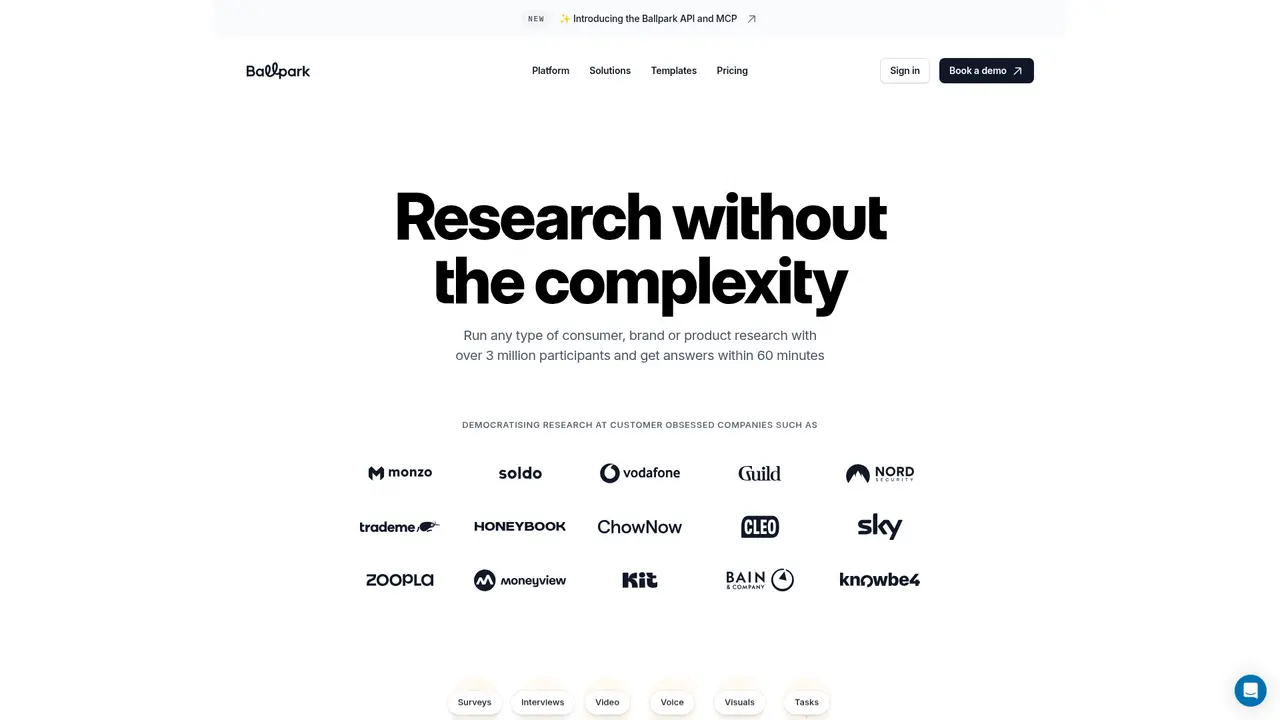
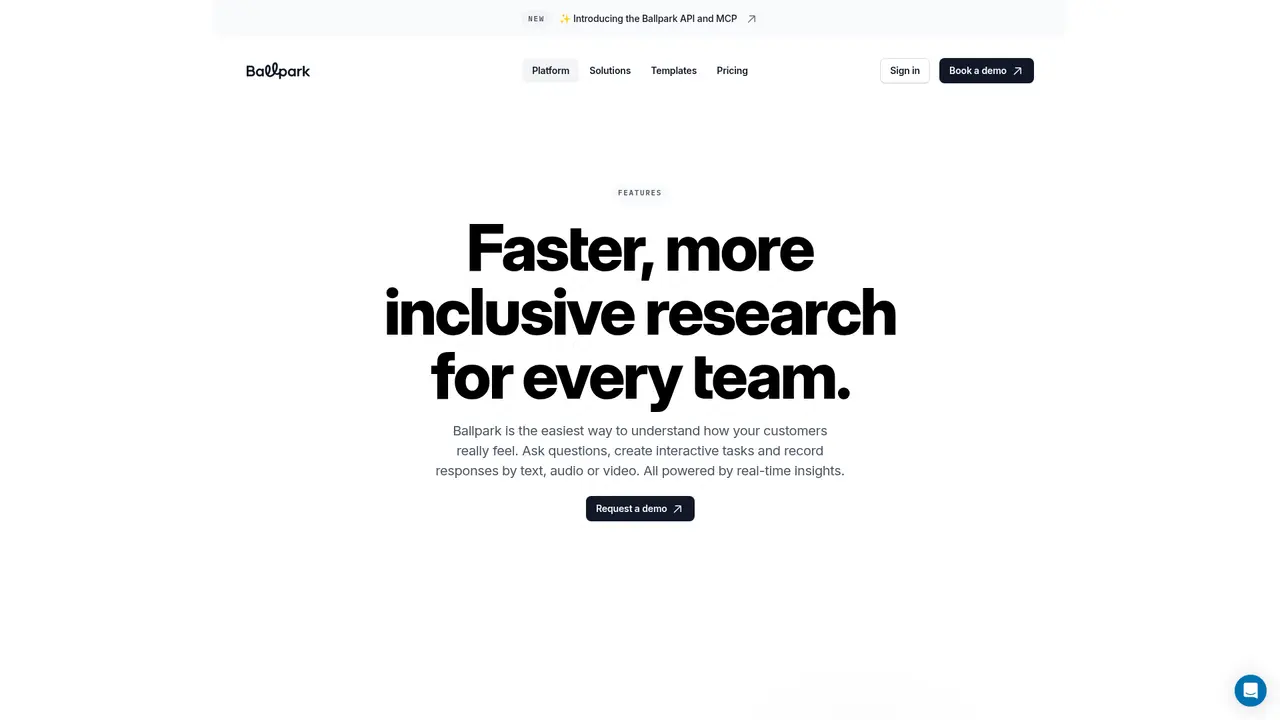
Launched on Mar 11, 2025Ballpark is an AI-powered user research platform that helps product managers, designers, and researchers gather actionable insights in just 60 minutes. With access to over 3 million global participants, AI interviewers, and automated analysis, Ballpark democratizes research by making enterprise-grade user research accessible to teams of any size.
What is Ballpark
If you've ever tried to conduct user research for your product, you know how painful the traditional process can be. Waiting weeks for research participants, paying premium fees for recruiting, and spending countless hours manually analyzing interview recordings—it's enough to make any product team push research to the back burner. That's exactly the problem Ballpark was built to solve.
Ballpark is an AI-powered user research platform that helps teams get answers to their research questions in 60 minutes or less. Instead of the traditional weeks-long research cycle, you can now validate product concepts, test designs, and gather customer insights in a fraction of the time—all from a single platform.
What makes this possible is Ballpark's combination of advanced AI technology and access to a massive global participant pool. With over 3 million participants across 18 countries, you can reach your exact target audience without the headache of recruitment. The platform handles everything from participant matching to interview scheduling, letting you focus on what matters most: making better products based on real user insights.
The AI capabilities are where Ballpark truly stands apart. Their AI Interviewer can simultaneously conduct hundreds of interviews, adapting in real-time to participant responses and asking smart follow-up questions automatically. Meanwhile, the AI Study Creator generates research frameworks based on your goals, and AI Insights Report pulls actionable conclusions from all your data—whether that's multiple choice responses or recorded verbal feedback.
This isn't just theoretical. Companies like Vodafone, Soldo, FEVO, and Glean are already using Ballpark to transform how they make product decisions. On G2, Ballpark holds a 4.6-star rating, with users consistently highlighting how the platform reduces project timelines and shifts discussions from opinions to research-backed decisions. The average research project completes in under 2 hours—a stark contrast to the weeks traditional methods require.
:::card{type="summary" title="TL;DR"}
- 60 minutes to get research answers instead of weeks
- 3 million+ global participants across 18 countries
- AI-driven interviews and analysis that scale with your needs
- Unlimited team members included in every plan
- Rated 4.6 stars on G2 with proven enterprise results :::
---
Ballpark's Core Features
You can think of Ballpark as your complete research toolkit—one that handles everything from participant recruitment to insight generation. Let's walk through the capabilities that make this possible.
AI Interviewer is perhaps the most powerful feature. Instead of scheduling dozens of individual interviews and spending hours transcribing them, you can launch hundreds of AI-powered interviews simultaneously. The system adapts in real-time to each participant's responses, guiding conversations toward the insights that matter most to your research goals. This means you get the depth of qualitative research with the scale of quantitative methods.
AI Study Creator takes the friction out of research design. Tell Ballpark what you want to learn, and it generates a complete research framework—questions, formats, and structure—ready for your review and deployment. This dramatically speeds up the research setup process.
Once data starts flowing in, AI Insights Report does the heavy lifting of analysis. It automatically pulls relevant themes from multiple-choice answers and verbal feedback, organizing findings into a coherent, actionable report. Instead of spending days manually coding interview transcripts, you have insights ready to share with stakeholders in hours.
When it comes to participants, Ballpark gives you flexibility. You can tap into their panel of over 3 million people across 18 countries with more than 200 targeting options—including demographics, industries, interests, and professional roles. On average, research recruitment completes in under 2 hours. Alternatively, if you already have your own participant database, you can bring your own audience at no additional cost.
For design validation, Website Testing lets you test any live website without installing plugins—just provide the URL and you can immediately see heatmaps, design metrics, and user behavior patterns. If you're working in Figma, the Figma Prototype Testing integration goes deeper, tracking every click, goal conversion, and user path so you can validate design decisions before writing a single line of code.
You can also run specialized research tests including first-click tests, five-second impression tests, card sorting exercises, copy and image preference tests, and live video interviews—giving you the right tool for every research question.
::::grid :::card{type="advantages"}
- Comprehensive AI automation: From study creation to insight generation, AI handles repetitive tasks so your team focuses on strategy
- Massive global reach: 3M+ participants across 18 countries with 200+ targeting options ensures you find the right audience fast
- Speed: Average research completes in under 2 hours—compared to weeks with traditional methods
- Flexible testing: From live websites to Figma prototypes to video interviews, one platform handles diverse research needs
- Cost control: Bring your own participants free, or purchase panel access as needed ::: :::card{type="disadvantages"}
- Participant costs: Panel recruitment is priced separately from platform access, so budget accordingly
- Enterprise pricing: Full platform access requires contacting sales—no public pricing for larger teams
- Learning curve: With so many features, teams may need time to explore and adopt best practices ::: ::::
---
Who Uses Ballpark
Ballpark serves a wide range of teams—all united by the need to make better decisions through user insights. Here's how different roles typically leverage the platform.
Product Managers often use Ballpark to validate product concepts before committing development resources. Instead of building something and hoping users want it, you can test assumptions early. One key use case is concept testing—presenting product ideas to target users and gathering immediate feedback on appeal, pricing sensitivity, and feature priorities. This shifts product discussions from "I think" or "we believe" to concrete research-backed decisions. Vodafone's team specifically notes that Ballpark helped them reduce project timelines and move conversations from opinions to evidence-based decisions.
User Researchers appreciate the scale AI Interviewer provides. Traditional qualitative research meant conducting maybe 5-10 interviews personally— Ballpark can handle hundreds simultaneously while maintaining conversation quality through AI that adapts in real-time. The AI Insights Report then synthesizes all that qualitative data into themes and patterns that would take weeks manually. This means you can run comprehensive qualitative studies in days, not months.
Designers rely heavily on Figma Prototype Testing and Website Testing. Before writing code, you can validate navigation choices, layout decisions, and conversion flows through heatmaps and task completion tracking. Trade Me's product designers specifically mentioned getting user insights faster than ever before. You can also run design preference surveys with video feedback, collecting subjective input in a structured, data-driven way.
Brand Teams use Ballpark for brand perception research—understanding how your brand lands with different audience segments. By combining surveys, video responses, and follow-up interviews, you get a comprehensive view of brand awareness, associations, and sentiment. This creates the foundation for data-driven brand strategy.
Marketing Teams leverage the platform to optimize campaign effectiveness before spending budget. Test ad copy variations, landing page designs, and creative assets with real target audiences. Glean found the platform so user-friendly and visually appealing that creating surveys became enjoyable—meaning marketing teams actually run more tests, leading to better-optimized campaigns.
:::card{type="tip" title="💡 Not sure if Ballpark is right for you?"} If you need to validate design ideas or product concepts quickly, Ballpark's AI capabilities can complete research in hours that traditionally takes weeks. This is especially valuable if your team lacks dedicated research resources but still needs to make user-informed decisions regularly. :::
---
Technical Features
For teams that need to integrate research into existing workflows or build custom solutions, Ballpark offers a robust technical foundation backed by enterprise-grade infrastructure.
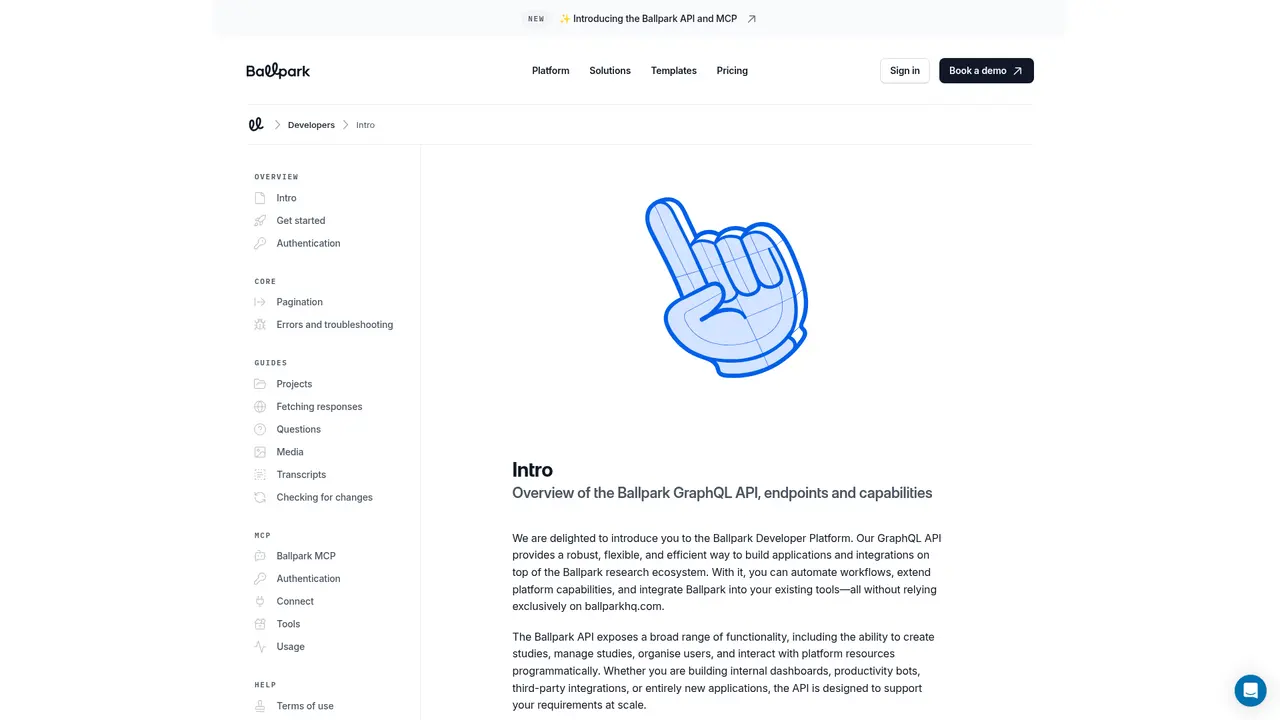
The platform provides a GraphQL API that gives developers complete access to platform functionality. This means you can programmatically create studies, manage participants, and retrieve results—integrating research directly into your product development pipeline. The API-first approach ensures Ballpark fits naturally into existing tool stacks rather than requiring workarounds.
The Figma integration goes beyond simple embedding. You can set up prototype tests directly within Figma using Ballpark's plugin, tracking every user interaction including clicks, hover behavior, goal completions, and navigation paths. This gives designers immediate feedback on how users actually move through their designs, not just what they say about them.
Ballpark's AI capabilities run on sophisticated technology designed for research applications. AI Interviewer uses conversational AI that adapts in real-time—it recognizes when participants touch on important topics and naturally guides the conversation deeper. The system can handle hundreds of concurrent interviews while maintaining personalized, contextually aware dialogues. AI Coach acts as an always-available research assistant within your workspace, analyzing and comparing data across studies, identifying patterns, and pulling specific insights on demand.
The platform supports Model Context Protocol (MCP), enabling more intelligent analysis and integration with emerging AI tools. Combined with real-time video and audio recording (including webcam, microphone, and screen capture), you have everything needed for comprehensive usability studies.
:::card{type="summary" title="Technical Highlights"}
- GraphQL API for full programmatic control
- Native Figma integration with deep tracking
- Real-time adaptive AI Interviewer
- AI Coach for ongoing insight extraction
- MCP support for modern AI workflows
- Video/audio/screen recording for qualitative studies :::
::::grid :::card{type="advantages"}
- Enterprise API: Full GraphQL API enables custom integrations and automation
- Advanced AI: Real-time adaptive conversations and intelligent analysis go beyond simple automation
- EU-based infrastructure: Data hosted on Google Cloud/AWS with ISO 27001 compliance—ideal for European teams with strict data requirements
- Security certifications: SOC 2 Type II, GDPR compliance, HIPAA in final validation, and 256-bit SSL/TLS encryption
- Flexible deployment: SAML-based SSO, IP restrictions, and project-level password protection for enterprise needs ::: :::card{type="disadvantages"}
- Integration effort: Full API utilization requires developer resources—teams without technical capacity may not leverage all capabilities
- Complexity: The breadth of features means onboarding takes longer for non-technical users
- Limited self-serve: Large enterprise deployments require sales conversations rather than instant sign-up ::: ::::
---
Common Questions
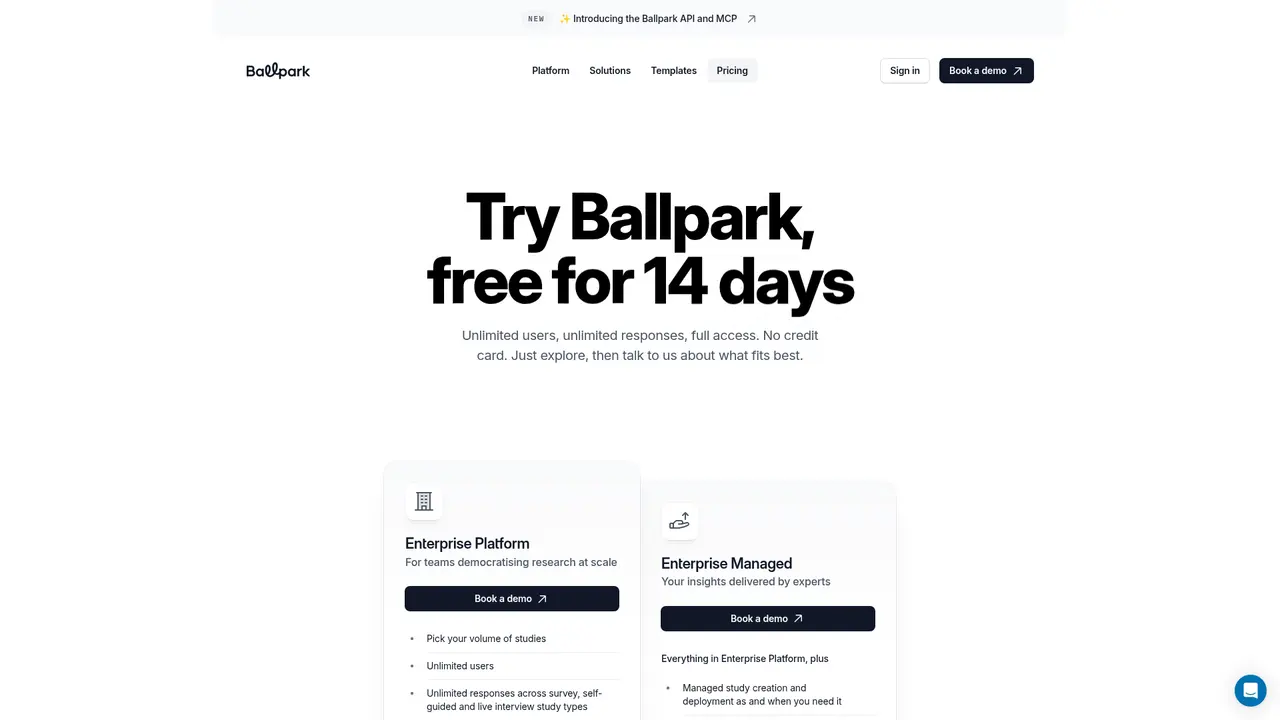
:::card{type="faq" title="What's the difference between Enterprise Platform and Enterprise Managed?"} Enterprise Platform is designed for teams that want to run their own research at scale, using Ballpark as their central research hub. You get unlimited users, unlimited responses across surveys, self-serve, and live interviews, plus full AI capabilities for study creation and insights. Enterprise Managed is for teams that want research delivered as a service—from study design through insight delivery. Ballpark experts handle research creation, deployment, and validation while you maintain visibility into all studies and data. Both include training, onboarding, and support, but Managed adds hands-on execution. :::
:::card{type="faq" title="Is participant recruitment included in the platform cost?"} No. Participant recruitment is priced separately from platform access. You can purchase participant credits to access Ballpark's panel of 3 million+ people, or you can bring your own participants at no additional cost. This gives you flexibility to control spending based on whether you need Ballpark's recruitment reach or already have an existing participant database. :::
:::card{type="faq" title="If we choose Enterprise Managed, do we still get access to the platform?"} Yes. Enterprise Managed includes everything in Enterprise Platform—you maintain full access to the platform, all studies, and your data. The difference is that Ballpark experts also handle the heavy lifting of research creation, deployment, and validation. It's essentially Platform plus dedicated research support. :::
:::card{type="faq" title="Is there a limit on how many studies we can run simultaneously?"} There's no concurrency limit or scheduling restrictions. Studies are limited by quantity rather than simultaneous execution—you can run as many parallel studies as you need without hitting platform barriers. :::
<card type="faq" title="What does "custom B2B and B2C participant procurement" mean?"> This is an Enterprise Managed feature where Ballpark leverages its partner recruitment network to find highly specific audiences based on your needs. Rather than standard demographic targeting, you can recruit participants like small business owners, specific automotive brand owners, healthcare professionals, or any niche audience that fits your research requirements. </card>
:::card{type="faq" title="Does Ballpark offer a free trial?"} Ballpark doesn't currently offer a free trial, but you can request a demo to explore the platform and discuss your specific needs with their team. This lets you understand capabilities firsthand before committing. :::
Related Content
Copy.ai Review 2026: AI Copywriting Made Easy
Our honest Copy.ai review for 2026. We test Content Agents, AI Workflows, pricing ($29-$249/mo), and compare it to Jasper and Writesonic. Find out if it's worth it for your marketing team.

Rytr Review 2026: Is This Budget AI Writer Worth It?
Our hands-on Rytr review for 2026. We test features, pricing, content quality, and compare it to Jasper & ChatGPT. Find out if Rytr is the best budget AI writing tool.

Word Changer - Free AI tool to rewrite and improve your writing instantly
Writing always using repetitive words or need to avoid plagiarism? Word Changer is a free AI writing assistant that instantly rewrites any text with richer vocabulary and appropriate tone. Get multiple versions with one click, adjust formality level, check readability - all for free!

Unite - AI-powered platform for romantic fantasies and dream couple moments
Explore romantic fantasies and create special moments for your dream couple. This AI-powered platform lets you generate personalized romantic content and experience exclusive AI-created romantic experiences.
Comments