




Finished today's Krillion? Choose ∞ Unlimited on krillion.io to open the original Endless Dive. Looking for yesterday’s questions? In a signed-out check on November 26, 2026, the official Archive showed a one-time $5 unlock. For another free round, try one of the independent games below. PlayDaily also calls its game “Krillion Unlimited.” The 6,000 m walkthrough in this guide is for PlayDaily Classic.
- krillion.io · original. Open Classic to start Endless Dive #1. Archive has a purchase and restore screen. The number of free dives and the official depth conversion remain unconfirmed.
- UnlimitedKrillion.com · independent. Play seven prompts for free, then start another round. Its library spans 23 packs, and the game tries to avoid recent questions.
- Krillion.games · independent. Free challenges run up to 50 prompts, with three lives and two metres per point. A friend invitation preserves the same question set.
- Krillion.game · independent. Play a free seven-prompt dive and send a friend the same game without revealing your answers.
- PlayDaily · independent. Free Classic rounds have seven prompts and award ten metres per point. Choose a private room to play live with friends.
There's a good reason to remember which link you opened. “When does Krillion Unlimited stop?” has several correct answers. One game's Classic mode ends after seven questions. Another site's challenge can end on your third zero. A room host can even choose how many prompts everyone gets. The name in the address bar and the mode on the start screen tell you which rule applies.
How to play the original Krillion Unlimited
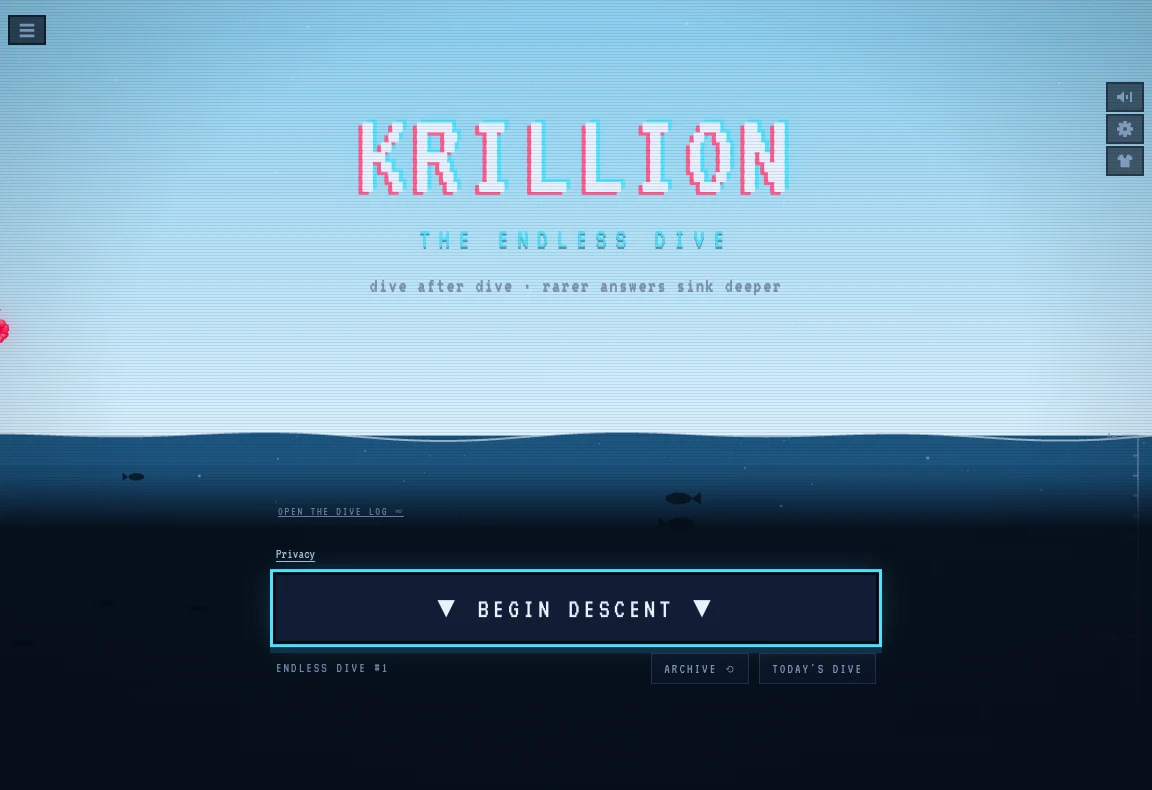
Open the menu on krillion.io to choose Daily Dive, Unlimited, Archive, Themed Packs or Puffer Party.
Open krillion.io. If a friend sent you a similarly named site, check the address before looking for your existing purchase.
Choose ∞ Unlimited for another seven-prompt dive. You can bookmark the official Classic entry.
Choose Archive if you want to find a particular past daily. The signed-out Archive showed the $5 unlock and a restore option. Once you have access, a date or dive number from your friend's result will help you find the right one.
If your family is still talking about yesterday’s geography question, ask for the date and use Archive. If you have ten minutes and any fresh set will do, open Unlimited.
If you're new to Krillion, a prompt has many possible correct answers. Imagine being asked for a country beginning with A. Australia and Andorra both satisfy the condition. The fun is in skipping the obvious answer for a rarer one you’re confident fits. The actual tier depends on the game's answer set for that prompt. Those two countries are an illustration, so you can try the thought process without spoiling today's puzzle.
The distinction matters when someone sends you their depth. To play along fairly, ask them for the site, mode and challenge or date before they reveal an answer. A link to the homepage gets you into the same game, but a random new run can give you different questions. Once you've seen a friend's rare answer, it is hard to tell whether you'd have found it in 25 seconds on your own.
How much is Krillion Unlimited, and what does a purchase include?
The original advertised Unlimited for a one-time $5 on the Archive screen. In a signed-out browser check on November 26, 2026, Classic opened Endless Dive #1, while Archive offered the unlock and a way to restore an earlier purchase. The final checkout total, the number of free Classic dives and the full list of archive dates covered remain unverified.
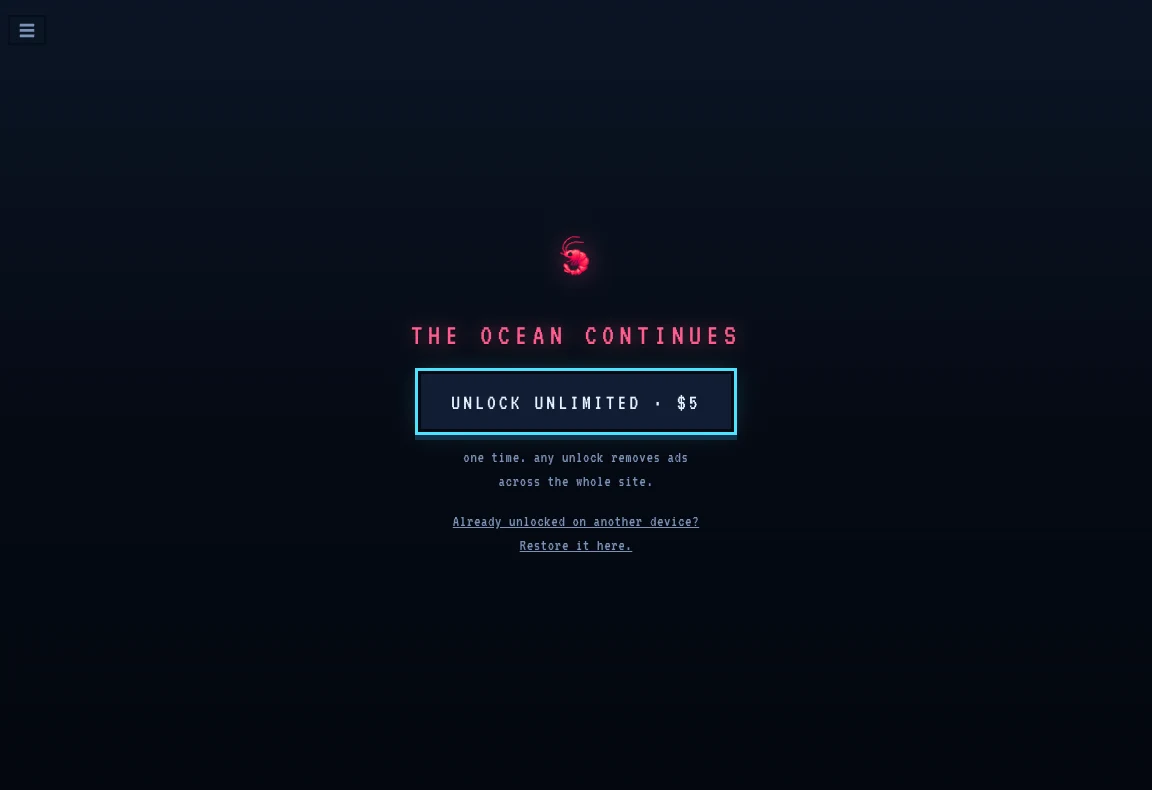
Any unlock removes ads across krillion.io. The developer says linking a Google account carries that benefit across devices.
Is it a subscription, or do I have Unlimited forever?
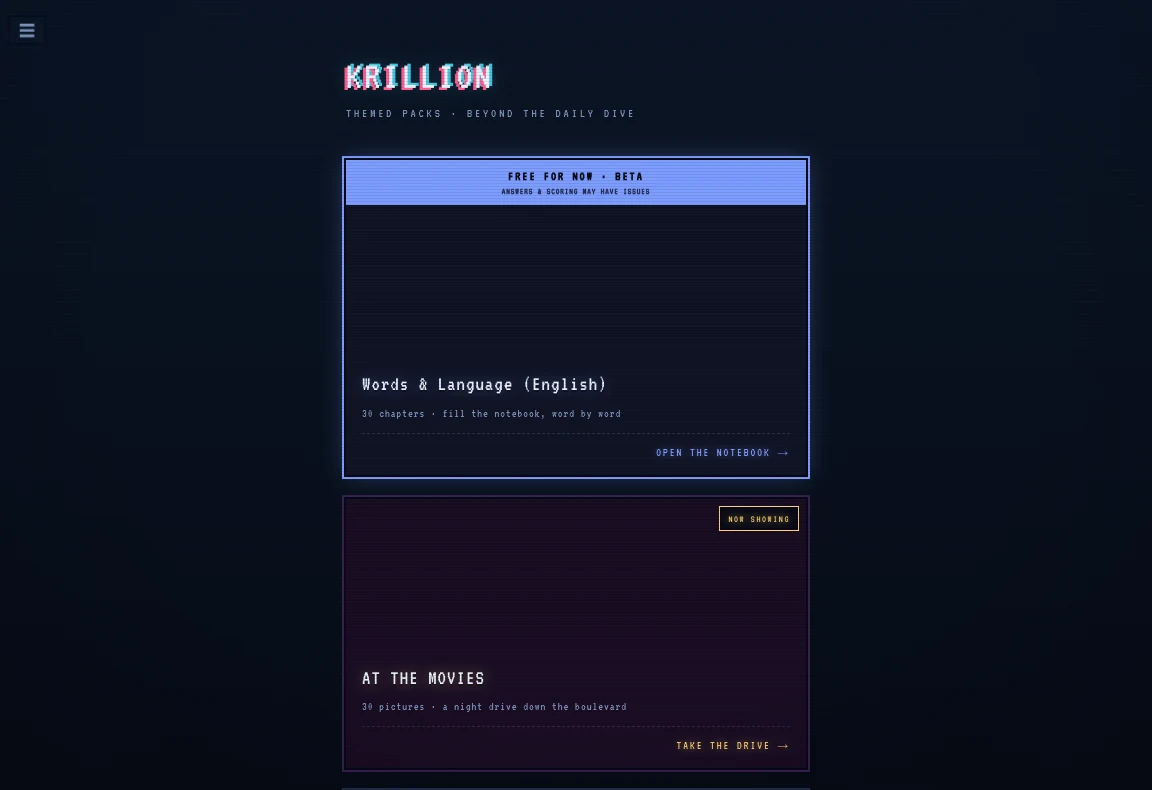
The Archive offer described a single payment. It gave no guaranteed number of future dives. If you’re looking for Words & Language, Movies, Sports or Geography, open Themed Packs directly. On November 26 the packs were marked free during beta, with a warning that answers and scoring could still change.
If you want to replay a particular puzzle, the official logbook says every aired daily can be resurfaced. The offer screen doesn't list dates, so we couldn't confirm a specific date before purchase.
UnlimitedKrillion.com has its own purchases. On November 26, 2026, its listed one-time offers were $2.99 to remove ads, $6.99 for 12 premium packs and $12.99 for All-Access, including that site’s Daily Archive. Before buying, compare the domain on the offer with the one where you actually play.
Where is my unlock link, and can I gift the game?
Start from the same service and purchase identity you originally used. If you linked your Google account, check which account you are using on the new device. The original site has a restore link on its Archive and Themed Packs pages. On a shared computer, two people can open exactly the same address and see different entitlements.
For gifting, check whether the current checkout explicitly offers a recipient or gift purchase. The public official FAQ does not document a gifting workflow. A game link is fine to send someone who wants to try a round. A purchase-restoration link or private receipt is a different thing, and sending it is a poor substitute for a gift option. If the intended recipient just wants to play with you tonight, a free private room below gets you both into the same match.
Which free Krillion version should you play?
| Game | Mode | Rules |
|---|---|---|
| UnlimitedKrillion.com | Quick solo round | 7 prompts, 25 seconds each |
| Krillion.games | Long challenge | Up to 50 prompts, three lives |
| Krillion.game | Play at different times | The same seven prompts for both players |
| PlayDaily | Live room | 5–50 prompts, 5–60 seconds each |
UnlimitedKrillion.com for a quick seven-question dive
This fan-made game has a straightforward loop: seven random prompts, 25 seconds apiece, one answer per prompt. You can replay the basic dive for free. A guest's statistics stay in the browser, and signing in is an option if you want to carry progress across devices. The homepage distinguishes free replay from extras such as removing ads and unlocking premium packs.
One detail on the start page explains the appeal better than a paragraph of rules. Its sample fruit question gives apple 10 points and salak 100. If you've eaten salak, it might be the first fruit that comes to mind for you even though it's an unusual answer for the game. That's the skill worth practising: draw on an area you know personally. Trying to invent an exotic-sounding fruit puts you at the mercy of both the clock and the answer checker. Its five tiers are Surface (10), Reef (30), Twilight (60), Midnight (85) and Abyss (100). The scoring examples below that use only those values give the same totals here.
This is a sensible choice for two people passing a phone back and forth. Each can finish a short dive without committing to a long survival run. If you're comparing ability, however, two randomly dealt sets make a poor head-to-head test. Use this site’s Challenge a Friend or Dive Room if the point of your evening is to see who can come up with the better answer to the same clue.
Krillion.games for a longer three-life challenge
On this site you can start another challenge whenever you like. Each run has up to 50 different prompts. Your third zero-score round ends the attempt, even if there are plenty of questions left. Get to question 50 with lives remaining and that attempt is complete. Each prompt gives you 25 seconds. A rejected guess leaves time to try again. Passing or finishing the prompt with an empty or unrecognised answer costs a life. At two metres per point, 3,000 points reaches 6,000 m here. A perfect 5,000 points reaches 10,000 m.
The three-life rule changes the value of a safe answer. Suppose you have already taken two zeroes. You know one valid answer and have a hazy memory of a much rarer one. On a short fixed-length dive you might risk the long shot to improve your final result. Here, getting anything on the board also buys you a chance to see the next prompt. A modest score can be worth more to the run than the number beside it suggests.
The site also explains how it selects questions. Each run contains distinct prompts, and later runs can revisit material from its finite pool. A browser with saved history gives the game information about which prompts to favour. That's a useful choice if repeated questions are your main annoyance. It's also a reason to use the same browser if you want the site's history-aware selection to be useful.
Krillion.game for friends who play at different times
Try this independent version when you want the same game as a friend but can't both be online. Finish an Unlimited dive, use the result-copying control and send the resulting link. The guide says the link opens the same game ID for the next person. The copied result shows points, depth and tier emojis. Your answers stay hidden, so you can share it before your friend plays.
This works well for a family group chat spread across time zones. The first player does the dive over breakfast. The next opens that specific challenge after work. Keep the unusual answers for the conversation afterward: two people reaching the same depth can have taken completely different routes, and comparing the actual words is half the fun. If the second person opens a fresh game instead, ask them to reopen the link before either of you spends seven questions chasing an invalid comparison.
PlayDaily for Classic, Endless and live rooms
PlayDaily calls its own game Krillion Unlimited. Its rooms and ratings belong to PlayDaily. It offers free solo play alongside private rooms and ranked duels. Classic gives you a compact target to chase. Endless adds an air supply. A room lets a group answer together, and ranked play adds an opponent and a rating. These distinctions explain why one player's advice says to protect your air while another recommends watching the seven-question total. They're describing different modes on the same site.
To follow the scoring examples, open Classic on PlayDaily. In Endless you can keep playing past the seventh prompt while you have air.
When does Krillion Unlimited stop, and how deep can you go?
There are three different finish lines worth knowing. PlayDaily Classic ends after seven prompts. PlayDaily Endless ends when you exhaust your air supply. The Krillion.games challenge ends at the third zero or the fiftieth question. The original krillion.io also calls its own mode The Endless Dive. Its public menu confirms the entry, but does not establish the same air rules or a mathematical ceiling. Apply the calculation below to PlayDaily Classic.
A seven-question Classic dive tops out at 7,000 m on PlayDaily
PlayDaily awards up to 100 points for an answer, gives you seven chances in Classic, and converts each point into 10 metres. Multiply those numbers and you get 7 × 100 × 10 = 7,000 m. To pass 6,000 m you need more than 600 points. A final score of exactly 600 reaches the line without crossing it.
The game uses six scoring tiers. For the calculations that follow, the important values are 100 for One in a Krillion, 85 for Deep Cut, and 60 for Rare. The remaining tiers are Schooler (30), Too Clever (15) and Plankton (10). A missed prompt earns zero. Think of each question as offering a possible 100 points. A Deep Cut costs 15 points of that perfect ceiling. A Rare costs 40. To finish above 6,000 m, your combined shortfall over seven questions must stay under 100 points.
Can you pass 6,000 after one miss? With six questions left at a maximum of 100 points each, the best possible finish is exactly 600 points. You could still land on 6,000 m, an excellent recovery, but the chance to beat it is gone for that seven-prompt round. In Endless you can face another prompt. In Classic there's no eighth answer to make up the difference.
Four combinations that explain the 6,000 m line
| Seven answers | Points | Depth |
|---|---|---|
| 7 × Deep Cut | 7 × 85 = 595 | 5,950 m |
| 6 × Deep Cut + One in a Krillion | 510 + 100 = 610 | 6,100 m |
| 5 × One in a Krillion + Rare + Schooler | 500 + 60 + 30 = 590 | 5,900 m |
| 4 × One in a Krillion + 2 × Deep Cut + Rare | 400 + 170 + 60 = 630 | 6,300 m |
Follow one illustrative round from start to finish
Here's a worked example you can compare against a results screen. The sequence is constructed from the published scoring tiers. It doesn't reveal a live puzzle or claim that particular words earned these scores.
- Deep Cut, 85 points. Depth 850 m. A strong opening, with six chances left. At this stage a projected final score would tell you very little about the categories still to come.
- Deep Cut, another 85. Depth 1,700 m. Both answers felt unusual, but continuing at this pace for all seven would land just short of 6,000.
- One in a Krillion, 100. Depth 2,700 m. Four prompts remain. Four more Deep Cuts would finish the dive at 6,100 m.
- Rare, 60. Depth 3,300 m. Three questions remain. To clear 600 points, the final three now have to contribute more than 270. Three Deep Cuts would add only 255.
- One in a Krillion, 100. Depth 4,300 m. The last two need more than 170 together. Two Deep Cuts would land exactly on the line.
- Deep Cut, 85. Depth 5,150 m. You need more than 85 points from the final prompt. Only the 100-point tier will carry you past the target.
- One in a Krillion, 100. Final depth 6,150 m. A last-question Deep Cut would have ended the run at 6,000 m. The difference between those two outcomes is a single change of tier.
On PlayDaily Classic, divide your depth by ten to get your points, then subtract that from 600. To pass 6,000 m, your remaining answers must beat the difference. At 5,450 m you have 545 points and need more than 55. A 60-point Rare takes you to 6,050 m. At 5,400 m the same Rare lands exactly on the line.
Can you still beat your personal best halfway through a run?
There's a quick way to tell whether a target is still reachable. Count the prompts left and multiply by 1,000 m, the most one perfect PlayDaily Classic answer can add. Add that distance to your current reading. Suppose you've finished four questions at 2,850 m. Three perfect answers would bring you to 5,850 m. You can still set a personal best if your previous record was 5,700 m, even though 6,000 m is already out of reach. That's a more useful goal for the last three turns than hoping for a bonus the rules never promised.
You can run the same calculation backward after a close loss. A finish at 5,950 m is only 50 m short of the line, but moving between answer tiers changes the score in particular jumps. Look at the seven reveals and find one answer you could realistically have improved. Turning a 30-point answer into a 60 adds 300 m. Remembering one more good example from a familiar category might therefore help more than studying the rarest answer to all seven questions. If a friend finished higher, compare the prompt where your tiers differed most. That's where the interesting conversation usually starts.
What changes in Endless?
On PlayDaily, Endless starts with three air tanks. A pass or a timeout without an accepted answer costs a tank. Finding the top-tier answer can restore air. The site describes an ocean extending to 250 km. That figure describes the extent of the ocean in its rules; it doesn't establish how the score behaves at that boundary. It also tells you nothing about the final dive in the original game's library.
Picture the same last-second decision in Classic and Endless. In Classic you're at 5,150 m with one question left and a personal target of 6,000. A safe 60 won't do it. In Endless you're down to one tank and recognise a perfectly valid ordinary answer. Getting that answer in preserves the run and leaves you a new question to work with. A strategy that makes sense when chasing a fixed seven-question score can be a poor choice when your objective is simply to survive.
How many questions are there, and when do they refresh?
“How many puzzles do I get?” can mean the number of prompts in a round, the number of rounds you may start, or the number of unique prompts in the library. A site can give you unlimited attempts from a finite set of questions. That's why the right answer can be both “play again now” and “you may eventually recognise a prompt.”
Once unlocked, the archive lets you look for a particular date. Krillion Helper recorded a seven-prompt official Endless Dive in October. The original's public FAQ gives no complete, current count of original Unlimited dives or timetable for refreshing the entire library. If a fixed number of unseen rounds is essential to your buying decision, look for that number in the current offer.
For Krillion.games, you can answer the repetition question more precisely. The pool is finite. Start one challenge and its prompts are distinct within that run. Start another and a familiar question can appear again. A friend invitation deliberately reproduces a particular set, which is helpful when you want a repeat. If a friend sends you yesterday's challenge link and you keep opening it, choose the option to start a fresh challenge when you're ready for a new draw.
On UnlimitedKrillion.com, seven is the number of prompts you play at a time. The site lists 1,002 original prompts across 23 packs, with more than 82,940 accepted answers. That last figure counts possible answers rather than playable questions. The game tries to avoid recent prompts, and a guest’s history is stored in the browser. The library count includes packs beyond the basic free dive.
There is also a difference between recognising a category and getting the same question. “Name a fish” and “name a freshwater fish” evoke much of the same vocabulary, but an answer valid for one may fail the other. Before concluding that a question repeated or a formerly good answer stopped working, check the exact wording. One adjective, a geographic restriction or a date can change the eligible set considerably.
A spoiler-light way to practise with older questions
If your goal is to get better at judging rarity, an archive can be more useful than a fresh random dive. Krillion Helper has a practice exercise built around saved results from past daily games. It presents a handful of known answers and asks you to order them by the tiers they received on that date. You can do this without guessing what a checker might accept, which makes it easier to focus on your intuition about familiar and unfamiliar answers.
Try it with someone who knows a different subject from you. Rank the choices separately, then explain the one placement you feel most confident about. Your friend's obvious choice might be a word you've never heard outside that game. That's also a good explanation for a result that feels unfair: personal familiarity and the game's estimate of familiarity across its players can diverge quite sharply.
How to find rarer answers without wasting the clock
Read the qualifying word first. Imagine a prompt asking for an island country. Greenland might come to mind immediately, and it certainly satisfies the island part. Iceland satisfies both parts. Before reaching for the least familiar place you can remember, make sure your candidate belongs to the requested category. Ten seconds spent remembering the spelling of a beautifully obscure ineligible answer buys you nothing.
Then move one step away from your first association. Suppose the category is musical instruments. If “guitar” springs to mind, try a section of an orchestra, an instrument a relative plays, or one you saw in a particular performance. “Bassoon” might come more readily from that memory than from trying to alphabetise every instrument you know. These examples illustrate a way of searching your own memory. The game decides the score for its actual prompt.
Keep one valid fallback in mind. On a short clock, it's easy to spend the entire turn trying to recall a name you almost know. If your fallback is ready, you can spend a few seconds on the interesting possibility and still answer in time. Check the rules for your mode before submitting: on PlayDaily your first accepted answer ends your attempt at that prompt. Submitting the fallback immediately gives up the opportunity to think of a better one.
Finally, read the reveal with curiosity. On the original game, the developer says that beyond a certain depth the top gem also takes account of how satisfying the answer is to discover. That helps explain how an extraordinarily obscure answer can land below one a few more people thought of. Aiming exclusively for the most technical dictionary entry can miss the joy of finding an answer that makes everyone at the table say, “Of course that counts.”
How to play against friends, use chat and read a 1v1 rating
For a specific friend playing live, a private PlayDaily room is the straightforward option. One person creates the room and sends its six-digit code or invitation link. Rooms can host up to 40 players, with 5–50 prompts and 5–60 seconds per prompt. Everyone sees the same prompt and can compare answers after the reveal. For a family game, agree on a generous timer before the first question. For a short competitive set, agree how many prompts you'll play. Those two choices do more for a fair match than arguing over the depth after the fact.
For ranked play, PlayDaily's 1v1 queue looks for a similarly rated opponent. Each match has seven prompts with 15 seconds to answer. Points determine the winner, with time on scoring answers used to break a tie. A rating of 1,300 is 300 above the published season starting rating of 1,000 and above the 1,250 threshold where PlayDaily introduces its stricter tab rule. To see how it compares with current players, consult the season leaderboard. Those thresholds alone don't tell you a percentile.
That last rule matters if you're trying to get chat to stay on screen. PlayDaily documents a match chat for the two opponents and an emote area near the answer box. Its published guide doesn't identify an always-open chat toggle. At ratings covered by the tab rule, switching away during an active match can count as a forfeit. Explore chat controls before queuing or after the results, especially on a phone where opening another app takes you out of the game.
On the original site, friends looking for a live party game can open Puffer Party. The developer describes a shared hidden fuse that passes from player to player. That makes it a different evening from two people taking turns on seven solo prompts. If a player says the timer suddenly became very short, check whether they inherited an already-running fuse. If your group prefers to mull over unusual trivia answers at its own pace, sharing a fixed solo dive is a better match for that mood.
Krillion Unlimited FAQ
Why can't I play Krillion Unlimited anymore?
First identify exactly where play stopped. A final score after seven prompts can be the normal end of a Classic round. A third zero ends the 50-question challenge. An access offer on the original site is a purchase or restoration question. A new device showing no history on an independent practice site can be browser-local progress. Note the address, mode and last screen before changing anything. Clearing browser data can discard the local history you'd want to recover.
Does Krillion Unlimited use AI to judge my answer?
It depends on the site. The original developer describes collecting and cleaning answer sets, using familiarity data for some prompts and a combination of model assistance and human review for others. On PlayDaily, the published rules describe an additional AI check for answers outside a prompt's bank. Those are two distinct uses of AI. One game's explanation won't tell you exactly what happened to a guess you submitted on another.
Why was a correct answer rejected, or an odd fish name accepted?
On the original game, a real answer can be missing from the curated list. Conversely, alternate names and spelling correction can produce surprising matches. The developer gives a concrete example: one accepted fish has the alias “sea donkey,” close enough in spelling to “sea monkey” to explain an unexpected match. That mechanism is documented. A claim that one particular fish always works would need the exact site, prompt, submitted spelling and result to establish what happened.
Do I get the same score as my friend if we both enter the same answer?
Start by checking that you played the same prompt on the same site and mode. In PlayDaily ranked play, both players score if they find the same answer. Their speed can still matter if your match totals tie. If you played separate random solo games, matching words alone tell you little: the category, wording and answer bank may all differ.
How can I try another dive without spoiling today's answers?
Open a free random practice mode before visiting a daily-answer page. If a friend sends a share card, ask whether it contains the solution words or only the challenge link. If what you really want is to review an old result, choose a dated official archive entry (the signed-out Archive showed the $5 unlock) or a past-dive ranking exercise. That lets you inspect how an unusual answer was graded while preserving today's game for later.
To chase a friend’s score, ask for their challenge link so you both get the same prompts.