
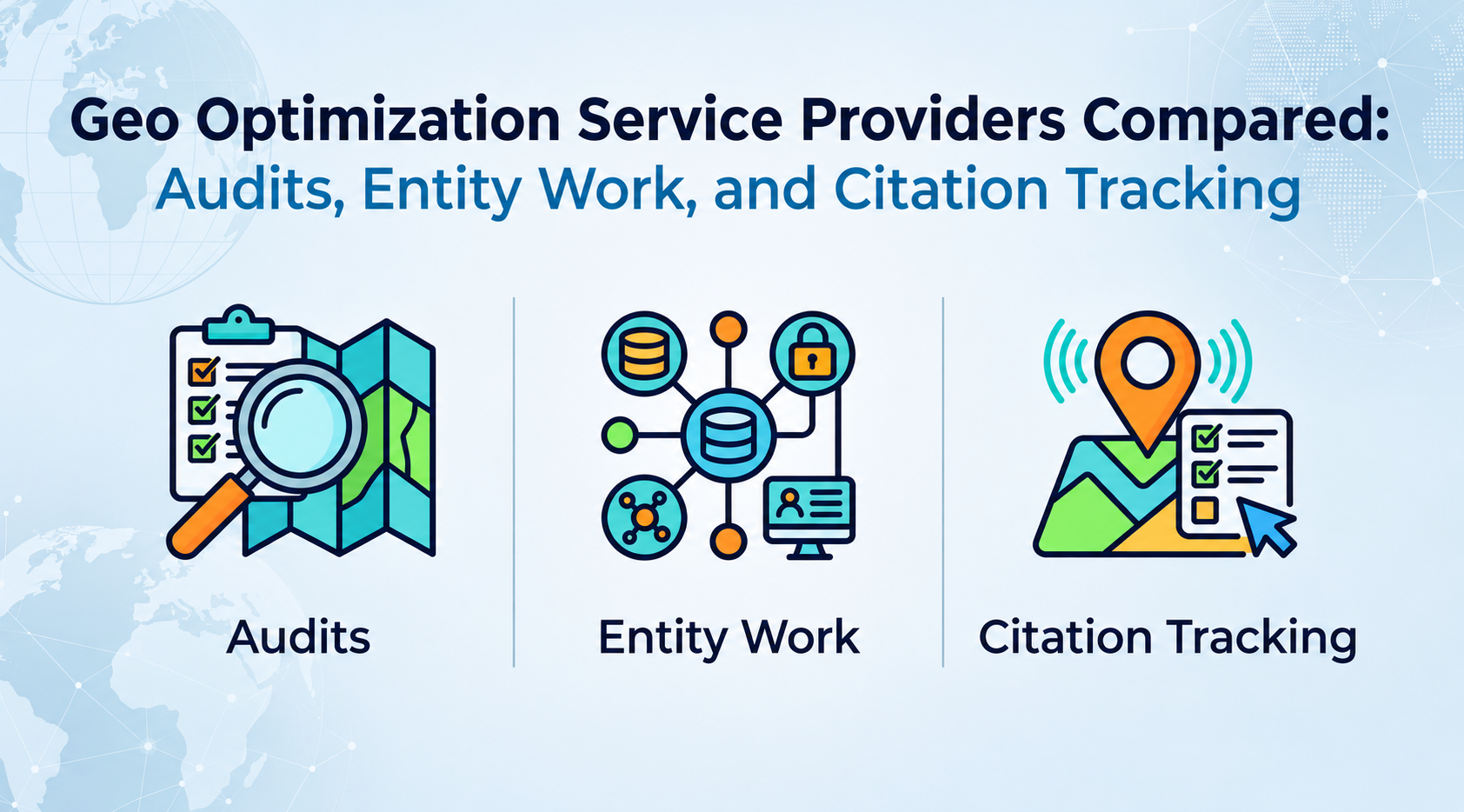
Geo optimization service providers differ less in their labels than in what they deliver: some focus on audits and technical fixes, some on entity work that clarifies who a brand is, and some on tracking citations across ChatGPT, Perplexity, Gemini, and Google AI Overviews. The right choice depends on which gap is holding your brand back in AI answers.
It is tempting to start by comparing firms. A more useful comparison starts with service components and provider types, then checks which providers cover the components you need. This guide breaks down both, along with the questions that separate a substantive engagement from a rebranded SEO package.
What Do Geo Optimization Service Providers Typically Offer?
Generative engine optimization, or GEO, covers improving how a brand is found, described, and cited in AI-generated answers. Most provider offerings combine some mix of five components.
Audits
An audit establishes the starting point. It usually includes a technical review of crawlability and indexing, a content review of whether core pages answer real questions clearly, and a baseline run of prompts across the AI assistants that matter to the business. Good audits record which sources each assistant cites, not just whether the brand appears.
Entity Work
Entity work helps search engines and language models understand exactly who or what a brand is. It covers structured data on the brand's own site, consistent names and descriptions across profiles, and accurate entries in public knowledge sources where the brand qualifies for them.
Citation Tracking
Citation tracking runs a fixed set of prompts on a schedule, and records mentions, cited URLs, and how the brand is described. It shows whether visibility is moving and which outside sources shape the answers.
Content
Content work produces or revises pages so they answer questions directly and give assistants clear, quotable statements. It can also include earning coverage on third-party sites that AI tools already cite.
Reporting
Reporting ties the other components together. Useful reports show the same metrics every cycle, include raw answers, and explain what changed and why.
How Do Different Types of Providers Compare?
Providers tend to fall into a few broad types. Each brings different strengths, and few cover every component equally well.
| Provider Type | What They Typically Do | Questions to Ask |
|---|---|---|
| SEO agencies adding GEO | Technical audits, content updates, structured data | How is AI visibility measured separately from rankings? |
| Reputation management firms | Entity consistency, source correction, review and search work, AI answer monitoring | How do you handle inaccurate claims in AI answers about the brand? |
| Content and PR agencies | Thought leadership, earned media, bylined articles | Which of your placements are already cited by AI assistants? |
| Software platforms | Prompt tracking, citation reports, share of voice dashboards | Who interprets the data and turns it into actions? |
| Independent consultants | Strategy, audits, prompt set design | What capacity do you have for ongoing execution? |
The table is a starting point. Many firms blend types, so ask about each component directly instead of assuming from the label.
Why Does Entity Work Matter So Much in GEO?
AI assistants have to decide which entity a question is about before they can describe it. Brands with common names, recent rebrands, multiple product lines, or founders who share names with other people are especially prone to mix-ups.
Structured data is one part of the fix. Google's documentation on organization structured data says that adding it to a home page can help Google understand an organization's administrative details and disambiguate it in search results. Properties such as the official name, logo, URL, and links to official profiles give search systems clear signals.
Consistency across the web is the other part. The brand name, description, leadership, and category should match on the website, business directories, social profiles, review sites, and any public knowledge sources. When those sources disagree, assistants may blend them or pick the wrong one.
Knowledge panels deserve particular attention. Errors there can spread into AI summaries, and correcting them is often slower than editing a single page. For a closer look at that problem, see this piece on fixing knowledge panel errors and why they tend to persist.
How Should Citation Tracking Work?
Citation tracking is only as good as its prompt set. A solid set mirrors how real customers, journalists, candidates, and investors ask about the brand: category questions, comparisons, problem questions, brand-name questions, and reputation questions.
The set should stay stable over time so trends mean something, with a smaller rotating set for discovery. Each prompt should run more than once per cycle, since generated answers vary between runs.
Coverage matters too. Ask which assistants are tracked and how. ChatGPT, Perplexity, Gemini, Claude, and Google AI features can all give different answers to the same question, and a provider that checks only one may miss where the brand is weakest.
For Google specifically, there is a measurement limit worth knowing. Google's guidance on AI features and your website says traffic from AI Overviews and AI Mode is included in the overall Web search data in Search Console's Performance report. That means it cannot be isolated there, so prompt tracking fills a gap that standard reporting leaves open.
Where Do Reputation Firms Fit Among GEO Providers?
AI answers about a brand can pull from reviews, news coverage, forums, and knowledge sources, material that reputation firms already work with. That overlap is why some reputation management firms now offer GEO as part of their services.
NetReputation is one example of a reputation firm that offers GEO. When comparing geo optimization service providers of this type, ask how AI answer work connects to search results, reviews, and entity accuracy, so a fix in one area supports the others. That model suits brands where the main risk is an inaccurate or negative description, more than a simple lack of mentions.
Brands whose main problem is low visibility in a crowded category may lean toward providers with deeper content and PR capacity. Brands that need help reading the data they already collect may start with a platform and add consulting. Neither path is better in general. The best fit depends on the gap.
What Questions Separate Strong Providers From Weak Ones?
A short set of questions reveals a lot about any provider, whatever its type.
How do you build and maintain the prompt set? A strong answer covers real buyer questions, intent tags, and a stable core set.
Which AI assistants do you track, and how often? Look for multiple engines and repeated runs.
Do reports include raw answers and cited URLs? Scores without evidence are hard to verify.
How do you handle entity consistency? Ask about structured data, matching profiles, and public knowledge sources.
What do you do when an assistant gets a fact wrong? The answer should involve tracing and correcting the source, not just publishing more content.
What can you not promise? Providers that say plainly they cannot guarantee citations or control how a model responds are giving an honest picture.
What Red Flags Should Buyers Watch For?
Guaranteed placements in AI answers are the clearest warning sign. No outside firm controls how ChatGPT, Gemini, or any other model responds.
Reports that change metrics every month, hide raw answers, or rely on a single engine make progress impossible to judge. So do engagements with no baseline.
Be wary of tactics that try to game models with keyword-heavy or misleading content. The GEO research paper that introduced the term found that keyword stuffing offered little benefit in generative engine responses, and misleading content creates new reputation risks of its own.
Finally, watch for proposals that skip entity work entirely. If assistants are confused about who the brand is, more content alone rarely solves the problem.
Frequently Asked Questions
What Do Geo Optimization Service Providers Do?
They improve how a brand appears in AI-generated answers from tools such as ChatGPT, Perplexity, Gemini, and Google AI Overviews. Typical services include audits, entity work like structured data and profile consistency, content updates, citation tracking across a fixed prompt set, and regular reporting that shows how mentions, accuracy, and cited sources change over time.
How Is a GEO Provider Different From an SEO Agency?
An SEO agency focuses mainly on rankings, traffic, and technical health in classic search results. A GEO provider measures and improves presence inside AI answers, including mentions, citations, and description accuracy. Some SEO agencies offer both, so ask how AI visibility is tracked separately from rankings before assuming a package covers it.
What Is Entity Work in Generative Engine Optimization?
Entity work helps search engines and AI models correctly identify a brand. It includes organization structured data on the brand's site, matching names and descriptions across directories and profiles, and accurate entries in public knowledge sources where the brand qualifies. The goal is to prevent confusion with similarly named companies or outdated information.
Can a GEO Provider Guarantee Citations in ChatGPT?
No. No outside provider controls how ChatGPT, Gemini, Perplexity, or Google AI features respond. A credible provider can improve the signals those systems use, track changes over time, and correct inaccurate sources, but it should state plainly that it can't promise specific citations or placements. Treat guarantees as a reason for caution.
How Should You Compare GEO Proposals?
Compare them component by component: audit scope, entity work, prompt set design, engines tracked, content and outreach plans, and reporting format. Ask each provider for a sample report with raw answers and cited URLs. Proposals that explain methods and limits clearly are easier to evaluate than those built around a single score.
Final Thoughts
Comparing GEO providers works best when the comparison starts with the problem. Map whether the brand is missing from answers, misdescribed in them, or confused with another entity, then choose the provider type and components that address that gap directly.

