


Vanna AI - AI SQL Agent for natural language database queries
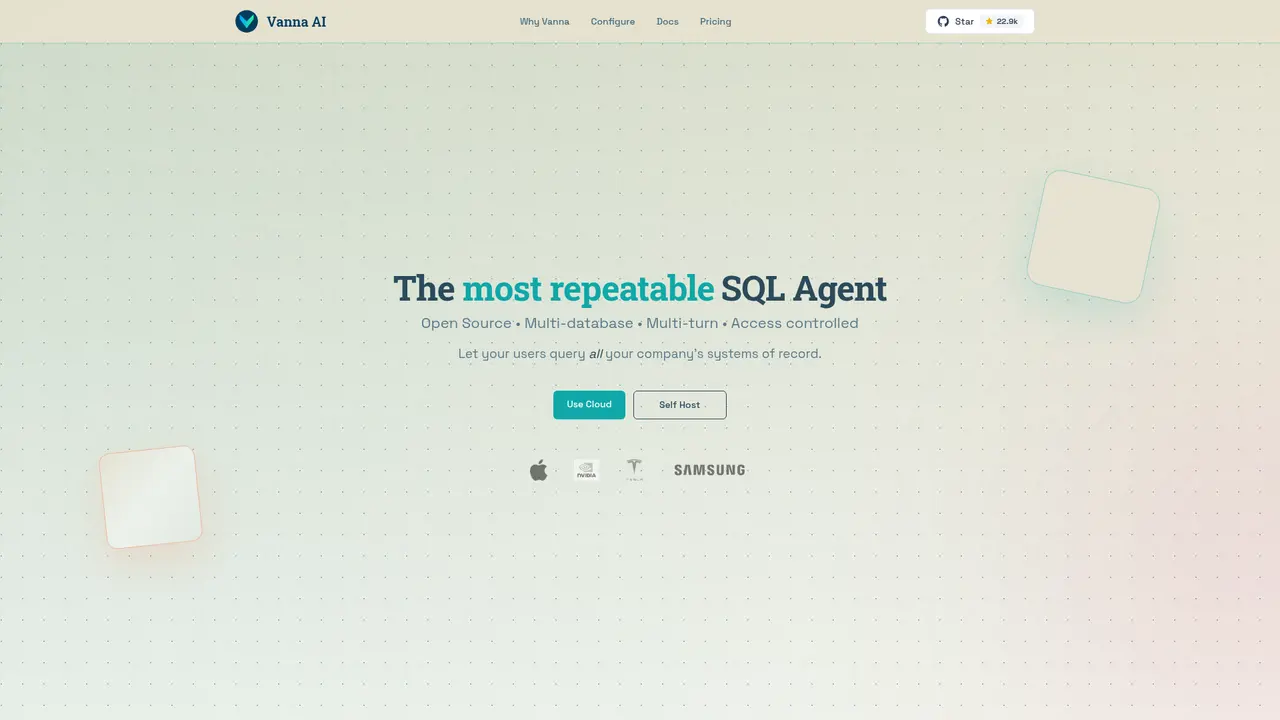
Launched on Feb 18, 2025Vanna AI is an open-source SQL Agent framework that transforms natural language into SQL queries. It connects LLMs with databases, enabling non-technical users to query data independently. The Tool Memory mechanism learns from successful interactions, making the system smarter over time.
What is Vanna AI
The fundamental challenge facing enterprises today is the disconnect between those who understand the data and those who need it. Business analysts, customer service representatives, and department managers frequently require immediate data insights, yet they lack the technical skills to write SQL queries. Traditionally, this gap has been bridged by data teams acting as intermediaries—a process that introduces delays, creates bottlenecks, and diverts skilled analysts from high-value work. Meanwhile, granting direct database access to non-technical users presents significant security risks and makes compliance auditing nearly impossible.
Vanna AI addresses these challenges through an open-source SQL Agent framework that enables non-technical users to query databases using natural language. Built on large language model technology, Vanna acts as an intelligent intermediary between users and your existing data infrastructure. When a user asks "What were our top-selling products last quarter?" in plain English, Vanna's LLM-powered engine understands the intent, generates the appropriate SQL query, executes it against your database, and returns actionable results—all without the user needing to understand database schemas or query syntax.
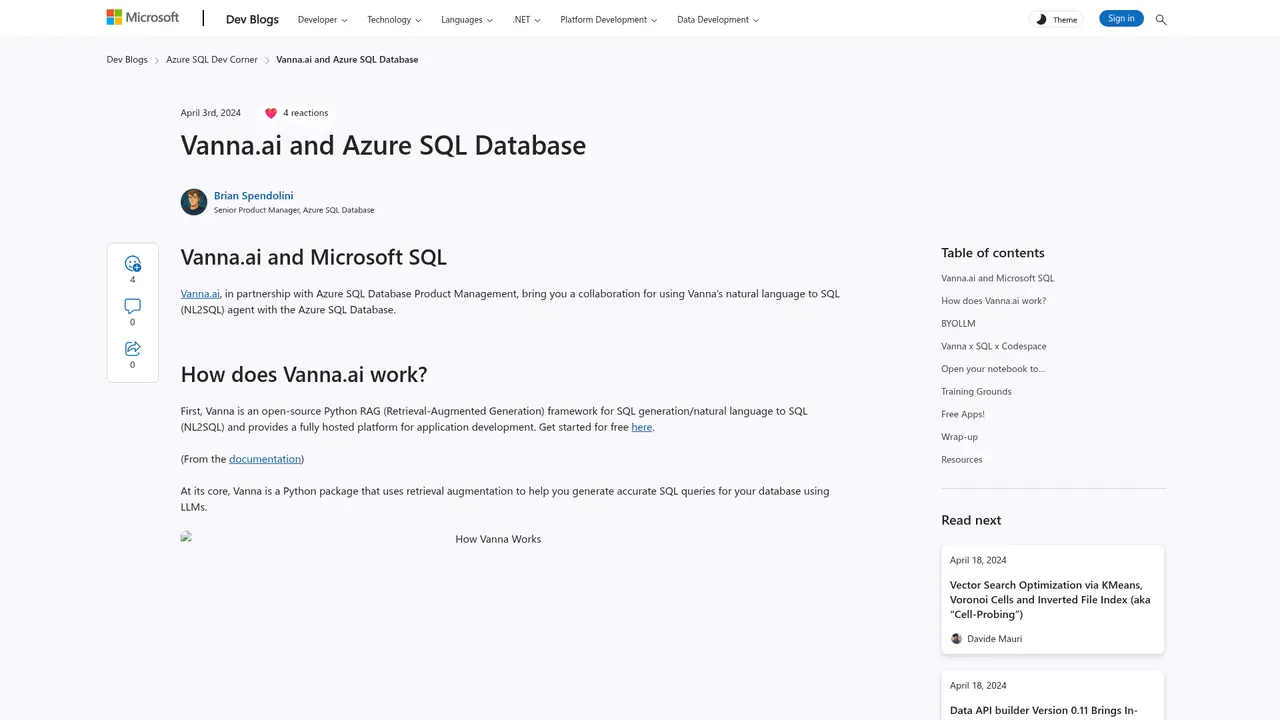
The platform has gained traction among industry leaders, with adoption by companies including Apple, NVIDIA, Tesla, and Samsung. Microsoft has officially integrated Vanna with Azure SQL Database, with Azure's product management team providing direct endorsement. This combination of enterprise adoption and official platform recognition positions Vanna as a trusted solution for organizations seeking to democratize data access while maintaining security and compliance standards.
:::card{type="summary" title="Core Capabilities"}
- Open-source SQL Agent framework enabling natural language-to-SQL conversion
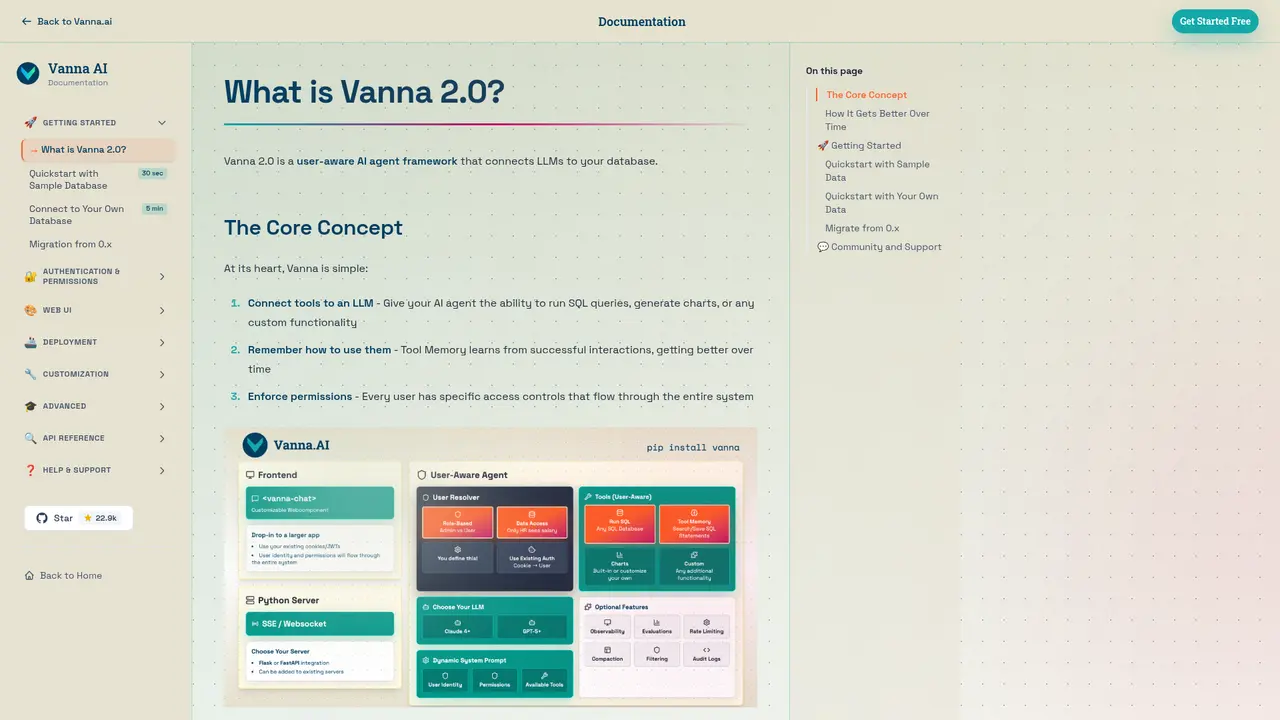
- Tool Memory mechanism that learns from interactions to improve accuracy over time
- Support for major databases including PostgreSQL, MySQL, Snowflake, BigQuery, and SQLite
- Fine-grained access control ensuring data security at the user and role level
- Enterprise deployment options including on-premises and private cloud installations :::
---
Core Features of Vanna AI
Natural Language to SQL Conversion
Vanna's primary capability transforms how users interact with databases. The system leverages large language models to comprehend user intent from natural language queries, then generates precise SQL statements based on your specific database schema. This isn't simple keyword matching—Vanna understands table relationships, column contexts, and business logic to produce accurate queries. Non-technical users gain self-service access to data insights without dependency on data teams, dramatically reducing turnaround time from days or weeks to seconds.
Tool Memory: Continuous Learning Architecture
A distinguishing feature of Vanna is its Tool Memory mechanism. The system employs a vector database to store successful interaction patterns, enabling it to learn from each query. When similar questions arise in the future, Vanna retrieves relevant historical examples, resulting in faster and more accurate responses. This self-improving capability means the system becomes progressively smarter without requiring manual training or model retraining—a significant advantage over static query builders.
Fine-Grained Access Control
Security remains paramount in enterprise data environments. Vanna implements permission flows that propagate throughout the entire system. When generating SQL, the LLM automatically applies appropriate permission filters based on the authenticated user's role and data access rights. This architecture supports multi-department data isolation scenarios common in large organizations, ensuring each user sees only what they're authorized to access.
Multi-Database Support
Vanna provides unified database abstraction supporting SQLite, PostgreSQL, MySQL, Snowflake, BigQuery, and additional database platforms. This flexibility allows organizations with heterogeneous data sources—common in enterprises running ERP, CRM, and financial systems—to create a unified querying layer across all systems.
Multi-LLM Provider Architecture
Organizations can select from multiple language model providers based on their specific requirements: OpenAI (GPT models), Anthropic (Claude), Google Gemini, or Ollama for local on-premises deployment. This choice enables balancing privacy requirements, cost considerations, and performance needs without vendor lock-in.
Observability and Monitoring
The Admin Dashboard provides real-time metrics and distributed tracing capabilities. Operations teams can monitor agent behavior, track query patterns, identify bottlenecks, and optimize performance systematically.
Audit Logging
Complete activity tracking supports compliance requirements in regulated industries such as finance and healthcare. Every query and operation is logged with full attribution, enabling comprehensive audit trails and regulatory reporting.
::::grid :::card{type="advantages"}
- Open-source foundation: Full transparency, self-hosting capability, no vendor lock-in
- Multi-database connectivity: Unified abstraction layer across major SQL databases
- Flexible LLM options: Cloud providers or local deployment via Ollama
- Enterprise-ready: SAML SSO, on-premises deployment, dedicated support
- Continuous improvement: Tool Memory mechanism enhances accuracy over time ::: :::card{type="disadvantages"}
- Database access requirement: Requires read access to target databases
- LLM API dependency: Requires API keys from OpenAI, Anthropic, or Google
- Initial setup complexity: Technical configuration needed for optimal performance
- Query latency: Additional processing time compared to direct SQL execution ::: ::::
---
Who Is Using Vanna AI
Scenario 1: Self-Service Analytics for Non-Technical Employees
Business users often need quick answers to operational questions—"What's our inventory turnover rate?" or "Which customers have overdue payments?" Previously, these requests required submitting tickets to data teams, waiting for prioritization, and accepting delays. With Vanna, business personnel pose questions in natural language and receive immediate results. Data teams benefit from reduced ad-hoc request volume, enabling focus on strategic analysis and complex modeling.
Scenario 2: Cross-System Data Queries
Enterprises typically operate multiple disconnected systems: ERP for supply chain, CRM for customer relationships, financial systems for accounting. Each system maintains its own database, making holistic reporting difficult. Vanna connects to all systems simultaneously, providing a unified query interface. Users asking "Show me revenue by customer region for Q3" receive results that aggregate across all platforms, breaking down data silos.
Scenario 3: Secure Compliant Data Access
Direct database access for business users introduces substantial risk—accidental or intentional data exposure, compliance violations, and audit trail gaps. Vanna acts as a controlled intermediary, returning only permission-filtered results. Financial institutions and healthcare organizations—subject to SOX, HIPAA, and similar regulations—benefit from this security layer while maintaining user productivity.
Scenario 4: Customer Self-Service Portals
Organizations can build dedicated AI agents for customers to query their own data—order status, account balances, appointment history. This reduces customer support ticket volume while improving response times. The agent operates within strict data boundaries, ensuring customers access only their own information.
Scenario 5: Data Analysis Training
New employees often require SQL skills to perform analysis roles. The learning curve can be steep, delaying productive contribution. Vanna enables new team members to begin querying data immediately using natural language, building intuition about data structures before tackling SQL syntax. This approach creates smoother onboarding and faster time-to-productivity.
:::card{type="tip" title="Selection Guidance"} Organizations in regulated industries (finance, healthcare) should prioritize audit logging capabilities when evaluating Vanna. Enterprises with strict data sovereignty requirements should consider the Enterprise deployment option for on-premises or private cloud installations. :::
---
Quick Start
Prerequisites
Before deploying Vanna, ensure you have: a Python environment (3.8 or higher), database connection credentials with read-only access, and an API key from your chosen LLM provider (OpenAI, Anthropic, or Google).
Installation
Install Vanna via pip:
```bash pip install vanna ```
Alternatively, clone the GitHub repository for the latest development version:
```bash git clone https://github.com/vanna-ai/vanna.git cd vanna && pip install -e . ```
Minimal Working Example
The following code demonstrates a complete query workflow:
```python from vanna.openai import OpenAI_Chat from vanna.vannadb import VannaDB_VectorStore import os
Configure your LLM
vn = OpenAI_Chat(api_key=os.environ["OPENAI_API_KEY"], model="gpt-4")
Connect to your database
vn.connect_to_sqlite(" Chinook.sqlite")
Train on your schema
vn.train()
Query using natural language
question = "Which artists have the most albums?" sql = vn.generate_sql(question) results = vn.run_sql(sql)
print(f"Question: {question}") print(f"SQL: {sql}") print(f"Results: {results}") ```
Production Recommendations
For production deployments handling sensitive data, consider running Ollama locally to keep all data within your infrastructure. This approach eliminates external API calls and ensures complete data privacy. When deploying for multiple users, configure fine-grained access controls from the outset to establish proper permission boundaries.
:::card{type="tip" title="Best Practices"} Production environments handling sensitive data should leverage Ollama for local LLM deployment. This ensures data never leaves your infrastructure while maintaining natural language query capabilities. :::
---
Vanna AI Pricing
Vanna's pricing philosophy provides an open-source foundation with paid enhancements for enterprise requirements. This structure enables individual developers to explore the platform freely while supporting organizational scale.
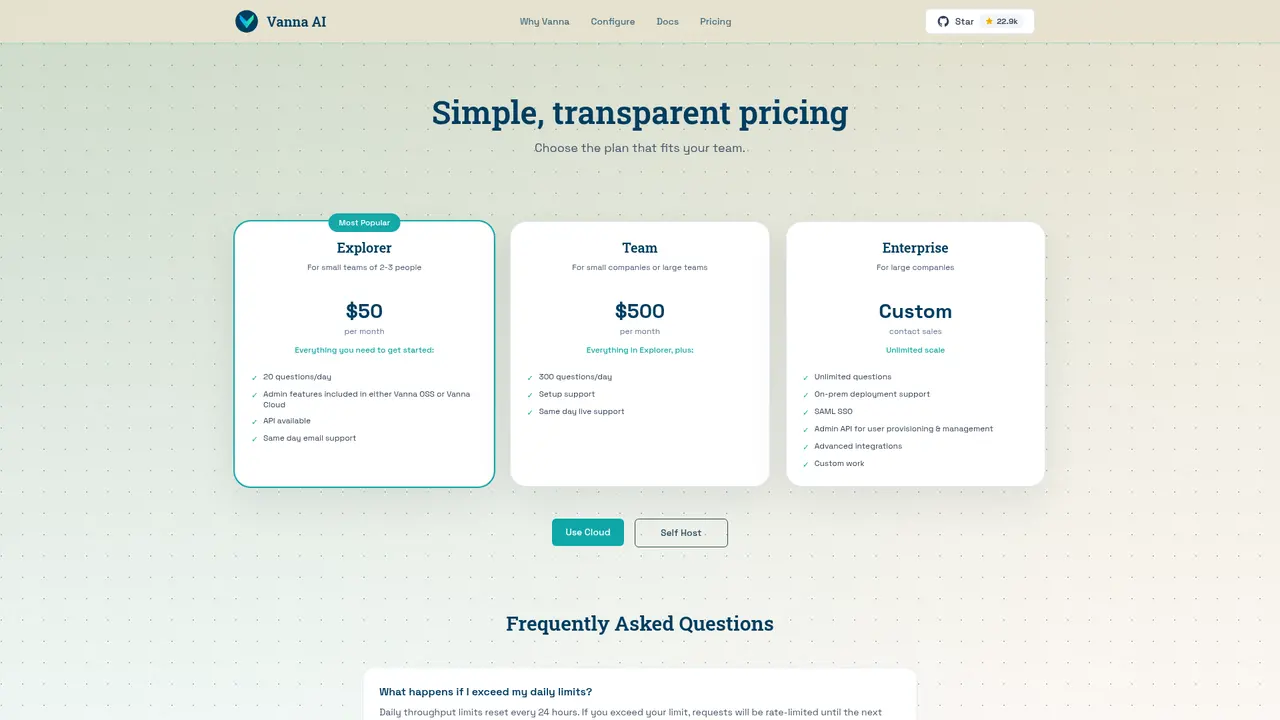
| Plan | Price | Daily Queries | Key Features | Target Users | |------|-------|---------------|--------------|--------------| | Explorer | $50/month | 20 questions/day | Core SQL Agent, Email support, Community access | Individual developers, small projects | | Team | $500/month | 300 questions/day | Priority processing, Team management, Slack support | Growing teams, departmental deployment | | Enterprise | Custom | Unlimited | SAML SSO, On-premises deployment, Dedicated support, SLA guarantees | Large organizations, regulated industries |
Plan Details
Explorer ($50/month): Designed for individual exploration and small-scale implementations. Includes the core SQL Agent functionality, access to community support channels, and email assistance. Suitable for evaluating the platform's fit for your use case.
Team ($500/month): Supports team collaboration with higher query limits and priority processing. Includes team management features, direct Slack support for faster issue resolution, and expanded storage for Tool Memory.
Enterprise (Custom): Tailored to large organizations requiring unlimited queries, SAML Single Sign-On for enterprise identity management, on-premises or private cloud deployment options, dedicated support representatives, and service level agreements. Pricing depends on deployment complexity, SLA requirements, and support tier.
Annual Discount
All paid plans offer a 20% discount for annual billing. Switch to annual payment during checkout or contact the sales team to apply the discount to your account.
Upgrade Path
All Vanna tiers share the same core framework, enabling seamless upgrades without code modifications. Organizations can begin with Explorer and progress to Team or Enterprise as requirements evolve.
:::card{type="tip" title="Migration Guidance"} Existing open-source deployments can upgrade to any paid tier without rewriting integration code. The same Vanna core powers all plans, ensuring compatibility as your requirements grow. :::
---
Frequently Asked Questions
:::card{type="faq" title="What happens when I exceed my daily query limit?"} Daily limits reset every 24 hours. When exceeded, queries are rate-limited until the next reset period. You can upgrade your plan at any time to increase limits. :::
:::card{type="faq" title="Can I upgrade from the open-source version to a paid plan?"} Yes. All plans share the same core framework, enabling seamless migration to paid tiers without code changes. Simply upgrade your account to access additional features and higher limits. :::
:::card{type="faq" title="How is Enterprise pricing determined?"} Enterprise pricing is customized based on your deployment requirements: infrastructure type (on-premises, VPC, private cloud), SLA guarantees, support level, and user count. Contact the sales team for a tailored quote. :::
:::card{type="faq" title="Is annual billing available with discounts?"} Yes, annual billing provides a 20% discount across all paid plans. Select annual payment during checkout or reach out to sales to apply this to your account. :::
:::card{type="faq" title="Which LLM providers does Vanna support?"} Vanna supports Anthropic (Claude), OpenAI (GPT), Google Gemini, and Ollama for local on-premises deployment. Each provider offers different capabilities for privacy, cost, and performance optimization. :::
:::card{type="faq" title="Which databases are compatible with Vanna?"} Vanna supports major SQL databases including PostgreSQL, MySQL, Snowflake, BigQuery, and SQLite. Additional database support is continuously expanding through community contributions. :::
---
Additional Resources
- Documentation: https://vanna.ai/docs
- GitHub Repository: https://github.com/vanna-ai/vanna
- Pricing Details: https://vanna.ai/pricing
- Support: support@vanna.ai
Related Content
Copy.ai Review 2026: AI Copywriting Made Easy
Our honest Copy.ai review for 2026. We test Content Agents, AI Workflows, pricing ($29-$249/mo), and compare it to Jasper and Writesonic. Find out if it's worth it for your marketing team.

Rytr Review 2026: Is This Budget AI Writer Worth It?
Our hands-on Rytr review for 2026. We test features, pricing, content quality, and compare it to Jasper & ChatGPT. Find out if Rytr is the best budget AI writing tool.

Word Changer - Free AI tool to rewrite and improve your writing instantly
Writing always using repetitive words or need to avoid plagiarism? Word Changer is a free AI writing assistant that instantly rewrites any text with richer vocabulary and appropriate tone. Get multiple versions with one click, adjust formality level, check readability - all for free!

Unite - AI-powered platform for romantic fantasies and dream couple moments
Explore romantic fantasies and create special moments for your dream couple. This AI-powered platform lets you generate personalized romantic content and experience exclusive AI-created romantic experiences.
Comments