


Ocular AI - Unified Multimodal Data Platform for Enterprise AI Development
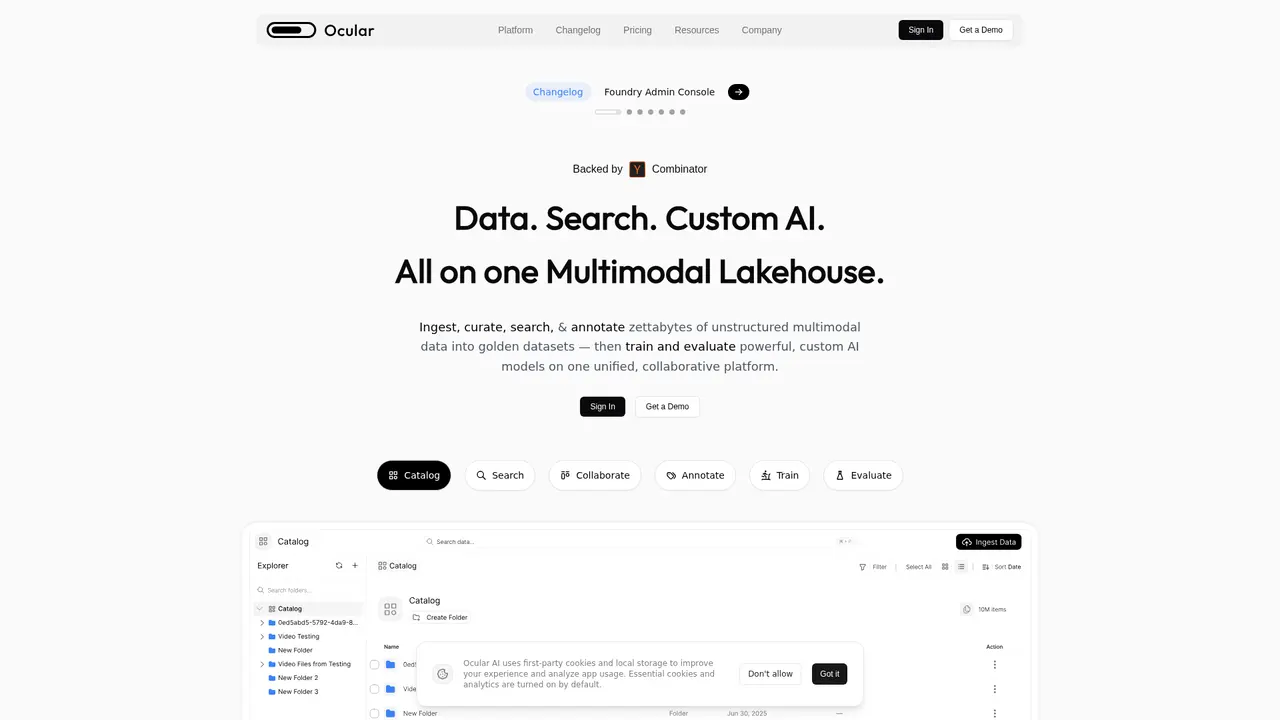
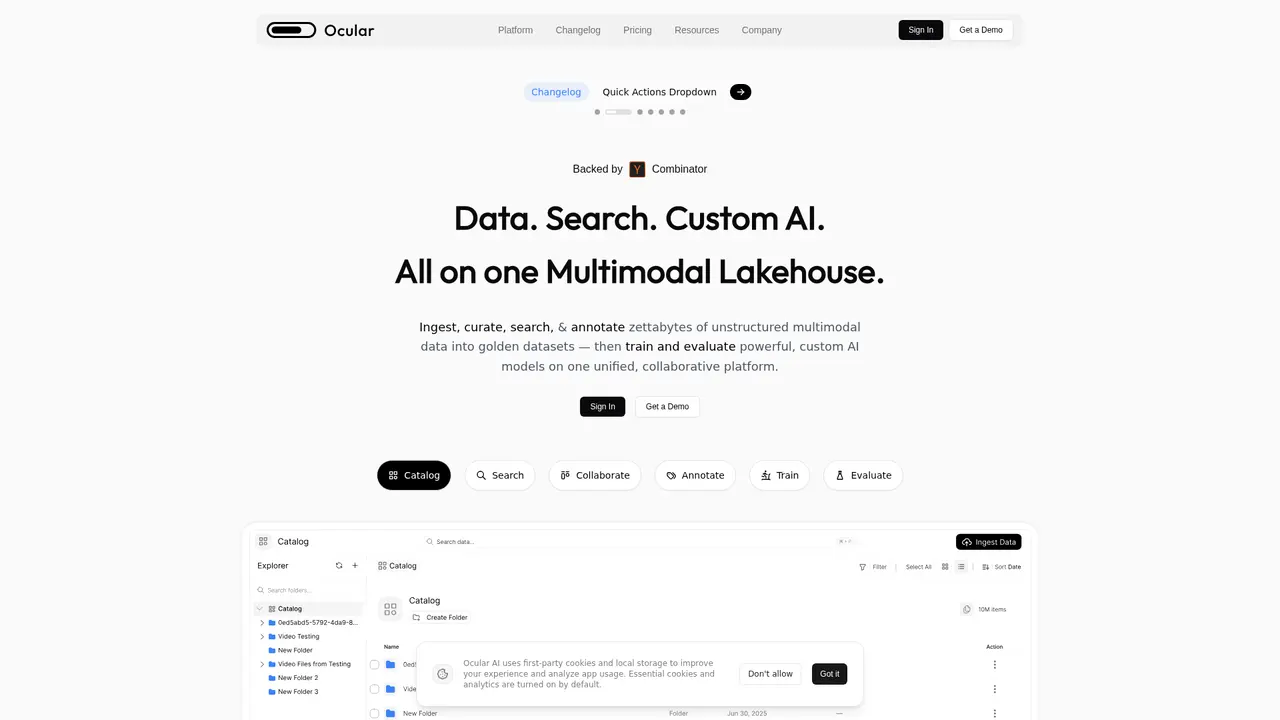
Launched on Feb 23, 2025Ocular AI is an enterprise-grade AI data infrastructure platform that unifies multimodal data storage, annotation, and model training into a single end-to-end solution. The platform processes zettabytes of unstructured video, image, and audio data with advanced vector search and AI-powered labeling. Using SAM 2 and agentic labeling, teams efficiently prepare training data, while managed GPU clusters enable custom model development. Enterprise security includes SOC 2 compliance and HIPAA support.
What is Ocular AI
AI and machine learning teams face a fundamental challenge in modern enterprise environments: the proliferation of multimodal data across disparate storage systems creates significant operational friction. Video files, images, and audio recordings typically reside in isolated cloud storage buckets, local drives, and data lakes, making unified management and discovery nearly impossible. Traditional keyword-based search engines cannot comprehend the semantic content within these unstructured assets, forcing teams to rely on manual tagging and folder organization—approaches that scale poorly and introduce inconsistencies.
Ocular AI addresses this challenge as an enterprise-grade multimodal data infrastructure platform that spans the entire AI development lifecycle. Unlike point solutions that focus on individual stages of the machine learning pipeline, Ocular provides an end-to-end solution encompassing data ingestion, annotation, management, model training, and evaluation. This unified approach eliminates the data silos that impede AI development velocity and ensures consistency across the entire workflow.
The platform's core technology stack centers on three interconnected capabilities. First, the Multimodal Lakehouse serves as a unified storage layer capable of handling zettabytes of unstructured data—video, images, and audio—while maintaining organizational clarity through data catalogs and lineage tracking. Second, the intelligent annotation system leverages SAM 2 (Segment Anything Model 2) for automated segmentation and agentic labeling workflows that dramatically reduce human annotation costs while maintaining quality through human-in-the-loop validation. Third, the managed GPU training infrastructure enables organizations to train custom models directly on their data without migration, supporting popular frameworks including PyTorch and TensorFlow.
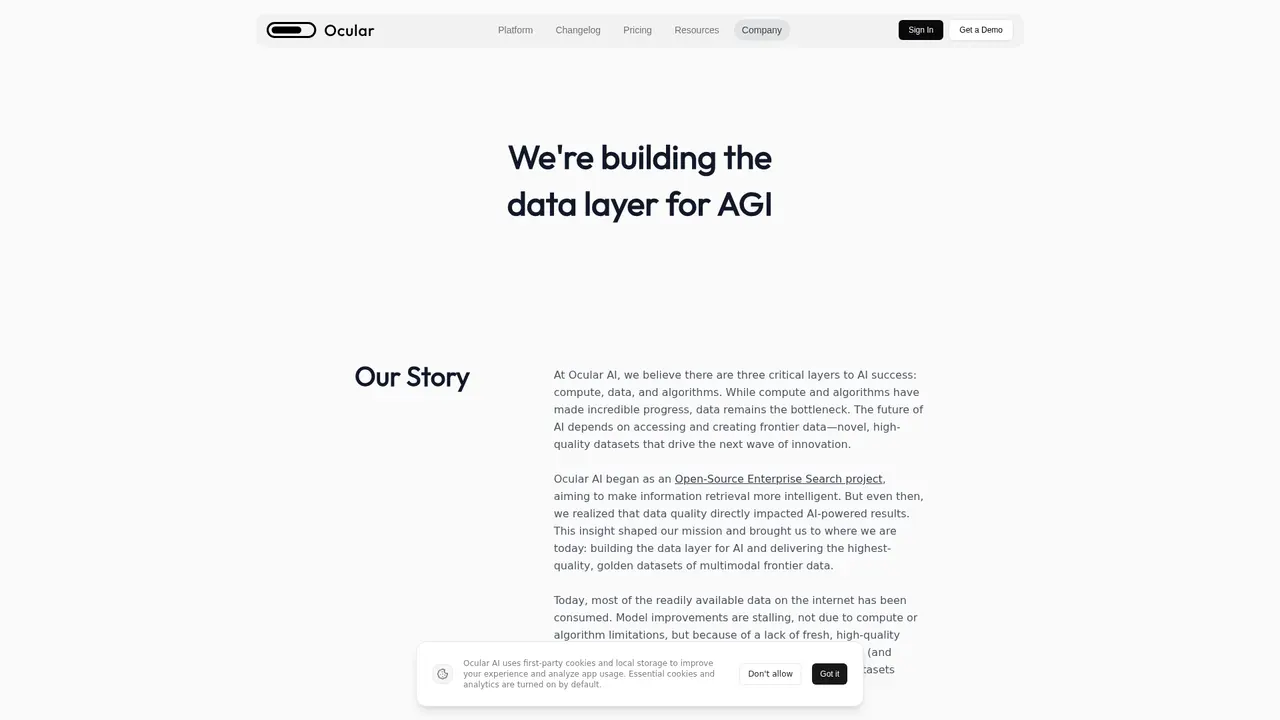
The company's positioning reflects substantial market validation. As a Y Combinator-backed startup with headquarters at 128 King Street in San Francisco, Ocular AI serves engineers at leading global AI and software companies. The founding team brings enterprise software expertise from Microsoft and Google, and the company has attracted investment from prominent venture capital firms including BDMI Fund, Orange Collective, and myAsiaVC, alongside angel investors with track records at Stripe, Airbnb, DoorDash, Coinbase, Twitch, and Cruise.
:::card{type="summary" title="Core Capabilities"}
- Multimodal Lakehouse: Unified storage for video, images, and audio supporting zettabyte-scale data with catalog and lineage tracking
- Intelligent Annotation: SAM 2-powered segmentation with agentic labeling and human-in-the-loop validation across 150+ annotation task types
- Model Training: Managed GPU clusters enabling in-place training with PyTorch and TensorFlow integration :::
---
Core Features of Ocular AI
The platform delivers substantial technical capabilities across six primary feature areas, each designed to address specific pain points in the AI development workflow.
Multimodal Lakehouse provides unified data storage that eliminates fragmentation across cloud providers. The architecture supports zettabyte-scale volumes of video, images, and audio files while maintaining accessibility through REST APIs and a visual data catalog. Data lineage tracking enables teams to understand the provenance of each asset throughout its lifecycle, supporting compliance requirements and debugging workflows. This unified approach replaces multiple disconnected storage solutions with a single source of truth for multimodal data.
Multimodal Search transforms how teams discover content within their data repositories. Rather than relying on manual tags or filename conventions, users can issue natural language queries such as "a person walking a dog in a city park" and receive relevant matches across video, images, and audio. The system employs NLP combined with multimodal vector embeddings to understand semantic content, returning results with confidence scores that can be filtered using thresholds ranging from 50% to 100%. This capability proves particularly valuable when searching large video libraries for specific events or activities that would be impractical to locate manually.
Data Annotation combines artificial intelligence with human expertise to produce high-quality labeled datasets at scale. The platform integrates SAM 2 for intelligent segmentation, enabling automatic object identification that dramatically accelerates the annotation process. Agentic labeling workflows leverage state-of-the-art models to pre-annotate data, which human reviewers then validate and refine—a approach that reduces annotation costs while maintaining accuracy. The system supports over 150 annotation task types including classification, detection, segmentation, and keypoint annotation, making it suitable for diverse computer vision and audio processing applications.
Dataset Versioning addresses the critical need for reproducibility in machine learning experiments. Teams can track version history for datasets, compare versions side-by-side, and manage exports for training, validation, and testing splits. This capability ensures that experimental results can be reproduced and provides audit trails for production machine learning systems.
Model Training provides managed GPU infrastructure that enables organizations to train custom models without building and maintaining their own ML infrastructure. The platform supports in-place training, meaning data remains in the customer's existing storage while the training process executes on Ocular's GPU clusters. Integration with PyTorch and TensorFlow allows teams to leverage familiar frameworks, while built-in metric tracking monitors precision, recall, mAP50, and mAP50-95 during training runs.
Model Evaluation offers an interactive playground where teams can test and compare model performance on their own data. The evaluation interface supports side-by-side model comparison with visualized performance metrics, enabling data scientists to make informed decisions about which model versions meet their accuracy requirements before deployment.
::::grid :::card{type="advantages"}
- End-to-end workflow: Single platform covering data storage, annotation, training, and evaluation eliminates tool fragmentation
- Superior performance metrics: Training results achieve Precision 0.91, Recall 0.87, mAP50 0.84, mAP50-95 0.55 on standard benchmarks
- Extensive ecosystem integration: Native support for PyTorch, TensorFlow, Weights & Biases, AWS, GCP, Azure, Snowflake, and Databricks
- Scale-out architecture: Supports zettabyte-scale data volumes with enterprise-grade reliability ::: :::card{type="disadvantages"}
- Pricing transparency: All tiers require contacting sales for quotes, making cost comparison challenging during evaluation
- Learning curve: Comprehensive feature set requires onboarding investment for teams new to multimodal ML workflows ::: ::::
---
Technical Architecture and Performance
The platform's architecture reflects enterprise requirements for security, scalability, and integration flexibility. Ocular AI deploys on Microsoft Azure infrastructure, leveraging Azure's global network and security capabilities while maintaining compatibility with customer data stored across multiple cloud providers.
Infrastructure Layer supports customer data residing in existing storage systems including AWS S3, Google Cloud Storage, Azure Blob Storage, Snowflake, Databricks, or on-premises solutions. This federated approach ensures data sovereignty—organizations retain full control over their data location while gaining access to Ocular's processing and training capabilities. The platform does not require data migration, which eliminates a significant barrier to adoption for data-heavy enterprises.
Data Processing Engine handles natural language understanding and multimodal vector embedding generation at scale. The system can process zettabytes of unstructured data, indexing content to enable semantic search without requiring manual metadata entry. Vector embeddings capture semantic meaning, enabling queries to match conceptually similar content even when explicit keywords differ.
Intelligent Annotation Pipeline implements a hybrid approach combining automated intelligence with human oversight. SAM 2 provides state-of-the-art segmentation capabilities that identify and outline objects within images and video frames. The agentic labeling system leverages additional foundation models to generate initial annotations across classification, detection, and recognition tasks. Human annotators then review, correct, and approve automated outputs, achieving higher throughput than manual-only approaches while maintaining quality standards.
Training Infrastructure provides managed GPU clusters accessible via the platform's training interface. The system supports popular model architectures including YOLO for object detection and can accommodate custom model definitions. Training jobs execute with configurable batch sizes, image dimensions, and epoch counts—the documentation shows example configurations such as YOLO_11 nano with batch size 1.6k, image size 640, and 20 epochs. Built-in metric tracking captures precision, recall, mAP50, and mAP50-95 values throughout the training process.
MLOps Integration connects with industry-standard tools to fit within existing machine learning workflows. Weights & Biases integration enables experiment tracking and visualization, while Python SDK and REST API access allow programmatic interaction with all platform capabilities. Support for Linear and Slack integrations facilitates team collaboration and workflow notifications.
:::card{type="tip" title="Implementation Best Practice"} Organizations implementing Ocular AI should begin with data catalog organization and metadata enrichment before enabling automated annotation features. This sequencing ensures that the intelligent labeling system has sufficient context to generate accurate pre-annotations, maximizing the efficiency gains from SAM 2 and agentic labeling capabilities. Model training features can then leverage the well-organized, high-quality datasets to produce superior results. :::
---
Ecosystem and Integrations
Modern AI development rarely occurs in isolation—teams leverage diverse tools across the machine learning lifecycle, and platform selection must account for integration requirements. Ocular AI provides comprehensive connectivity options that position it as a flexible component within existing technology ecosystems.
Developer Experience centers on the ocular Python SDK, which provides programmatic access to all platform capabilities. The SDK follows Python conventions and integrates naturally with data science workflows. For systems requiring HTTP-based integration, the REST API at api.useocular.com exposes equivalent functionality including search, export, and project management operations. Documentation at docs.useocular.com provides guidance for common integration scenarios.
Framework Support covers the dominant deep learning frameworks used in production ML systems. PyTorch integration enables teams to leverage PyTorch's flexibility for custom model architectures and training loops. TensorFlow support provides equivalent capabilities for organizations standardizing on Google's framework. Both frameworks can access data directly from Ocular's lakehouse without additional data movement.
MLOps Tooling extends beyond training into experiment tracking and model management. Weights & Biases integration connects Ocular's training outputs with centralized experiment tracking, enabling teams to compare runs, visualize metrics, and collaborate on model development. This integration ensures that insights generated within Ocular flow into broader MLOps practices.
Cloud Storage Connectivity enables the platform to work with data wherever it resides. Native connectors support AWS S3, Google Cloud Storage, Azure Blob Storage, Snowflake, and Databricks. This multi-cloud approach prevents vendor lock-in and accommodates enterprises with data distributed across multiple providers. Local storage integration extends support to on-premises deployments for organizations with data residency requirements.
Collaboration Tools recognize that AI development involves cross-functional teams. Linear integration connects Ocular projects with issue tracking workflows, while Slack notifications keep teams informed of annotation completions, training job status, and other relevant events. The community ecosystem includes an active Slack community and Discourse forum where users exchange best practices and troubleshoot challenges.
::::grid :::card{type="advantages"}
- Multi-cloud flexibility: Native connectors for AWS, GCP, Azure, Snowflake, Databricks, and on-premises storage
- Developer-first SDK: Python-native API design that integrates naturally with data science workflows
- Established community: Active Slack and Discourse communities with responsive peer support
- Open source presence: GitHub repository demonstrates commitment to transparency and community contribution ::: :::card{type="disadvantages"}
- Limited self-service: No public pricing page requires sales engagement for basic evaluation
- Emerging ecosystem: While core integrations are solid, some niche tools may require custom integration work ::: ::::
---
Use Cases for Ocular AI
The platform's comprehensive capabilities address diverse industry requirements across sectors where multimodal data drives competitive advantage.
Autonomous Vehicle Development represents a primary use case where the platform delivers substantial value. Self-driving research generates massive volumes of high-resolution imagery and video from fleet vehicles, with data typically scattered across multiple cloud storage accounts and on-premises systems. Ocular's Multimodal Lakehouse provides unified storage capable of handling zettabyte-scale datasets, while the Data Catalog enables teams to organize and visualize data assets systematically. The Multimodal Search capability allows engineers to locate specific traffic scenarios—"pedestrian crossing at intersection," "vehicle merging onto highway," or "construction zone navigation"—using natural language queries rather than manually scanning hours of footage. This dramatically accelerates the data discovery process that precedes model training and evaluation.
Multimodal Training Data Annotation addresses the labor-intensive process of preparing datasets for computer vision and audio ML models. Traditional manual annotation approaches struggle with the scale of video data required for production ML systems. Ocular's Agentic Labeling system leverages SAM 2 and additional foundation models to generate initial segmentations and classifications, which human annotators then validate and refine. The Project Management interface tracks progress across annotation batches, while Dataset Versioning maintains clear histories of dataset evolution. Organizations implementing this workflow report significant reductions in annotation costs and timelines compared to manual-only approaches.
Custom Model Training and Evaluation serves teams building proprietary models on proprietary data. Rather than investing in GPU infrastructure and MLOps tooling, organizations can leverage Ocular's managed training clusters to execute training jobs directly on their data. The in-place training approach eliminates data movement, reducing both latency and security concerns. The Evaluation Playground provides interactive testing where data scientists can compare model versions, visualize performance metrics, and make evidence-based decisions about which models meet production requirements.
Medical Imaging AI presents specialized requirements where domain expertise is essential. Medical scans require interpretation by trained radiologists and specialists—general crowdsourced annotation cannot meet quality standards for clinical applications. Ocular Bolt addresses this need by connecting organizations with domain experts including physicians, who provide expert-level annotations and feedback for model alignment. This capability enables healthcare AI developers to produce models that meet clinical accuracy standards and regulatory requirements.
Enterprise Search Intelligence transforms internal knowledge management for organizations with large video, image, and audio repositories. Traditional keyword search fails to understand content, requiring manual tagging that quickly becomes outdated. Ocular's multimodal vector search enables employees to find relevant content using natural language queries without requiring consistent metadata across the organization's data assets. This capability applies across industries—from media companies searching footage archives to manufacturing firms locating product defect images.
:::card{type="tip" title="Selecting the Right Modules"} Organizations new to Ocular should evaluate their primary pain point: data discovery challenges suggest starting with Multimodal Lakehouse and Search, while annotation bottlenecks indicate priority for Data Annotation and Project Management. Teams ready for model training should leverage the full pipeline from Dataset Versioning through Model Evaluation to production deployment. :::
---
Frequently Asked Questions
:::card{type="faq" title="How does Ocular AI differ from other data annotation platforms?"} Ocular AI provides an end-to-end platform spanning the complete AI development lifecycle, from data storage and ingestion through annotation, training, and evaluation. Most competing solutions focus on individual stages—such as annotation-only tools—requiring organizations to stitch together multiple products. This fragmentation introduces integration overhead, data consistency challenges, and vendor management complexity. Ocular's unified architecture eliminates these friction points while providing native integration across workflow stages. :::
:::card{type="faq" title="What types of data does the platform support?"} The platform handles unstructured multimodal data including video files, images, and audio recordings. The architecture scales to zettabyte-scale volumes, accommodating the data requirements of enterprise AI initiatives. Support extends across common video formats, image encodings, and audio codecs used in production machine learning applications. :::
:::card{type="faq" title="Where is data stored?"} Ocular does not require data migration. The platform connects to data residing in customer-controlled infrastructure including AWS S3, Google Cloud Storage, Azure Blob Storage, Snowflake, Databricks, and on-premises storage systems. This federated approach ensures data sovereignty and eliminates the security and compliance concerns associated with moving large datasets to new providers. :::
:::card{type="faq" title="How does Ocular ensure data security?"} The platform implements enterprise-grade security measures including SOC 2 compliance (currently in audit status with Vanta), HIPAA compliance for Enterprise tier customers, role-based access control (RBAC), and comprehensive data privacy protections. Infrastructure runs on Microsoft Azure, leveraging Azure's security certifications and global security operations. The platform maintains formal security policies, incident response procedures, and undergoes regular security audits. :::
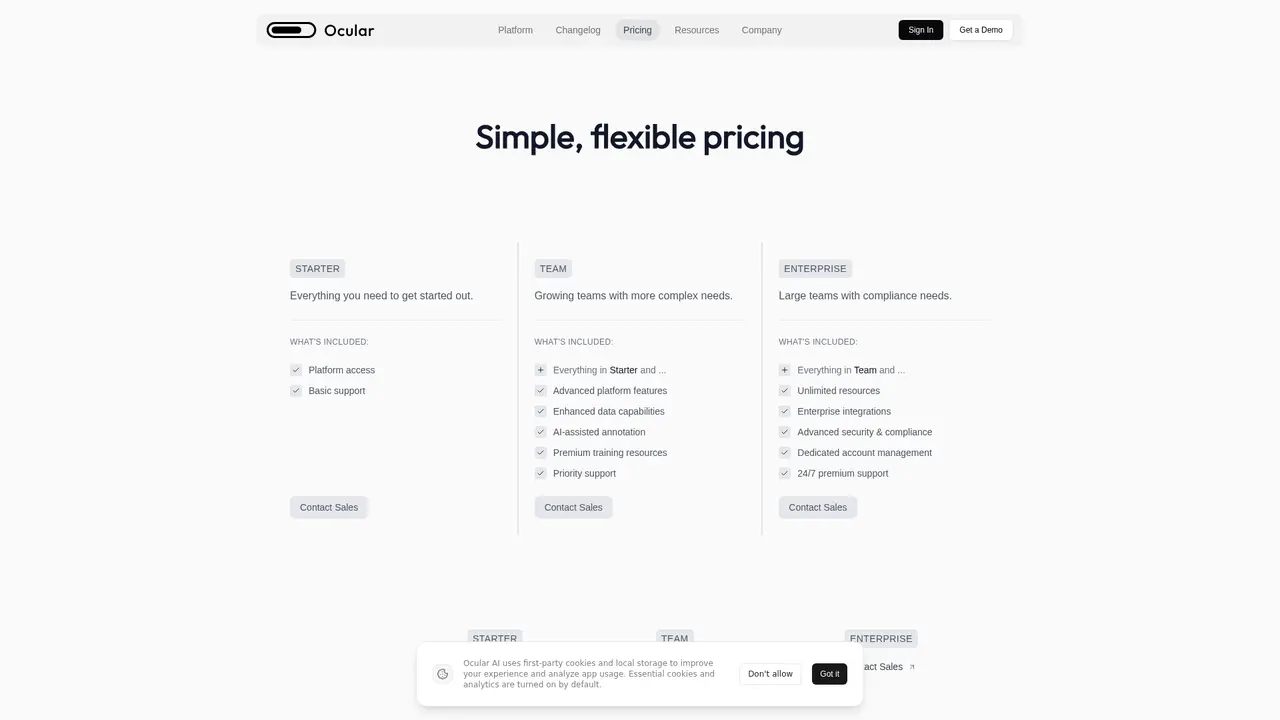
:::card{type="faq" title="What is the pricing structure?"} Ocular offers three pricing tiers: Starter (basic platform access with standard support), Team (advanced features with enhanced data capabilities, AI-assisted annotation, and priority support), and Enterprise (unlimited resources, enterprise integrations, advanced security compliance, dedicated account manager, and 24/7 premium support). All tiers require contacting the sales team for custom quotes based on organizational requirements. :::
:::card{type="faq" title="Does the platform support custom model training?"} Yes, Ocular provides managed GPU clusters that enable organizations to train custom models on their own data. The platform supports popular architectures including YOLO for object detection and accepts custom model definitions. Teams can upload pre-trained weights and download trained model weights for deployment. Integration with PyTorch and TensorFlow enables flexibility in model architecture and training configuration. :::
:::card{type="faq" title="How does Ocular integrate with existing toolchains?"} The platform offers multiple integration pathways: the ocular Python SDK provides Python-native access to all capabilities, REST APIs enable HTTP-based integration with any programming language or system, and native integrations connect with PyTorch, TensorFlow, Weights & Biases, Linear, and Slack. Cloud storage connectors enable data access from AWS, GCP, Azure, Snowflake, and Databricks without data movement. :::
Related Content
Copy.ai Review 2026: AI Copywriting Made Easy
Our honest Copy.ai review for 2026. We test Content Agents, AI Workflows, pricing ($29-$249/mo), and compare it to Jasper and Writesonic. Find out if it's worth it for your marketing team.

Rytr Review 2026: Is This Budget AI Writer Worth It?
Our hands-on Rytr review for 2026. We test features, pricing, content quality, and compare it to Jasper & ChatGPT. Find out if Rytr is the best budget AI writing tool.

Word Changer - Free AI tool to rewrite and improve your writing instantly
Writing always using repetitive words or need to avoid plagiarism? Word Changer is a free AI writing assistant that instantly rewrites any text with richer vocabulary and appropriate tone. Get multiple versions with one click, adjust formality level, check readability - all for free!

Unite - AI-powered platform for romantic fantasies and dream couple moments
Explore romantic fantasies and create special moments for your dream couple. This AI-powered platform lets you generate personalized romantic content and experience exclusive AI-created romantic experiences.
Comments