


SeeVid - AI video generation with producer-grade templates and controls
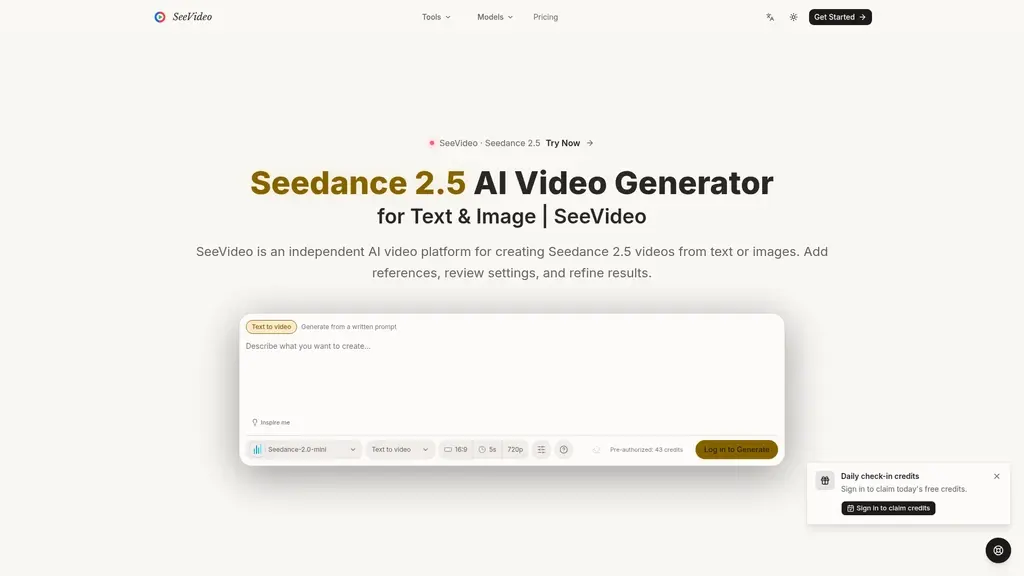
Launched on Aug 20, 2026SeeVid brings the Seedance 2.5 model into a workspace built for video creators. Start from a proven template or write your own scene brief, add image video or audio references, and generate edit extend or connect frames up to 30 seconds per request. Choose from Seedance 2.0 Standard Fast Mini or the flagship 2.5 for narratives and editing. Flexible credit-based pricing keeps production predictable without subscription lock-in.
What is SeeVid
You've probably felt it — you type what feels like a careful prompt into an AI video tool, hit generate, and get back a clip that has nothing to do with what you had in your head. The movement is wrong, the framing is off, or the scene just drifts with no purpose. So you iterate. And iterate. Each attempt burns credits and minutes, and by the time you get something usable, the creative spark has long faded.
That's the everyday reality of AI video creation — until now. SeeVid is a video generation workspace built to remove the guesswork. Instead of starting from a blank prompt and hoping for the best, you begin with a proven direction. The platform ships with a template library of 16 working video concepts — from POV Perfume Unbox and UGC Skincare Hook to Faceless Productivity and Nature Documentary. Each template lets you hover to preview a fixed example of the result, so you know exactly what success looks like before you commit. Then, with a single click, the template's full prompt and its image, video, or audio references load straight into the generator. No copy-pasting prompts by hand. No second-guessing your direction.
Under the hood, SeeVid is powered by the Seedance 2.5 model from ByteDance Seed — an audio-video joint generation engine capable of producing clips up to 30 seconds in a single request. That's a full mini-narrative, not just a five-second loop. And when a smaller, faster job fits better, you can switch to Seedance 2.0 Standard, Fast, or Mini for different resolutions and iteration speeds.
The workspace stacks three things together: proven templates, reference-aware generation, and full editing and extension workflows. It's a complete production loop, not just a prompt box.
One-click template loading: start from 16 proven video directions instead of a blank prompt
Reference-facing generation: guide the output with image, video, and audio assets
Flexible credit-based pricing: only pay for what you actually produce
SeeVid's Template Library: Start With a Working Direction
The hardest part of AI video isn't the tool — it's deciding on a direction and writing a prompt that actually works. Most creators freeze at exactly that point. SeeVid's template library removes that barrier entirely.
Hover to see success before you generate. Every template in the library comes with a fixed example. Hover over any card and you'll preview what the intended result looks like — the pacing, the look, the movement. This is your north star. You're not guessing what a prompt will produce; you're seeing a target outcome and deciding whether it's the right direction for your project.
One click loads everything. When a template matches your vision, one click pulls the complete prompt — plus any image, video, or audio references it uses — into the generator. The prompt is written, the references are attached, and the model settings are pre-configured. You can immediately generate, then customize from there.
The 16 templates break down into several categories, each pairing a proven model with the right generation type:
Category | Templates |
|---|---|
Text to video | POV Perfume Unbox, UGC Skincare Hook, POV Food Overhead, Faceless Productivity, GRWM Leave Home, Rainy-window pan |
First-frame generation | ASMR Serum Pour, Movie Trailer, Luxury Watch Orbit |
First and last frame | Nature Documentary, Room Before After |
Multimodal references | Art Creation |
Video edit | Mech Battle, Product Rebrand Grade |
Notice that each template isn't just a random concept — it's tied to a specific generation type and model (Mini, 2.0, 2.5, or Fast) that suits the job. A Faceless Productivity clip runs on Text to video Mini 5s, while a Movie Trailer leverages First-frame generation 2.5 5s for cinematic storytelling control.
Pick the template whose look is closest to what you're aiming for, then swap in your own subject and action. You keep the proven structure and pacing while making it yours — far easier than building a prompt from scratch.
Core Features of Seedance 2.5 in SeeVid
What sets Seedance 2.5 apart isn't a list of specs — it's what those specs let you actually accomplish. Here's what each production capability means for your workflow.
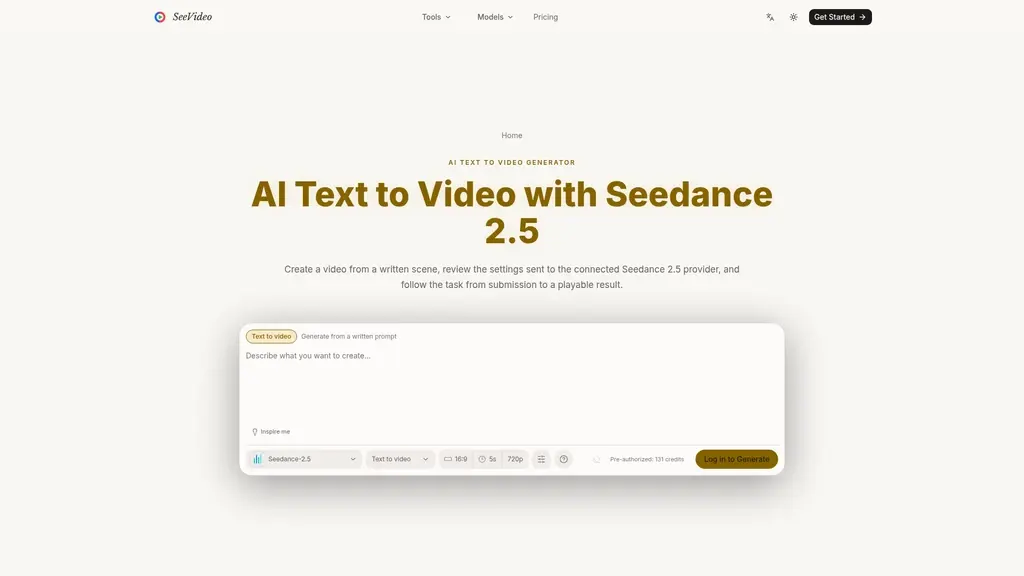
Text to video — you can use it to turn a clear scene brief into a real clip. Name the subject, the action, the setting, the time of day, and the camera move, and the model builds around it. A short, concrete prompt is far easier to revise later than a paragraph trying to describe every possibility at once. Something like "a courier runs through a wet market, handheld camera follows from behind, morning vendors call out" gives the model a visible action and an audible setting without unrelated adjectives.
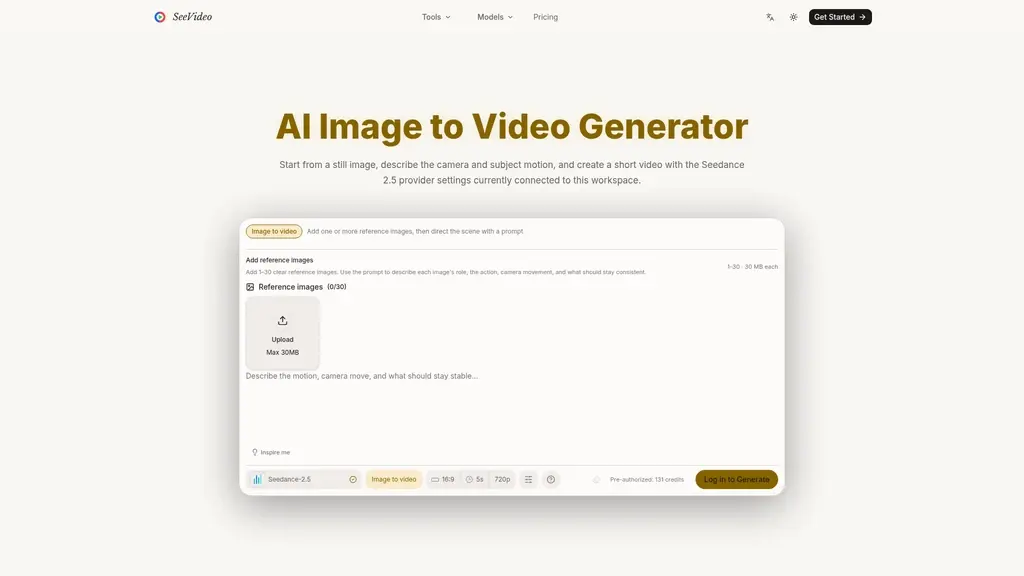
Image to video — you can use it to carry an approved still into motion. If the opening look matters — a product shot, a character pose, a specific visual style — an image sets the starting point, and you simply describe what should move, what stays stable, and how the camera travels through the shot.
Reference control — you can use it to guide the result the way a director guides a shoot. Each asset type has a distinct job: image for appearance, video for pacing or composition, and audio for sound direction. Seedance 2.5 reads reference videos more precisely than earlier models, understanding intent, framing, and cinematic language rather than just copying a pose.
Audio-video joint generation — you can use it to design sound together with visuals instead of treating it as an afterthought. When sound matters, describe the environment and timing in your prompt, then review the output as a whole — dialogue, music, and effects all work in concert.
30-second storytelling — you can use it to tell a small story in a single generation. Thirty seconds is enough for a complete arc: establish where the viewer is, show the change or action, then land on one deliberate closing beat. When you need more, two extension opportunities let you continue the sequence.
Editing and extension — you can use it to change only one part of an existing clip (edit) or add another beat to the ending (extend) — without regenerating the whole video. Frame-based operations help when the opening or ending image matters most.
30-second narrative generation: tell a complete mini-story in one request, not just short clips
Reference-aware editing: more precise reading of video references for intent, framing, and cinematic feel
Joint audio-video output: sound is designed with the visuals, not bolted on afterward
Generation time varies: processing depends on your request and queue position, so turnaround isn't always instant
Some limits are provider-dependent: audio sync quality and multimodal input support depend on your provider account and region
Who Is Using SeeVid
SeeVid works across a wide range of creative and professional workflows. The key is matching the right model to the right deliverable. Here's how different teams put it to work.
Marketing teams use Seedance 2.0 Standard or Fast for concepts and creative variants — testing multiple angles of a campaign before committing budget to a full production.
Ecommerce teams lean on Fast or Mini to build product motion and feature callouts — short, crisp clips that show a product from its best angle and highlight what matters.
Social media managers reach for Fast or Mini for short-form concepts and prompt tests, iterating quickly across formats without wasting credits on a high-end model for a throwaway test.
Training and education teams use Fast for illustrative lessons and walkthroughs — visual explanations that make abstract concepts concrete for learners.
Creative storytellers choose Standard for narrative tests and music-video ideas, where a richer generation path matters more than speed.
Dance and motion creators also favor Standard for movement studies and visual rhythm, capturing the flow of a performance in a way a static prompt can't.
Video editors use Standard or Fast when they need alternate endings or targeted changes to existing clips — extending a scene, adjusting a beat, refining a detail.
Filmmakers run Standard for pre-visualization — storyboards and scene discussions that help a whole team align before the real shoot.
Real estate and architecture professionals rely on Fast for previews and design conversations, turning architectural renders into walkthrough-style previews for clients.
When it's time to choose a model, the logic is straightforward:
Need 1080p or 4K for a short request? Use Seedance 2.0 Standard and confirm the resolution before generating.
Testing a direction frequently? Use Seedance 2.0 Fast for rapid 480p or 720p iterations.
Making lightweight drafts? Use Seedance 2.0 Mini for compact prompt tests before scaling up.
Ask yourself three questions before every job: what resolution does the final output need, how many iterations will you realistically run, and does the piece require a full narrative arc? Your answers point directly to the right model — Standard for premium, resolution-heavy work; Fast for iteration; Mini for lightweight drafts.
SeeVid Plans & Credit Pricing
SeeVid keeps pricing transparent and usage-based. Every plan shares the same credit system — you only pay for what you produce, and the models, resolution, queue, and concurrency you get scale with your plan.
Personal Plans
Plan | Price | Monthly Credits | Max Mini 480P Seconds | Models & Resolutions | Concurrency |
|---|---|---|---|---|---|
Spark | $19.90/mo | 800 | Up to 200 | Mini, Fast at 480P or 720P | 1 concurrent, standard queue |
Creator (Most Popular) | $59.90/mo | 3,000 | Up to 750 | Mini, Fast, 2.0, 2.5 at 480P or 720P | 2 concurrent, standard queue |
Pro (Best Value) | $109.90/mo | 6,600 | Up to 1,650 | All models and resolutions, incl. 1080P & 4K | 3 concurrent, priority queue |
Go annual and save: pay for 9 months and use all 12. Subscription credits may roll over by one billing period (up to one monthly allowance).
One-Time Credit Packs
Credit packs add capacity immediately and stay valid for 12 months, without changing your plan's benefits. They're ideal for bursts of work or testing the platform before committing.
Pack | Price | Credits | Max Mini 480P Seconds | Per Mini 480P Second |
|---|---|---|---|---|
Trial Refill | $14.90 | 440 | 110 | $0.1355 |
Creator Boost (Most Popular) | $59.90 | 2,400 | 600 | $0.0998 |
Power Pack | $199.90 | 9,600 | 2,400 | $0.0833 |
Full Reserve | $999.90 | 50,400 | 12,600 | $0.0794 |
What the credits actually buy
To give you a sense of scale, Mini 480P starts at 4 credits per second. A 5-second Seedance 2.5 video at 480P runs about 58 credits; at 720P, about 131 credits. A 5-second Seedance 2.0 clip at 1080P costs roughly 214 credits, and at 4K about 436 credits. The estimate is always shown before you submit, so there are no surprises.
How billing works
Credits are pre-authorized before generation — the estimated amount is held when you submit, then settled against actual provider usage when the task completes. Unused credits are returned; any shortfall is charged. Your earliest-expiring balance is consumed first, keeping your most flexible credits available longest.
If you're a hobbyist or just exploring, Spark gives you room to experiment. For consistent individual production, Creator offers the best balance of credits and model access — and it's our most popular choice. For high-frequency work and high-resolution output, Pro delivers the priority queue and 4K capability serious producers need.
Frequently Asked Questions
What is the difference between Seedance 2.5 and Seedance 2.0 variants?
Seedance 2.5 is the flagship model for longer narratives — up to 30 seconds per generation — with broader reference workflows, editing, and extension. Seedance 2.0 comes in three variants: Standard (widest resolution range, up to 4K), Fast (rapid 480p/720p iteration), and Mini (compact lightweight drafts). Choose 2.5 for storytelling and editing; choose 2.0 when a shorter task calls for a specific resolution or a faster iteration path.
Can I really generate a 30-second video in one request?
Yes. Seedance 2.5 is built for videos up to 30 seconds in a single generation. That duration supports a complete small narrative arc — establish the setting, show the action, land a closing beat. If you need a longer sequence, two extension opportunities let you continue from where the first generation ends.
How do image, video, and audio references each guide the result?
Each asset type has a distinct role. An image establishes appearance — the first frame, product shape, character look, or visual style. A video communicates pacing, composition, or cinematic language. Audio directs the sound design — environment, timing, and tone. Seedance 2.5 reads reference videos with particular precision, understanding intent and framing rather than merely copying a pose.
How are credits calculated for a generation task?
Credits are pre-authorized before generation — the estimate shown at submit is held temporarily. After the task completes, final credits are settled from actual provider usage; unused credits are returned and any shortfall is charged. Video input is billed from the combined input and output duration. For reference, Mini 480P starts at 4 credits per second, so a 5-second 2.5 video at 480P runs about 58 credits.
Do credits roll over between months?
Yes. Subscription credits may carry over one billing period, up to one monthly allowance. Your earliest-expiring balance is consumed first, keeping your newest credits available longest. One-time credit packs remain valid for 12 months from purchase.
Can I use SeeVid for commercial or client work on a Personal plan?
Personal plans do not include team seats, resale, or bulk API use. For commercial or client work, we recommend checking the provider's current commercial-use and content rules for your account and region, and confirming that your selected plan covers the volume and rights your projects require.
What resolutions and aspect ratios are supported in this workspace?
In this workspace, Seedance 2.5 generates at 480p or 720p resolution, while Seedance 2.0 Standard extends up to 1080p and 4K. Supported aspect ratios include 16, 9, 1, 21, 4, and 4. Output format is MP4, with MOV available for Seedance 2.5. Always confirm the aspect ratio setting before generating, since some editing and frame tasks use adaptive ratios.
How do editing, extension, and frame-based operations differ from generation?
Generation creates a new scene from scratch. Editing changes a specific detail within an existing clip that's otherwise close to final. Extension adds another beat when the ending comes too soon. Frame-based operations (first-frame, first-and-last-frame) let you control the opening or ending image precisely. These jobs are separate, and some editing, extension, and frame requests have stricter aspect-ratio rules.
Where is Seedance 2.5 available and what does the provider support?
Availability depends on your provider account and region. Before sending an API request, confirm the provider's exact model ID, region availability, supported operations, reference limits, accepted media URLs, asynchronous task flow, pricing, rate limits, and retention policy. In production applications, persist the task ID and show its state to the user — and handle failures honestly rather than pretending a queued video is complete.
Related Content
Copy.ai Review 2026: AI Copywriting Made Easy
Our honest Copy.ai review for 2026. We test Content Agents, AI Workflows, pricing ($29-$249/mo), and compare it to Jasper and Writesonic. Find out if it's worth it for your marketing team.

Rytr Review 2026: Is This Budget AI Writer Worth It?
Our hands-on Rytr review for 2026. We test features, pricing, content quality, and compare it to Jasper & ChatGPT. Find out if Rytr is the best budget AI writing tool.

Word Changer - Free AI tool to rewrite and improve your writing instantly
Writing always using repetitive words or need to avoid plagiarism? Word Changer is a free AI writing assistant that instantly rewrites any text with richer vocabulary and appropriate tone. Get multiple versions with one click, adjust formality level, check readability - all for free!

Unite - AI-powered platform for romantic fantasies and dream couple moments
Explore romantic fantasies and create special moments for your dream couple. This AI-powered platform lets you generate personalized romantic content and experience exclusive AI-created romantic experiences.
Comments