


SaladCloud - Decentralized GPU cloud network for AI workloads
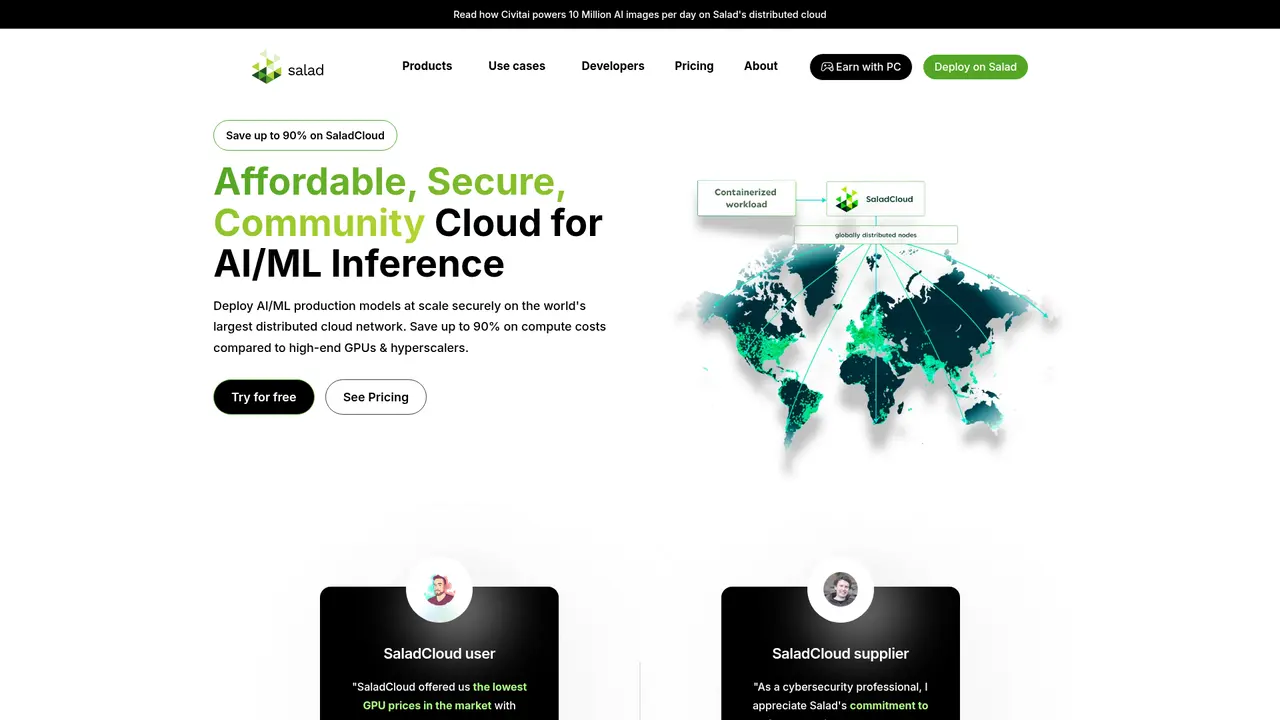
Launched on Feb 23, 2025SaladCloud is a decentralized GPU cloud network that harnesses idle consumer graphics cards worldwide for AI and ML workloads. With over 1 million nodes across 191 countries, it offers up to 90% lower costs than traditional cloud providers. The Salad Container Engine automates containerized GPU workload orchestration.
What is SaladCloud: Decentralized GPU Computing for Modern AI Teams
If you've ever tried to scale AI workloads on traditional cloud platforms, you know the frustration: GPU instances that cost an arm and a leg, waiting weeks for capacity, and budgets that disappear faster than you can train a model. This is the reality for thousands of AI companies navigating today's cloud landscape.
SaladCloud flips this model entirely. Instead of relying on massive data centers with expensive hardware, SaladCloud harnesses idle GPU power from consumer devices around the world—creating the planet's largest decentralized supercomputer. Think of it as Airbnb for GPU computing: individuals with powerful gaming rigs earn money by sharing their spare compute, while AI teams get access to massive scale at a fraction of traditional costs.
The platform connects you to over one million nodes across 191 countries, with more than 60,000 GPUs actively processing workloads daily. That's not a theoretical projection—it's real infrastructure powering real products right now. Companies like Civitai, Stability AI, Discord, and Blend already rely on SaladCloud for their most demanding GPU workloads.
The value proposition is straightforward: up to 90% cost savings compared to traditional cloud providers. For teams building AI products, that difference can mean the difference between shipping faster or running out of budget. Whether you're a startup iterating on new models or an enterprise running inference at scale, SaladCloud provides the compute power you need without the traditional cloud price tag.
:::card{type="summary" title="TL;DR"}
- Decentralized GPU network: Over 1 million nodes in 191 countries providing distributed computing power
- Cost efficiency: Up to 90% savings compared to traditional cloud GPU instances
- Salad Container Engine: Fully managed container orchestration built specifically for GPU workloads at scale :::
Core Features That Power Your AI Workloads
What makes SaladCloud actually work for production AI workloads isn't just the distributed infrastructure—it's the platform layer built on top of it. Let's break down what you actually get when you deploy on SaladCloud.
The Salad Container Engine (SCE) is the backbone of the entire platform. It's a fully managed container orchestration system purpose-built for large-scale GPU workloads. You don't need to worry about node selection, health monitoring, or workload distribution—SCE handles all of that automatically using Salad's proprietary trust rating system. This system indexes each node's performance history, predicts availability, and matches your workload to optimal hardware. When a node goes offline, SCE automatically reallocates your containers to other available GPUs without interruption.
For batch processing and high-performance computing jobs, SaladCloud's distributed GPU processing capability lets you distribute data processing across thousands of GPUs simultaneously. Whether you're running rendering queues, molecular dynamics simulations, or batch inference, the system dynamically allocates resources based on your job requirements. GROMACS benchmarking is available for scientific computing workloads.
The global edge network spans nearly 200 countries, meaning you can deploy compute closer to your end users. This matters for latency-sensitive applications like real-time AI services where every millisecond counts. The geographic distribution also helps with regional compliance requirements—your data can be processed in specific jurisdictions as needed.
SaladCloud plays nicely with your existing infrastructure through multi-cloud compatibility. Using Virtual Kubelets, you can deploy Kubernetes pods directly to SaladCloud containers while maintaining your existing orchestration workflows. This means you don't need to rip and replace your current setup—you can add SaladCloud as a compute layer alongside AWS, GCP, or Azure.
Finally, the economics are designed for real usage patterns. There's no ingress or egress data fees, no cold-start billing (you only pay for container runtime), and no upfront commitments. You scale elastically based on demand, paying only for what you use.
::::grid :::card{type="advantages"}
- Cost-effective: Up to 90% savings vs. traditional cloud GPU instances
- Global coverage: Nodes in 191 countries with low-latency edge options
- Elastic scaling: On-demand resource allocation with no pre-booking required ::: :::card{type="disadvantages"}
- GPU cold start: Longer initialization times compared to dedicated cloud instances
- Maximum VRAM: 24GB ceiling per GPU (suitable for most consumer AI workloads, but some enterprise models may need more)
- Not ideal for ultra-low latency: Real-time trading and extreme low-latency applications may need dedicated infrastructure ::: ::::
Real-World Use Cases: What Can You Build with SaladCloud?
Understanding features is one thing—seeing how they translate to actual products is another. Here are the most common ways teams use SaladCloud today.
AI Image Generation is perhaps the most popular use case. The economics work out remarkably well: running Flux.1-Schnell for image generation produces results in just 1.2 seconds per image on SaladCloud, compared to 2.86 seconds on a local RTX 4090. More importantly, generating 10,000 images on an RTX 5090 costs only about $1. For teams building content platforms, marketing tools, or creative AI products, this makes large-scale image generation economically viable in ways that simply weren't possible before.
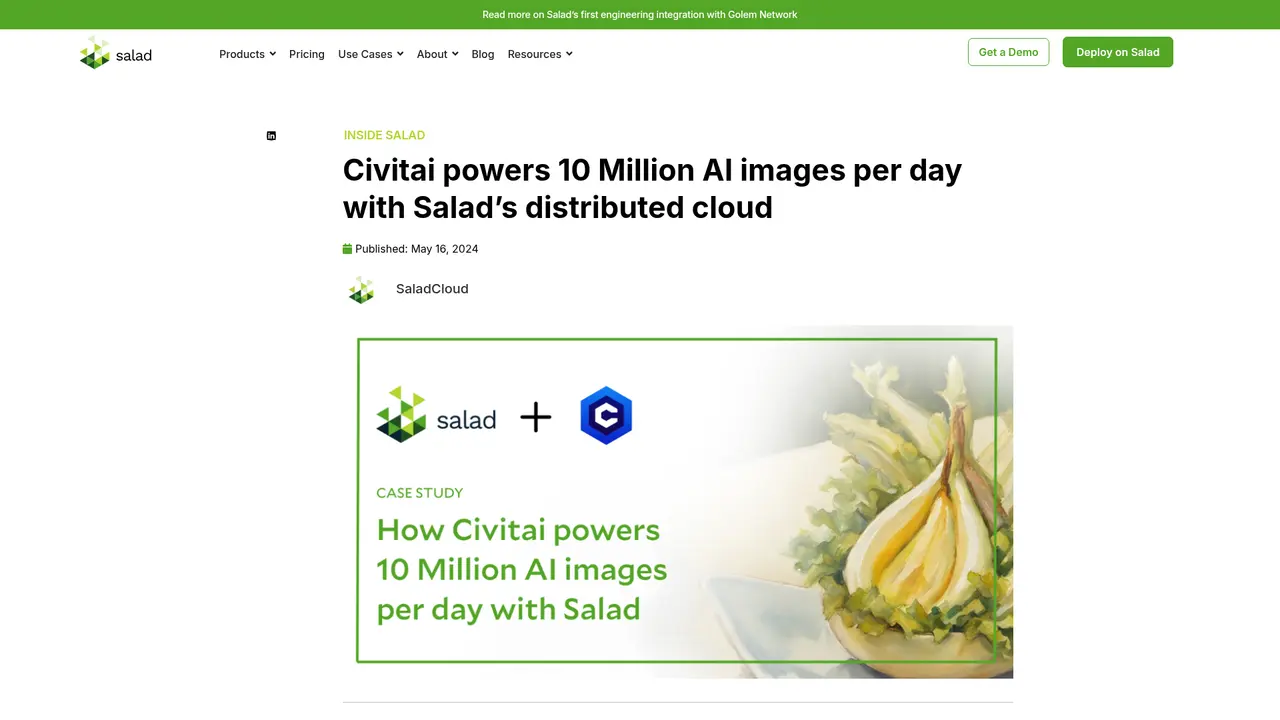
Large-scale Inference is where SaladCloud really shines for production AI. Civitai, one of the largest AI communities on the internet with 26 million monthly visitors, runs 600 GPUs on SaladCloud to generate 10 million images daily and train over 15,000 LoRA models monthly. Their founder Justin Maier puts it simply: SaladCloud offers the lowest GPU prices on the market with incredible scalability.
For Speech AI and Text-to-Speech, teams deploy models like OpenVoice, Bark, and MetaVoice at scale. The cost efficiency is remarkable—OpenVoice delivers 4.7 million words per dollar, while Bark achieves 39,000 words per dollar. That's dramatically cheaper than API-based TTS services.
Transcription services powered by Whisper Large v3 achieve 91.13% accuracy at just $0.10 per hour, with a free trial of 5 hours available. For companies building audio processing pipelines, this represents a massive cost reduction compared to third-party transcription APIs.
Computer Vision workloads like object detection and image segmentation see similar economics. Teams report segmenting 50,000 images per dollar and labeling 309,000 images per dollar—costs that are 73% lower than comparable Azure services.
For LLM Deployment, you can run 7-billion parameter models locally starting at just $0.04 per hour, with Text Generation Inference (TGI) pricing at $0.12 per million tokens. This opens up possibilities for companies wanting to deploy private or fine-tuned models without the API costs of hosted solutions.
:::card{type="tip" title="💡 Choosing the Right GPU for Your Workload"} For image generation and LLM inference, we recommend RTX 3090 or RTX 4090 for the best balance of VRAM and cost. For batch transcription and lighter workloads, RTX 3060 or 3070 provides excellent value. Need more guidance? Our team can help you right-size your deployment. :::
Why Choose SaladCloud Over Traditional Cloud Providers
Let's talk numbers, because that's where the difference becomes undeniable.
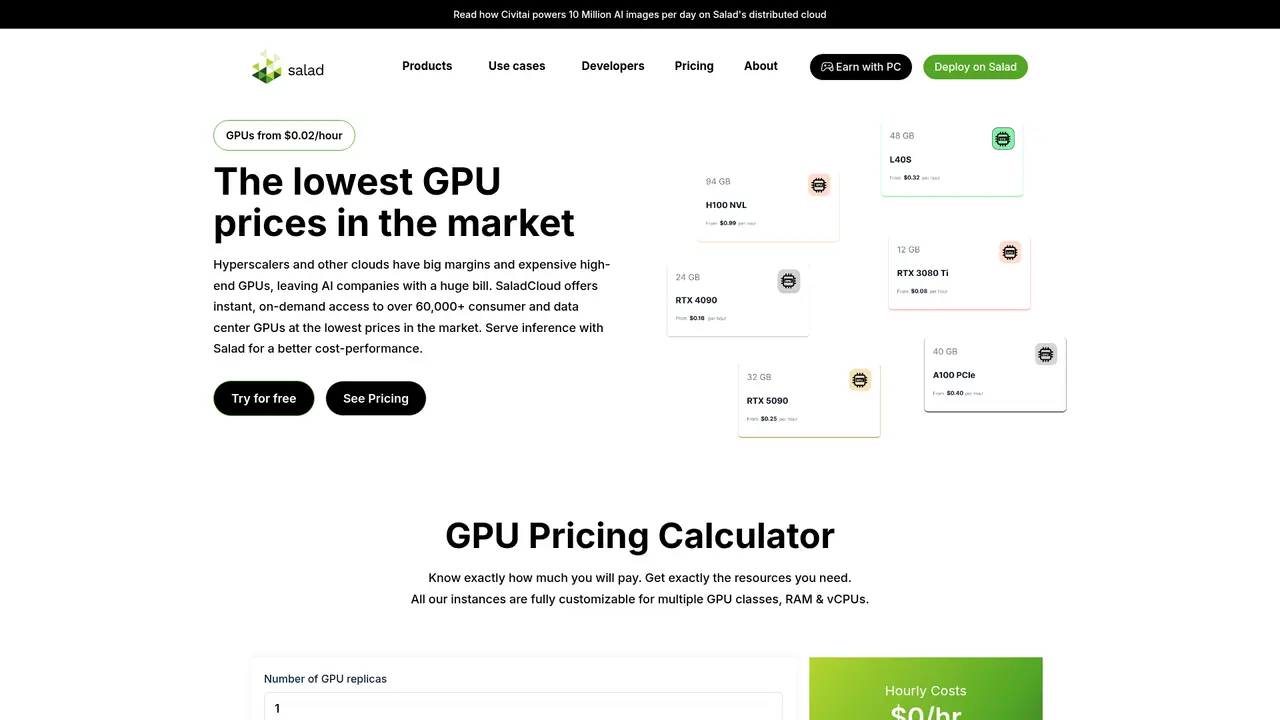
Traditional cloud providers like AWS, Azure, and Google Cloud charge premium prices for GPU instances—often $3-5 per hour for a single GPU with limited availability. SaladCloud's pricing starts at just $0.014 per hour for a GTX 1050 Ti and tops out at $0.294 per hour for an RTX 5090. Even the most powerful consumer GPUs available on SaladCloud cost less than half what you'd pay for equivalent compute on traditional platforms.
Blend, a financial technology company, saw their infrastructure costs drop by 85% while scaling to 3x their previous capacity. Their CTO Jamsheed Kamardeen put it bluntly: "We no longer lose sleep over scaling problems." That's the kind of statement that resonates when you've been burning through cloud budgets.
Klyne.ai, an AI company, gained access to over 1,000 GPUs while achieving better cost efficiency than their previous provider. More importantly, they got startup-level customer support—a level of attention that's impossible to get from hyperscale cloud providers.
The scalability model is fundamentally different too. Traditional cloud requires capacity planning and reservations—meaning you're either overpaying for idle resources or scrambling when you need more. SaladCloud's elastic model lets you scale up or down based on actual demand, with no commitment required.
Global coverage is another differentiator. With nodes in 191 countries, you have compute options that simply don't exist in traditional data center networks. This matters for latency-sensitive applications and regional compliance requirements.
::::grid :::card{type="advantages"}
- Significant cost savings: Up to 85-90% cheaper than AWS, Azure, or GCP for equivalent GPU compute
- Massive global reach: Nodes in 191 countries vs. limited regions from major cloud providers
- On-demand scaling: No capacity reservations needed—scale instantly based on demand ::: :::card{type="disadvantages"}
- Consumer-grade GPUs: While powerful, they differ from data center-grade hardware in consistency
- Maximum 24GB VRAM: Some large models may require multi-GPU setups or data center hardware
- Variable node availability: Consumer nodes can go offline; SCE handles this automatically but some jitter may occur ::: ::::
Security and Compliance You Can Trust
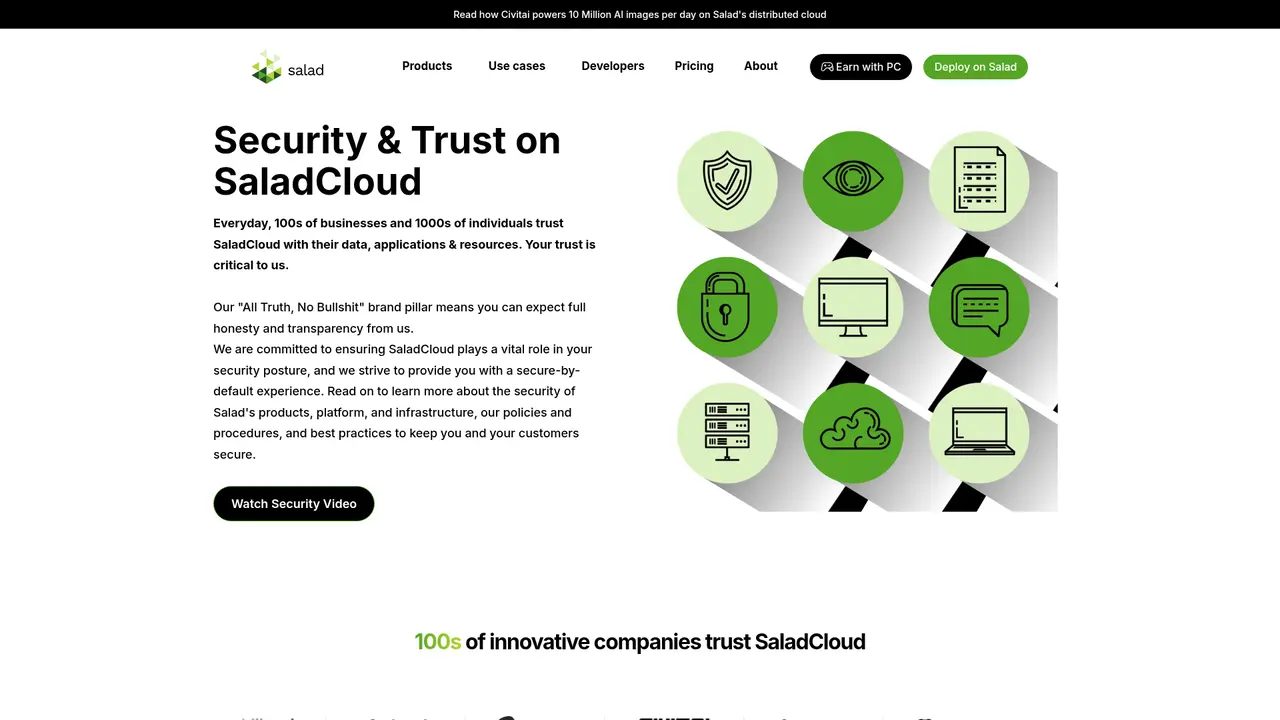
We understand that handing over your compute workloads to a distributed network raises questions. That's why security isn't an afterthought at SaladCloud—it's built into every layer of the platform.
First, the compliance foundation: SaladCloud maintains SOC 2 Type I certification, providing independent verification of our security controls. Your data is protected through encryption in transit (TLS) and at rest (AES), ensuring that even if somehow intercepted, your workloads and data remain secure.
Container isolation is fundamental to the architecture. Each customer's containers run in completely isolated environments—no shared resources, no cross-contamination risk. Your workloads are fully separated from other users on the network.
The host intrusion detection system is perhaps SaladCloud's most unique security feature. It continuously monitors for suspicious activity: unauthorized folder access, shell attempts, or any attempt by a host machine to access your container. If suspicious activity is detected, the system automatically destroys the compromised environment and blacklists the machine. This isn't a theoretical protection—it's actively monitoring every workload running on the platform.
Salad's proprietary trust rating system contributes to security by selecting only proven, stable nodes for your workloads. Each GPU undergoes automated health checks before being deployed, and performance is continuously monitored to identify and remove underperforming or unreliable nodes.
For automatic fault tolerance, when nodes go offline—because consumer hardware can always experience interruptions—SCE automatically redistributes your workloads to healthy nodes. Your containers keep running without manual intervention.
:::card{type="summary" title="Security at a Glance"}
- SOC 2 Type I certified: Independent security verification
- Container isolation: Fully separated environments per customer
- Active intrusion detection: Automated monitoring that terminates suspicious activity :::
Frequently Asked Questions
:::card{type="faq" title="What types of GPUs are available on SaladCloud?"} All GPUs on SaladCloud come from Nvidia's RTX and GTX consumer series. We have a strict selection policy—only AI-enabled, high-performance computing GPUs are admitted to the network. Our fleet includes everything from RTX 5090 (32GB) down to GTX 1050 Ti (4GB), giving you options for different workload requirements and budgets. :::
:::card{type="faq" title="How secure is SaladCloud?"} Security is layered throughout our platform. We use TLS encryption for data in transit and AES encryption for data at rest. Containers run in isolated environments with no shared resources. Our constant host intrusion detection system monitors for suspicious activity like unauthorized folder access or shell attempts—if detected, the environment is immediately terminated and the machine is blacklisted. We've also integrated Falco for robust runtime security checks. :::
:::card{type="faq" title="What are the limitations I should know about?"} As a decentralized compute network, SaladCloud has some characteristics worth understanding. GPU cold start times are longer than dedicated cloud instances because we're provisioning consumer hardware. Maximum VRAM is 24GB per GPU, which handles most AI workloads but may require multi-GPU configurations for very large models. Finally, workloads requiring sub-millisecond latency (like high-frequency trading) are better suited to dedicated data center infrastructure. :::
:::card{type="faq" title="What exactly is the Salad Container Engine?"} The Salad Container Engine (SCE) is our fully managed container orchestration platform purpose-built for large-scale GPU workloads. You deploy your Docker containers to the SaladCloud network, and SCE handles all the complexity: selecting optimal nodes based on our trust rating system, managing container lifecycle, monitoring health, and automatically redistributing workloads when nodes go offline. It's designed so you can focus on your models and applications while we handle the infrastructure. :::
:::card{type="faq" title="Why would someone share their GPU?"} GPU owners (we call them "Salad Chefs") earn rewards by contributing their spare compute capacity. Many compute providers earn $30-200 per month, which can be redeemed for games, gift cards, and other rewards. It's a passive income opportunity for anyone with a capable GPU and an internet connection. :::
:::card{type="faq" title="What happens if a host machine tries to access my container?"} Our intrusion detection system runs continuously and monitors for exactly this scenario. If a host attempts to access your Linux environment—whether through folder navigation, shell attempts, or any other method—the system automatically destroys the environment and blacklists the machine. This protection is always active and requires no configuration from you. :::
:::card{type="faq" title="How does SaladCloud ensure GPU quality and handle failures?"} Every GPU in our network goes through our proprietary trust rating system, which indexes performance history and predicts availability. Before any node handles your workload, it's been tested for network compatibility and reliability. If a GPU goes offline during your job, SCE automatically redistributes your workload to another GPU of the same type and tier—no manual intervention needed. Your containers keep running, and we handle the failover. :::
Related Content
Copy.ai Review 2026: AI Copywriting Made Easy
Our honest Copy.ai review for 2026. We test Content Agents, AI Workflows, pricing ($29-$249/mo), and compare it to Jasper and Writesonic. Find out if it's worth it for your marketing team.

Rytr Review 2026: Is This Budget AI Writer Worth It?
Our hands-on Rytr review for 2026. We test features, pricing, content quality, and compare it to Jasper & ChatGPT. Find out if Rytr is the best budget AI writing tool.

Word Changer - Free AI tool to rewrite and improve your writing instantly
Writing always using repetitive words or need to avoid plagiarism? Word Changer is a free AI writing assistant that instantly rewrites any text with richer vocabulary and appropriate tone. Get multiple versions with one click, adjust formality level, check readability - all for free!

Unite - AI-powered platform for romantic fantasies and dream couple moments
Explore romantic fantasies and create special moments for your dream couple. This AI-powered platform lets you generate personalized romantic content and experience exclusive AI-created romantic experiences.
Comments