


Roboflow - End-to-end computer vision platform for building and deploying AI models
Launched on Feb 23, 2025Roboflow is an end-to-end computer vision platform enabling developers and enterprises to build, train, and deploy AI models. It offers AI-powered annotation tools, managed GPU training infrastructure, and flexible deployment options including cloud APIs, edge devices, and VPC. With over 16,000 organizations and Fortune 100 adoption, it's the industry standard for visual AI implementation.
What is Roboflow
The traditional approach to computer vision development presents significant challenges for development teams. Building production-ready vision AI systems requires substantial annotated datasets, complex infrastructure configuration, and specialized MLOps expertise—often extending development cycles from weeks to months and demanding dedicated machine learning teams.
Roboflow addresses these fundamental challenges by providing an end-to-end computer vision platform that spans the entire ML lifecycle: from data annotation and model training to workflow construction and deployment across edge devices or cloud environments. This comprehensive approach eliminates the need to assemble multiple disparate tools and enables teams to move from concept to production within a unified ecosystem.
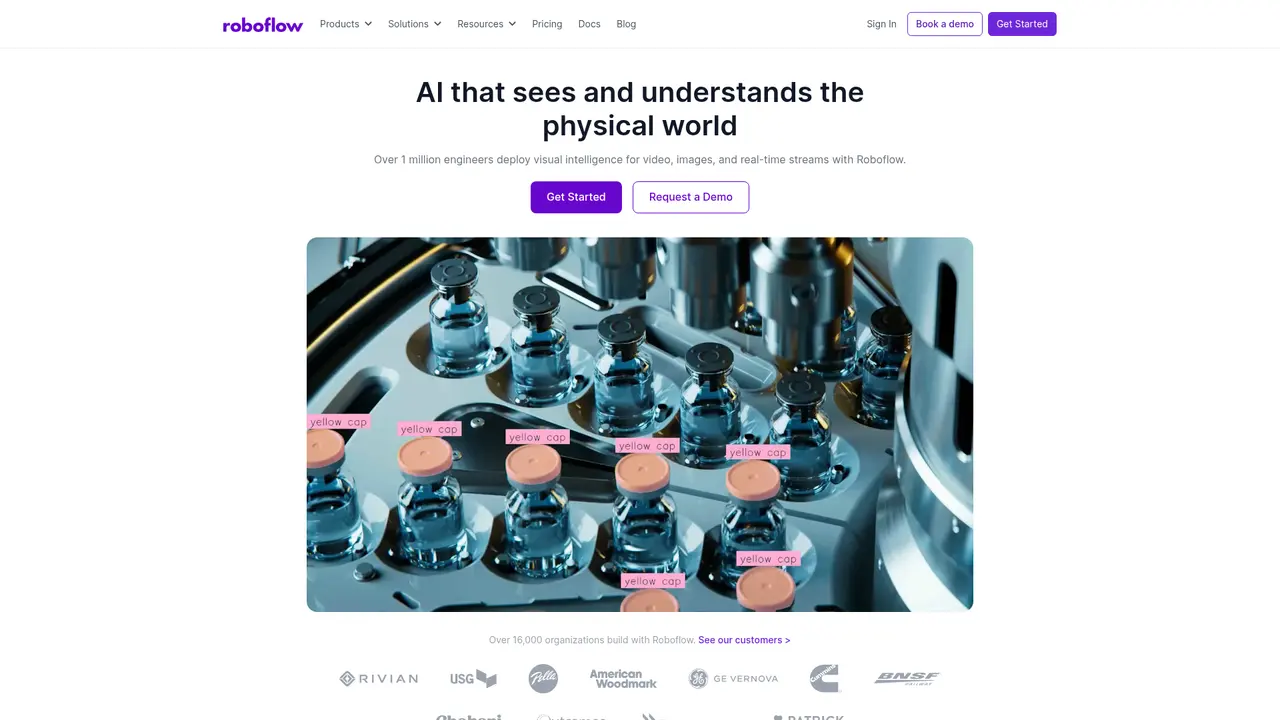
The platform has achieved substantial market adoption, with over 1 million engineers leveraging Roboflow to deploy visual intelligence across diverse applications. More than 16,000 organizations now rely on the platform, including notably, over half of Fortune 100 companies. This enterprise adoption spans industries from automotive manufacturing to logistics, sports broadcasting, and healthcare.
Prominent implementations include Rivian's quality control systems, BNSF's rail freight inspection infrastructure, and Fletcher Sports' groundbreaking coverage of the US Open and Wimbledon tournaments. Additional enterprise customers include GE Vernova, USG, Pella Corporation, and Chobani—demonstrating the platform's versatility across manufacturing, construction, food production, and energy sectors.
:::card{type="summary" title="Core Platform Capabilities"}
- AI-powered intelligent annotation reducing manual labeling effort by up to 95%
- Managed GPU infrastructure for model training with premium hardware access
- Flexible deployment options spanning cloud APIs, edge devices, and VPC private environments
- End-to-end workflow orchestration from data preparation through production monitoring :::
---
Core Platform Capabilities
The Roboflow platform delivers comprehensive computer vision functionality through five integrated pillars designed to accelerate development cycles and minimize operational complexity.
Intelligent Annotation (Annotate)
Data labeling represents one of the most time-intensive aspects of computer vision projects. Roboflow's annotation suite leverages advanced AI models to dramatically accelerate this process. Smart Polygon, powered by SAM 2 (Meta's Segment Anything Model 2), enables precise segmentation with minimal manual input—users define boundaries through intuitive point-and-click interactions rather than tracing complex shapes manually. Label Assist employs custom-trained models to suggest annotations based on project-specific patterns, learning from existing labels to predict classifications for new imagery. Auto Label applies foundational models to automatically generate initial annotations at scale, reducing annotation time by up to 95% compared to manual approaches.
Managed Model Training (Train)
The training infrastructure provides fully managed GPU access without requiring teams to maintain their own ML operations. The platform supports fine-tuning of foundational models including proprietary architectures and established frameworks, with Premium GPU access available for demanding workloads. Built-in training analytics offer visibility into model convergence, while comprehensive evaluation tools assess precision, recall, and mAP metrics. Preprocessing and augmentation pipelines—including rotation, flipping, color adjustment, and mosaic augmentation—enhance model robustness without additional data collection.
Flexible Deployment (Deploy)
Production deployment supports multiple architectural patterns to match varying operational requirements. Serverless托管API provides instant, scalable inference without infrastructure management. Batch processing handles asynchronous, high-volume inference jobs efficiently. Dedicated deployments offer guaranteed capacity for latency-sensitive applications. Edge device deployment supports both pre-configured hardware solutions and BYOD (bring-your-own-device) approaches, enabling inference execution on local hardware without cloud connectivity. Video stream management enables real-time analysis of camera feeds with configurable frame sampling and inference pipelines.
Workflow Construction (Workflows)
The visual workflow builder enables teams to construct complex AI pipelines through a drag-and-drop interface without writing code. The template library provides pre-built patterns for common use cases, accelerating implementation. Workflow version control maintains complete history of pipeline modifications, enabling rollback and systematic iteration. Cloud-based sandbox testing allows teams to validate behavior before deploying to production edge environments—bridging development and operational workflows seamlessly.
Open Source Resources (Universe)
The platform maintains an extensive repository of open-source computer vision datasets and pre-trained models accessible for learning, benchmarking, and rapid project initialization. This resource library enables teams to evaluate approaches quickly and leverage community-developed solutions.
::::grid :::card{type="advantages"}
- Comprehensive integration: Unified platform eliminates toolchain complexity and data transfer overhead
- Enterprise-grade security: SOC2 Type 2 and HIPAA compliance with comprehensive data encryption
- Flexible deployment: Cloud, edge, VPC, and self-hosted options matching diverse operational requirements
- Strong community: Over 1 million engineers with extensive documentation and active forums ::: :::card{type="disadvantages"}
- Learning curve: Advanced features require time investment to master effectively
- Cost at scale: Large deployments may require Enterprise tier pricing for required features ::: ::::
---
Technical Architecture and Core Capabilities
The platform architecture combines proprietary model innovations with open-source foundations, delivering enterprise-grade performance while maintaining deployment flexibility.
Proprietary Model Architectures
Roboflow has developed specialized models optimized for production computer vision workloads. RF-DETR represents a state-of-the-art detection transformer utilizing DINOv2 pre-trained encoders combined with multi-scale DETR architecture, delivering high accuracy across diverse object categories. The platform provides comprehensive support for YOLO family models including YOLO26, YOLO11, YOLOv8, and YOLOv5—offering teams multiple trade-offs between inference speed and detection precision. Support for SAM 3 (Meta's Segment Anything Model) enables flexible segmentation without requiring category-specific training data. The architecture framework also accommodates multimodal models for advanced visual reasoning tasks.
Inference Server and Container Orchestration
Roboflow Inference serves as the open-source inference runtime powering production deployments. Built on Docker container technology, the inference server deploys consistently across development, testing, and production environments. Kubernetes integration enables horizontal scaling, load balancing, and automated failover for mission-critical deployments. The server supports model versioning, enabling A/B testing and graduated rollouts of model updates without service interruption.
Deployment Architectures
The platform supports four primary deployment topologies:
Cloud API Deployment provides serverless inference with automatic scaling based on request volume. This approach suits applications requiring global accessibility and minimal operational overhead.
Edge Device Deployment executes models locally on specialized hardware—including NVIDIA Jetson modules, Intel Compute Devices, and custom ARM-based solutions. Edge deployment reduces latency to milliseconds, enables operation in network-constrained environments, and supports real-time video analysis scenarios.
VPC Private Deployment establishes dedicated infrastructure within customer-controlled virtual private clouds, meeting data residency requirements and security policies for regulated industries.
Self-Hosted Inference provides complete control over the inference environment for organizations requiring air-gapped operation or custom infrastructure integration.
Enterprise Security and Compliance
Security implementation addresses enterprise requirements through multiple protective layers. SOC 2 Type 2 certification validates operational controls and security practices through independent auditing. HIPAA compliance with Business Associate Agreement (BAA) availability supports healthcare applications handling protected health information (PHI). Data encryption applies both in transit (TLS 1.3) and at rest (AES-256), with SSL Labs rating of A+ validating transport security configuration.
Identity and access management features include SSO (Single Sign-On) integration with enterprise identity providers, RBAC (Role-Based Access Control) for granular permission management, and comprehensive audit logging for compliance and security monitoring.
:::card{type="tip" title="Security Architecture Recommendation"} For organizations in regulated industries (healthcare, finance, government), begin with the Enterprise tier to access HIPAA BAA, RBAC, and audit logging capabilities from project inception. Retrofitting these controls mid-project requires additional migration effort. :::
---
Ecosystem and Open Source Tools
Roboflow maintains an extensive open-source ecosystem that extends platform capabilities and enables community contribution. These tools address common computer vision development patterns while integrating with the broader MLOps landscape.
Core Open Source Libraries
supervision provides a comprehensive Python library for computer vision workflows, offering utilities for detection visualization, tracking, and dataset management. The library integrates seamlessly with model outputs from Roboflow-trained models and third-party frameworks.
notebooks delivers Jupyter notebook tutorials covering common development patterns—from initial dataset preparation through advanced deployment scenarios. These resources accelerate onboarding and provide reference implementations for production architectures.
trackers implements multi-object tracking algorithms enabling temporal analysis across video sequences. Support for multiple tracking paradigms allows teams to select approaches matching their accuracy and performance requirements.
autodistill automates the labeling pipeline by leveraging foundation models to generate training data with minimal human supervision. This framework dramatically reduces the data preparation overhead for new object categories.
inference provides the production inference runtime as an open-source project, enabling teams to deploy models with full visibility into runtime behavior and the ability to customize processing pipelines.
Developer Resources and Integration Points
The platform offers extensive integration with cloud infrastructure providers through marketplace listings on AWS Marketplace, GCP Marketplace, and Azure Marketplace, enabling simplified procurement and cloud credit utilization. Technical partnerships with Google, NVIDIA, AWS, and Azure ensure optimized performance across major cloud platforms and hardware accelerators.
Developer engagement occurs through multiple channels: GitHub hosts source code and issue tracking, the discussion forum enables community knowledge sharing, the model library provides access to pre-trained weights, and the template library offers starting points for common applications. The changelog maintains visibility into platform updates and new feature releases.
:::card{type="tip" title="Tool Selection Guidance"} For teams beginning computer vision projects, start with the supervision library for data handling and visualization, then leverage autodistill to accelerate initial dataset preparation. Progress to custom training once baseline performance is established. :::
---
Industry Application Scenarios
The platform's flexibility supports diverse vertical applications, with documented success across manufacturing, logistics, media, transportation, healthcare, and retail sectors.
Manufacturing Quality Control
Manufacturing facilities face persistent challenges with manual inspection: consistency degradation over shifts, throughput limitations, and scalability constraints during demand fluctuations. Edge-deployed visual AI systems address these issues through automated defect detection operating continuously at production speeds. One automotive manufacturing customer achieved defect detection across production lines, generating millions of dollars in savings through improved quality and reduced rework.
Logistics and Inventory Management
Manual inventory tracking consumes significant labor hours while introducing counting errors that cascade through supply chain operations. Real-time visual recognition systems track freight movement and inventory levels automatically, enabling perpetual inventory systems without dedicated scanning labor. One logistics provider reported substantial reduction in manual tracking time, enabling reallocation of personnel to higher-value activities.
Sports Broadcasting
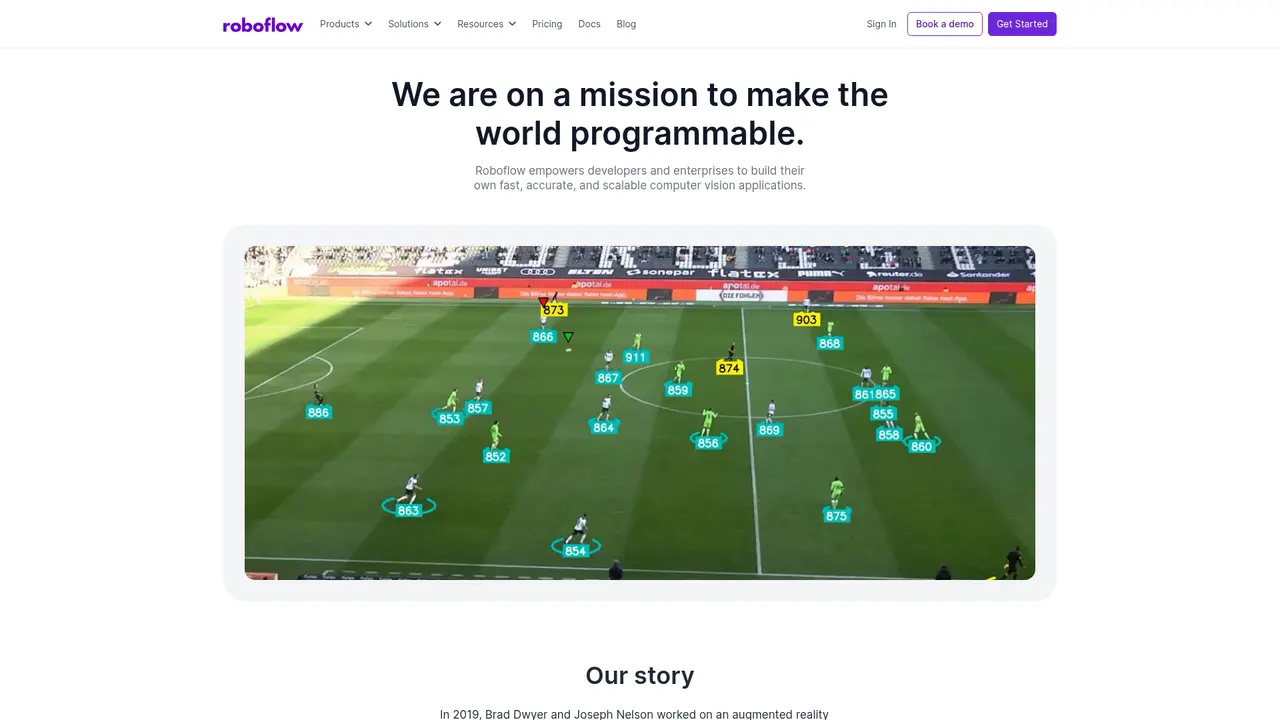
Sports media production requires tracking fast-moving athletes across multiple camera angles while directors coordinate live coverage. AI-powered tracking combined with high-performance edge inference enables automated camera switching and comprehensive field coverage. Fletcher Sports implemented these capabilities to deliver first-ever full-court coverage of the US Open and Wimbledon tournaments, transforming viewer experiences through automated multi-camera production.
Rail Freight Inspection
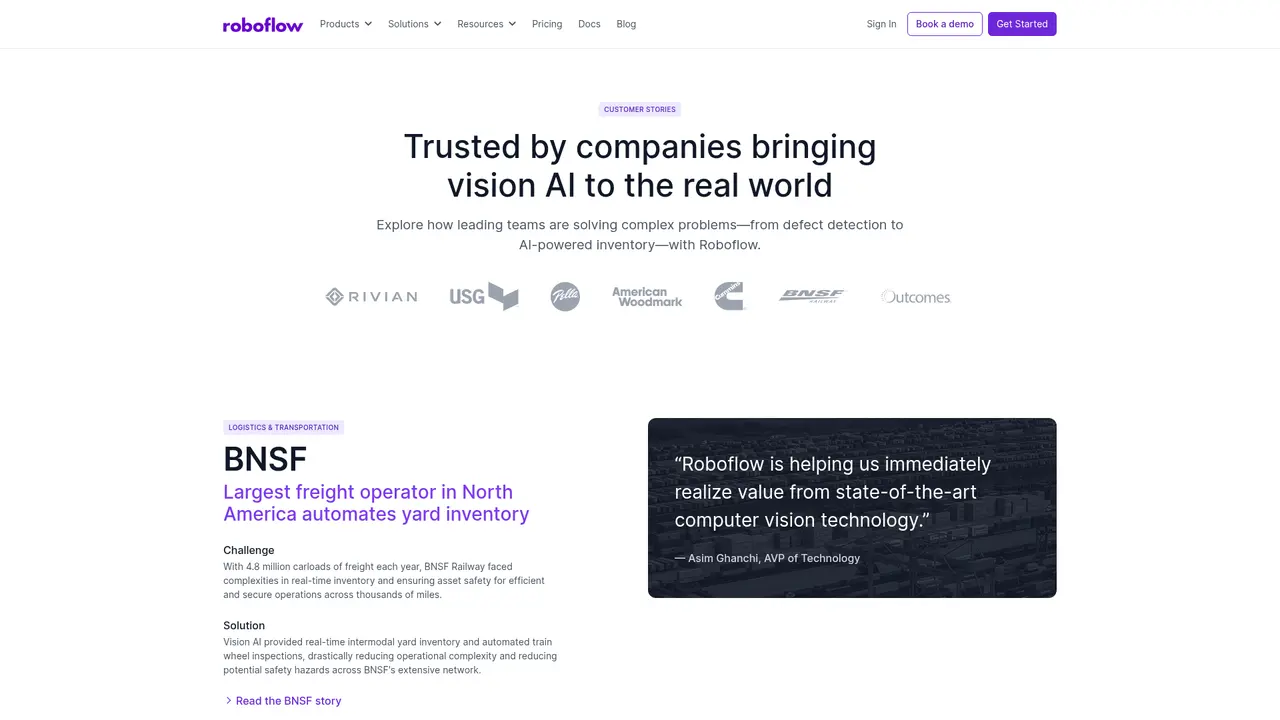
Rail networks span vast distances with thousands of freight cars moving daily, making comprehensive inspection challenging. Visual AI systems deployed at key inspection points automate freight car identification and wheel condition analysis. BNSF Railway implemented real-time train inspection capabilities, reducing operational complexity while improving safety through automated defect detection.
Healthcare and Patient Compliance
Patient adherence to treatment protocols significantly impacts outcomes, yet monitoring compliance historically required expensive observation or self-reporting with reliability limitations. AI-assisted monitoring provides objective measurement of patient behavior, enabling intervention before non-compliance escalates. Wellth leverages visual AI to improve patient treatment outcomes through behavioral monitoring and incentive programs.
Security, Retail, and Predictive Maintenance
Additional applications include real-time security monitoring with immediate alerting for unauthorized zone access, retail analytics providing customer flow patterns and shelf compliance measurement, and predictive maintenance through visual inspection of equipment condition—enabling maintenance scheduling that minimizes unplanned downtime while optimizing resource utilization.
:::card{type="faq" title="Which industry implementation should I prioritize?"} For manufacturing and industrial applications, begin with the Enterprise tier to access RBAC, deployment manager, and industrial protocol integrations (MQTT, OPC, PLC). For media, logistics, and research applications, the Core tier provides sufficient capabilities with private dataset support and concurrent training tasks. :::
---
Frequently Asked Questions
:::card{type="faq" title="What model architectures does Roboflow support?"} The platform supports multiple detection architectures including RF-DETR (proprietary transformer-based detection), the full YOLO family (YOLO26, YOLO11, YOLOv8, YOLOv5), SAM 3 for segmentation, and multimodal models for advanced visual reasoning tasks. All architectures support both cloud-hosted and edge deployment. :::
:::card{type="faq" title="How does local deployment work?"} Roboflow supports local deployment through Docker containerization, enabling consistent operation across development, testing, and production environments. Kubernetes integration provides orchestration for scalable deployments. VPC private deployment options accommodate air-gapped or customer-controlled infrastructure requirements. :::
:::card{type="faq" title="What security certifications does the platform maintain?"} The platform maintains SOC 2 Type 2 certification with annual independent audits. HIPAA compliance is available with signed Business Associate Agreement (BAA). All data is encrypted both in transit (TLS 1.3) and at rest (AES-256), with SSL Labs rating A+ validating transport security configuration. :::
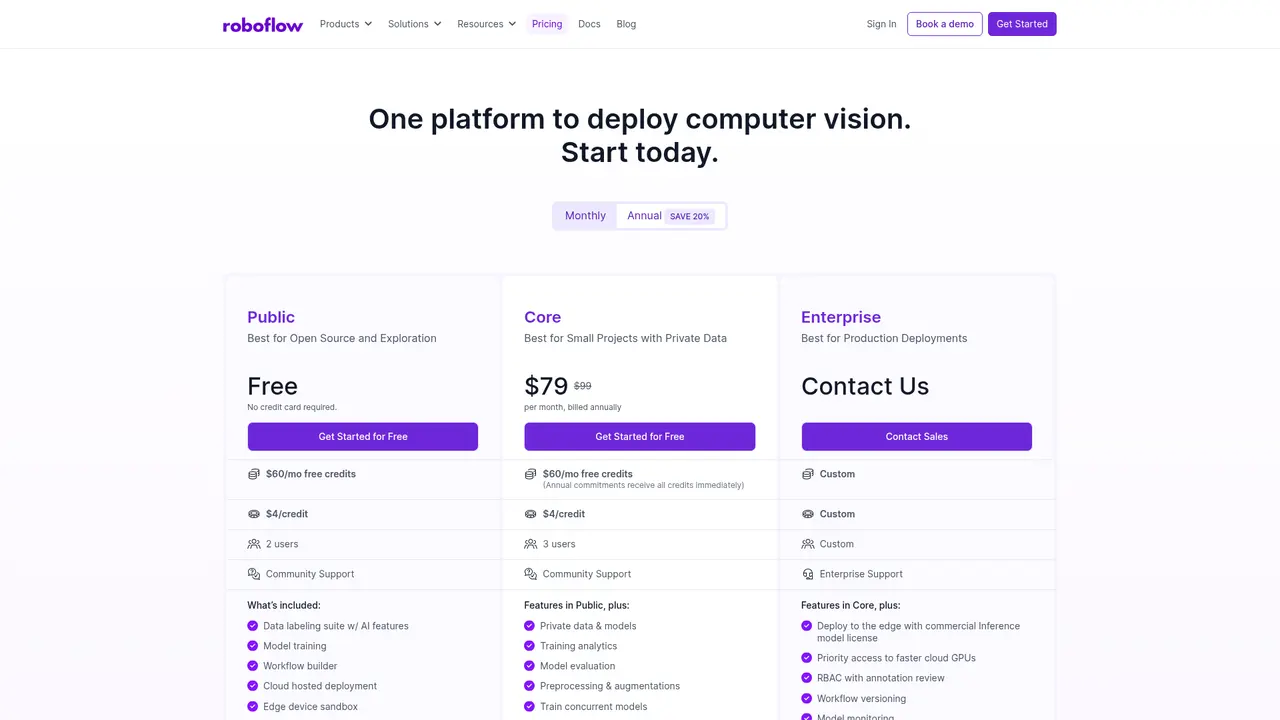
:::card{type="faq" title="What is the difference between free and Enterprise tiers?"} The Free tier provides $60 monthly compute credits, 2 user seats, and access to community support. Core tier ($79/month annual) adds private datasets and models, training analytics, concurrent training tasks, and model weight downloads. Enterprise tier provides custom pricing with unlimited users, Premium GPU access, RBAC, workflow version control, model monitoring, deployment management, and 24/7 SLA-backed support. :::
:::card{type="faq" title="What deployment options are available?"} Deployment options include: Serverless hosted APIs (automatic scaling), batch processing (asynchronous high-volume), dedicated deployments (guaranteed capacity), edge device deployment (pre-configured or BYOD), video stream management (real-time camera analysis), and self-hosted inference (complete infrastructure control). :::
Related Content
Copy.ai Review 2026: AI Copywriting Made Easy
Our honest Copy.ai review for 2026. We test Content Agents, AI Workflows, pricing ($29-$249/mo), and compare it to Jasper and Writesonic. Find out if it's worth it for your marketing team.

Rytr Review 2026: Is This Budget AI Writer Worth It?
Our hands-on Rytr review for 2026. We test features, pricing, content quality, and compare it to Jasper & ChatGPT. Find out if Rytr is the best budget AI writing tool.

Word Changer - Free AI tool to rewrite and improve your writing instantly
Writing always using repetitive words or need to avoid plagiarism? Word Changer is a free AI writing assistant that instantly rewrites any text with richer vocabulary and appropriate tone. Get multiple versions with one click, adjust formality level, check readability - all for free!

Unite - AI-powered platform for romantic fantasies and dream couple moments
Explore romantic fantasies and create special moments for your dream couple. This AI-powered platform lets you generate personalized romantic content and experience exclusive AI-created romantic experiences.
Comments