
Pieces - Long term memory for your whole workstream
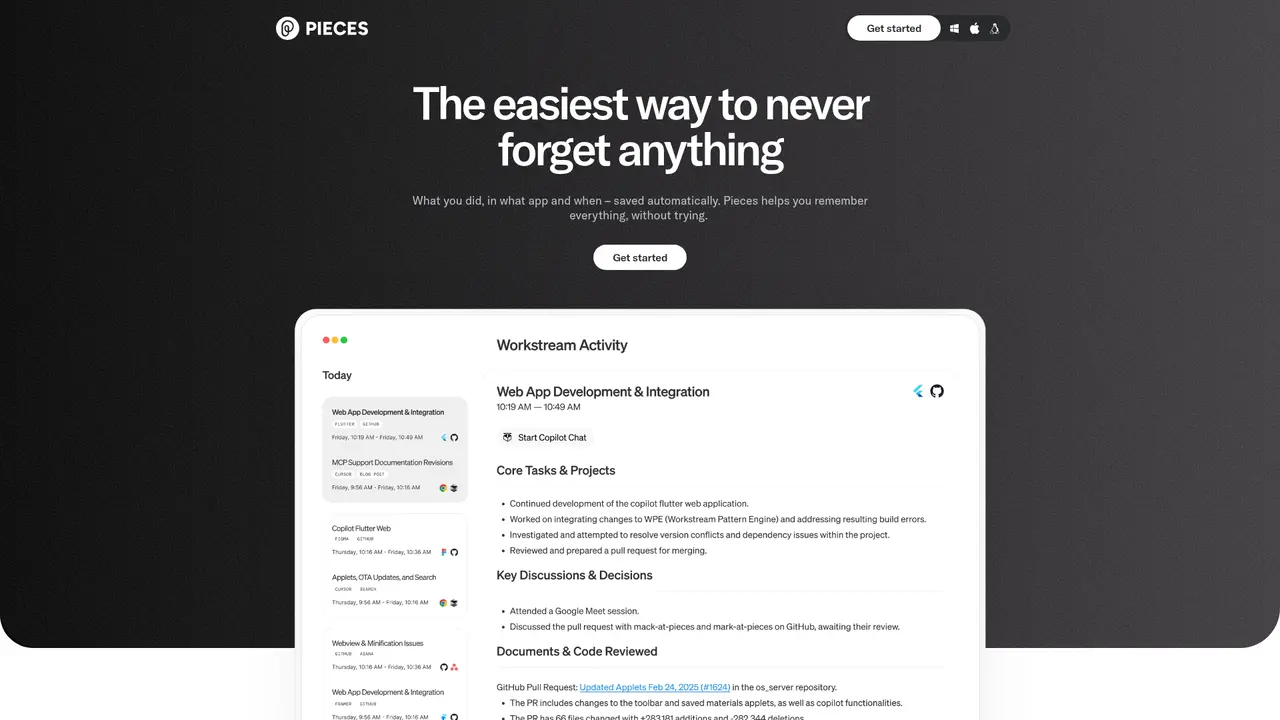
Launched on Feb 23, 2025Pieces is an AI-powered developer memory assistant that acts as your personal long-term memory for the entire software development workflow. With over 150,000 developers at companies like Google, Microsoft, and Meta using it, Pieces delivers 380% improvement in recall accuracy while keeping all your data locally on your device. It remembers everything so you don't have to.
What is Pieces
Every developer knows that feeling—the context switch between Slack and your IDE, the bookmark folder that grew unmanageable, the half-remembered solution from last week's debugging session. You're not just writing code; you're managing an overwhelming amount of information across dozens of tools. And somewhere in that noise, your best ideas and critical context get lost.
That's exactly the problem Pieces was built to solve.
Pieces is the first OS-level, local-first long-term memory engine designed specifically for developers. Think of it as your workstream's memory—not just a clipboard manager or a code snippet tool, but an intelligent system that actively remembers everything you've done, seen, and learned across your entire workflow. It integrates seamlessly with the tools you already use, working quietly in the background to capture, organize, and retrieve the context that matters to you.
What makes Pieces different from traditional AI assistants is its memory architecture. While most AI tools rely on Large Language Models that know things from their training data, Pieces knows you—your specific projects, your coding patterns, your team's conventions, and the solutions you've discovered along the way. It combines the power of on-device AI with privacy-first design, ensuring your sensitive work context never leaves your machine unless you explicitly choose to share it.
The result? You stay in flow longer. You find that snippet you saved three weeks ago without digging through folders. You pick up right where you left off after a meeting. You focus on creative problem-solving instead of information management.
And developers have noticed. More than 150,000 high-performing developers at companies like Google, Amazon, Microsoft, Meta, Shopify, and Notion now use Pieces as an essential part of their daily workflow. They're the teams building the products you use—and Pieces helps them do it faster, smarter, and with less friction.
:::card{type="summary" title="TL;DR"}
- LTM-2 Engine: First OS-level long-term memory system built specifically for developers
- 380% improvement in recall accuracy compared to traditional approaches
- 150,000+ developers at top tech companies rely on Pieces daily
- Privacy-first design: All processing happens on-device unless you choose otherwise :::
---
Core Features of Pieces
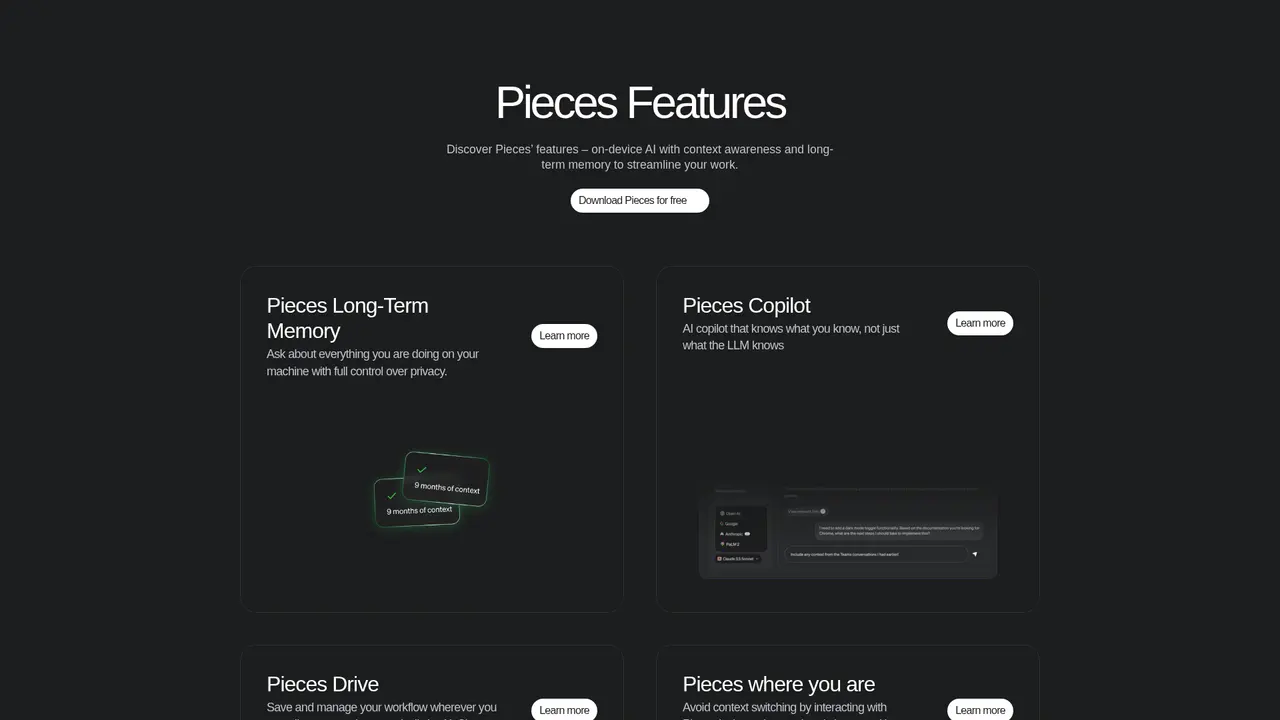
Pieces isn't just a single tool—it's a comprehensive memory ecosystem that transforms how you work. Let me walk you through the capabilities that make this possible.
Long-Term Memory System
At the heart of Pieces is the LTM-2 engine—a proprietary long-term memory system that operates at the OS level. Unlike temporary context windows in traditional AI, LTM-2 actively forms and maintains memories of your work over time. It uses technology inspired by REM sleep cycles to create meaningful associations between related pieces of information, so when you search for something, you find not just exact matches but contextually relevant results. Remarkably efficient, it can store 18 months of structured memory in just 4GB of storage.
AI Copilot That Actually Knows You
Your AI assistant should understand what you already know—and that's exactly what Pieces Copilot does. Rather than relying solely on public LLM knowledge, it provides context-aware help based on your personal workstream. It knows your codebase, your preferences, and your past solutions. So when you ask a question, you get answers that account for what you've already discovered, not just what exists in generic training data. This personalized approach delivers a 380% improvement in recall accuracy.
Pieces Drive: Workflow Storage with AI Enhancement
Save anything from code snippets to entire workflows, and Pieces automatically enriches them. It detects sensitive information, adds relevant context, and transforms raw snippets into searchable, reusable assets. For teams, Pieces Drive becomes a shared knowledge base where everyone contributes to a growing library of solutions—without the mess of scattered Slack messages and forgotten documents.
Multi-LLM Flexibility
You deserve the freedom to choose the right model for the task. Pieces supports OpenAI, Anthropic (including Claude 4 Sonnet and Opus), Google Gemini 2.5, Ollama, and more. Switch between models depending on your needs—whether you prioritize speed, reasoning capability, or specific domain expertise. You're not locked into any single provider.
MCP Integration
Through Model Context Protocol (MCP), Pieces connects directly with tools like GitHub Copilot, Claude Desktop, Cursor, and Goose. This means you can access your long-term memory directly from the AI tools you already use, eliminating context-switching while leveraging the power of Pieces behind the scenes.
Cross-Platform Plugins
Whether you prefer Chrome for research, VS Code for development, or work across Windows, Linux, and macOS, Pieces fits into your existing setup. Plugins for major platforms and browsers let you capture context without interrupting your flow—work where you normally work, let Pieces handle the memory.
::::grid :::card{type="advantages"}
- Local-first privacy: Your data stays on your machine by default
- Multi-LLM freedom: Choose and switch between OpenAI, Claude, Gemini, Ollama
- Team collaboration: Shared knowledge bases with role-based access
- Workflow integration: Works within tools you already use ::: :::card{type="disadvantages"}
- Local storage required: Needs disk space for the memory database
- Initial learning curve: Exploring all features takes some time
- Device-bound: Full functionality tied to where memory is stored ::: ::::
---
Who Uses Pieces
Pieces adapts to how you work. Whether you're diving deep into code, running meetings, or collaborating across teams, here's how different types of developers get value from Pieces.
Researchers and Technical Writers
If you've ever felt overwhelmed by hundreds of bookmarks, open tabs, and scattered notes from weeks of investigation, Pieces changes that entirely. It automatically captures every link you visit, highlight you make, and keyword you search for—building a searchable memory of your research journey. You never need another bookmark folder. Just ask Pieces what you were looking at last month, and you'll find it instantly.
Meeting Participants
How many great ideas shared in meetings get lost in the noise? Pieces silently captures the content shared during calls, the links mentioned, and the context of discussions. After the meeting, you have a complete record—not just notes, but the full context. Share specific insights with teammates later without trying to remember what was said or where that link was posted.
Deep Workers
When you're in the zone—debugging a tricky issue, writing a complex feature, or architecting a solution—the last thing you want is to break your flow to search for something you saw hours ago. Pieces preserves your mental state, letting you resume exactly where you left off, even after switching contexts. It handles the information management so you can focus on the creative work that requires your full attention.
Collaborating Teams
Knowledge silos kill team velocity. When one developer solves a problem that another faced last week, everyone loses time re-solving the same challenges. Pieces captures context across tools and team members, building a shared knowledge base that grows smarter over time. New team members onboard faster. Decisions get made with full context. The team's collective memory becomes a real, searchable asset.
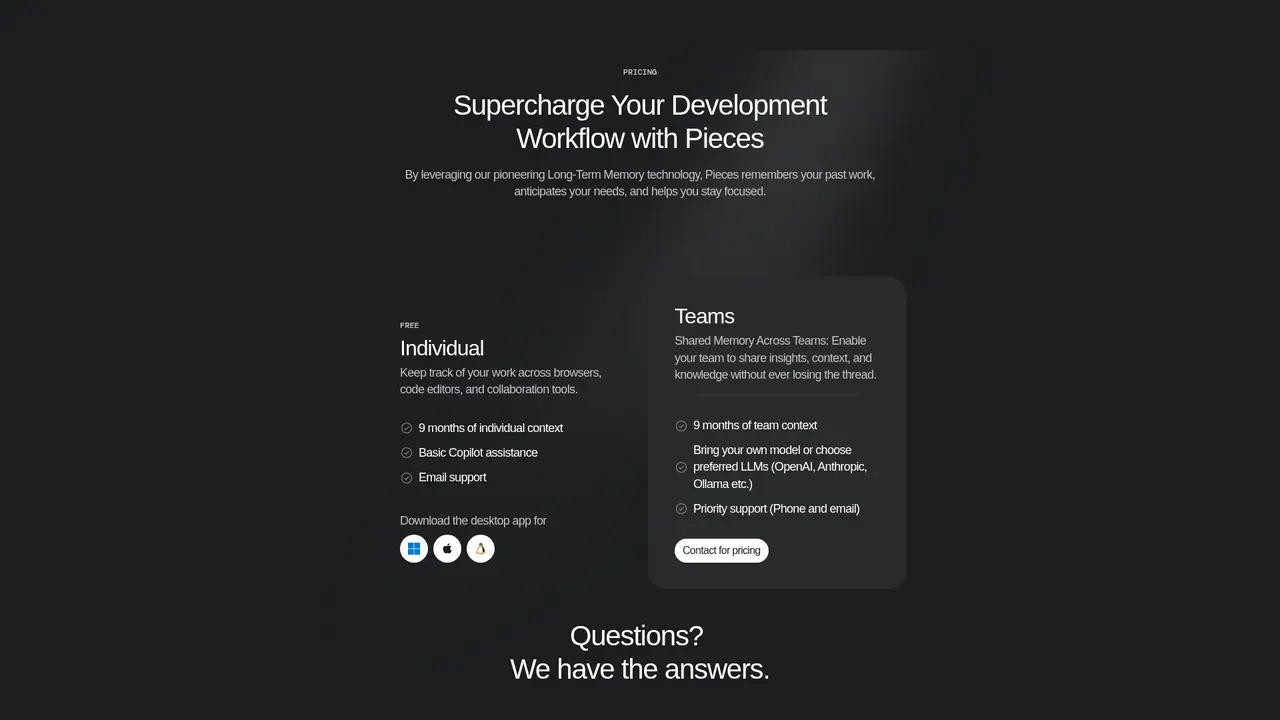
:::card{type="tip" title="💡 Choosing Your Version"} For individual developers, the Free version gives you powerful local AI capabilities with 9 months of personal context. If you're working with a team and need shared knowledge, the Teams version unlocks collaborative features and extended context windows that make collective memory possible. :::
---
Technical Features
If you're curious about what makes Pieces work under the hood, this section is for you. The technical architecture reflects one core principle: privacy shouldn't mean sacrificing capability.
LTM-2: The Memory Engine
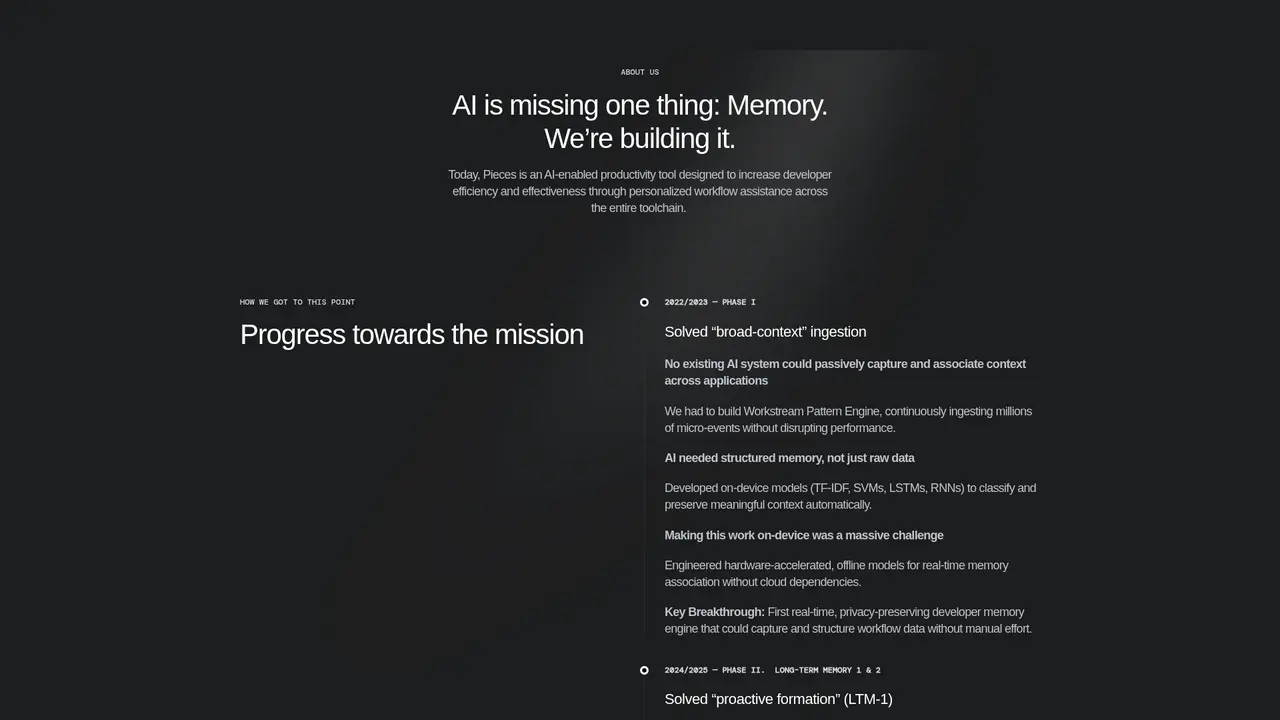
The Long-Term Memory 2 engine is Pieces' proprietary technology for active memory formation and retrieval. Unlike passive storage systems, LTM-2 continuously learns from your workflow patterns through its Workstream Pattern Engine, identifying relationships between your activities and forming memories that matter. The architecture supports both structured data (code, documents) and unstructured context (conversations, links), creating a comprehensive picture of your work over time.
On-Device Machine Learning
All intelligence runs locally on your machine. Pieces uses a combination of algorithms including TF-IDF for semantic search, Support Vector Machines (SVMs) for classification, Long Short-Term Memory networks (LSTMs) and Recurrent Neural Networks (RNNs) for sequence learning. These models run with hardware acceleration, meaning you get powerful AI capabilities without the cloud compute costs or latency. Critically, these on-device "nanomodels" are trained only on synthetic data—never on your actual content, ensuring privacy at every level.
Performance That Scales
The numbers speak for themselves: 380% improvement in recall accuracy over traditional approaches, and CPU and RAM usage that's 14 times more efficient than cloud-based alternatives. That efficiency means Pieces runs quietly in the background without draining your system resources. You get enterprise-grade AI capability on a laptop.
Privacy Architecture
Pieces follows a strict local-first philosophy. By default, your data never leaves your device. Cloud sync is entirely optional—enabled only when you explicitly choose it. Perhaps most importantly, your data is never used to train any models, whether Pieces' internal systems or third-party LLM providers. You're in complete control: enable, disable, or delete any memory at any time.
Security You Can Trust
For teams and enterprises, Pieces operates on SOC 2 compliant infrastructure with continuous security audits. Authentication uses Auth0 with full MFA (multi-factor authentication) support, giving security teams the controls they require. Whether you're an individual developer or managing a team, your sensitive work context stays protected.
::::grid :::card{type="advantages"}
- Maximum privacy: All processing on-device by default
- No data mining: Your content never trains any models
- Enterprise-ready: SOC 2 compliance, Auth0 integration, MFA support
- Efficient performance: 14x less CPU/RAM than cloud alternatives ::: :::card{type="disadvantages"}
- Device-dependent: Full functionality requires local compute resources
- Not cross-device by default: Memories stored on one machine need explicit sync to access elsewhere ::: ::::
---
Pricing Plans
Pieces offers three tiers designed for different needs—from individual developers exploring the product to high-performance teams requiring shared knowledge and advanced capabilities.
| Plan | Price | Core Features | Best For | |------|-------|---------------|-----------| | Free | Free forever | 9 months personal context, Basic Copilot assistance, Email support, Local-first storage | Individual developers wanting powerful free AI tools | | Pro | $18.99/month + tax | Everything in Free, plus Claude 4 Sonnet & Opus, Gemini 2.5, Early access to advanced models, Priority processing | Professional developers needing advanced AI models | | Teams | Contact for pricing | Everything in Pro, plus 9 months team context, Self-select LLM (OpenAI, Anthropic, Ollama), Priority support (phone + email), Shared knowledge base | High-performing teams needing collaborative memory |
Which version should you choose?
If you're a solo developer building personal projects or exploring AI-assisted coding, the Free version gives you substantial capability without any cost. You get local memory, Copilot assistance, and nine months of personal context—more than enough to transform how you work.
If you're a professional developer who needs the latest and most capable AI models, Pro at $18.99/month unlocks Claude 4 Sonnet and Opus, Gemini 2.5, and early access to new model releases as they become available.
If you're leading or working in a team where knowledge sharing matters, Teams gives you shared context windows, collaborative storage, and the ability to choose which LLM your team uses. Contact Pieces directly for custom pricing based on your team size and requirements.
---
Frequently Asked Questions
:::card{type="faq" title="How much does Pieces for Developers cost?"} Pieces offers both free and paid options. The Free version is genuinely full-featured—perfect for individuals who want powerful local AI capabilities without paying. It includes Copilot assistance, Pieces Drive for workflow storage, complete local memory, and chat history. The Pro version at $18.99/month (plus tax) adds access to advanced models like Claude 4 Sonnet & Opus and Gemini 2.5, with early access to new model releases. :::
:::card{type="faq" title="Is my data safe?"} Absolutely. All data processing happens locally on your device by default. Your content is never used for any purpose—including model training—unless you explicitly choose to enable cloud features. You have complete control over your data: enable or disable cloud sync at any time, and delete any stored memories with a single action. Privacy isn't an afterthought; it's foundational to the architecture. :::
:::card{type="faq" title="How do you ensure long-term memory doesn't send privacy-sensitive information to the cloud?"} You have full control over every memory Pieces stores. All processing happens on-device using local machine learning models. You can enable, disable, or delete individual memories—or clear everything—through simple controls. The system is designed with privacy as the default, not an optional setting. Cloud sync only happens when you deliberately turn it on, and even then, you control what's shared. :::
:::card{type="faq" title="How does Pieces compare to other AI assistants like GitHub Copilot?"} The fundamental difference is memory. GitHub Copilot and similar tools are incredibly capable at generating code based on their training data—they know what's in the public domain. Pieces, however, knows what's in *your* personal workstream: the solutions you've discovered, the code you've written, the context of your specific projects. It's not about choosing one over the other; many developers use both. Copilot helps generate new code while Pieces remembers what you've already solved and found. :::
:::card{type="faq" title="What languages does Pieces support?"} For the most accurate and up-to-date language support information, please refer to the official Pieces documentation at pieces.app/docs. The team regularly updates supported languages as the product evolves. :::
Related Content
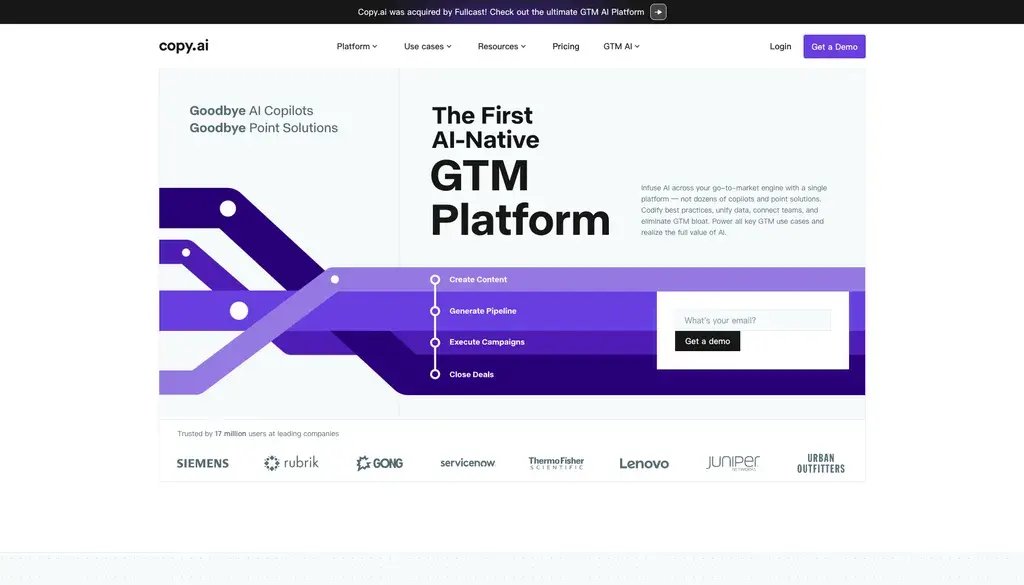
Copy.ai Review 2026: AI Copywriting Made Easy
Our honest Copy.ai review for 2026. We test Content Agents, AI Workflows, pricing ($29-$249/mo), and compare it to Jasper and Writesonic. Find out if it's worth it for your marketing team.

Rytr Review 2026: Is This Budget AI Writer Worth It?
Our hands-on Rytr review for 2026. We test features, pricing, content quality, and compare it to Jasper & ChatGPT. Find out if Rytr is the best budget AI writing tool.

Word Changer - Free AI tool to rewrite and improve your writing instantly
Writing always using repetitive words or need to avoid plagiarism? Word Changer is a free AI writing assistant that instantly rewrites any text with richer vocabulary and appropriate tone. Get multiple versions with one click, adjust formality level, check readability - all for free!

Unite - AI-powered platform for romantic fantasies and dream couple moments
Explore romantic fantasies and create special moments for your dream couple. This AI-powered platform lets you generate personalized romantic content and experience exclusive AI-created romantic experiences.
Comments