


Datature - End-to-end Vision AI platform for enterprises and developers
Launched on Feb 23, 2025Datature is an end-to-end Vision AI platform that enables teams to build production-grade computer vision models without writing code. From data annotation with AI-assisted tools to model training using state-of-the-art architectures like FasterRCNN and YOLOX, all the way to deployment on cloud or edge devices. With SOC2 Type 2 and HIPAA compliance, it's trusted by 6,000+ teams across healthcare, manufacturing, retail, and smart city sectors.
What is Datature
Building production-ready computer vision models has traditionally been a significant challenge for enterprises. You need specialized machine learning engineers who can write complex code, access to expensive GPU infrastructure, and a deep understanding of model deployment pipelines. For many organizations, these barriers mean that valuable visual data goes unused, and AI projects stall at the proof-of-concept stage.
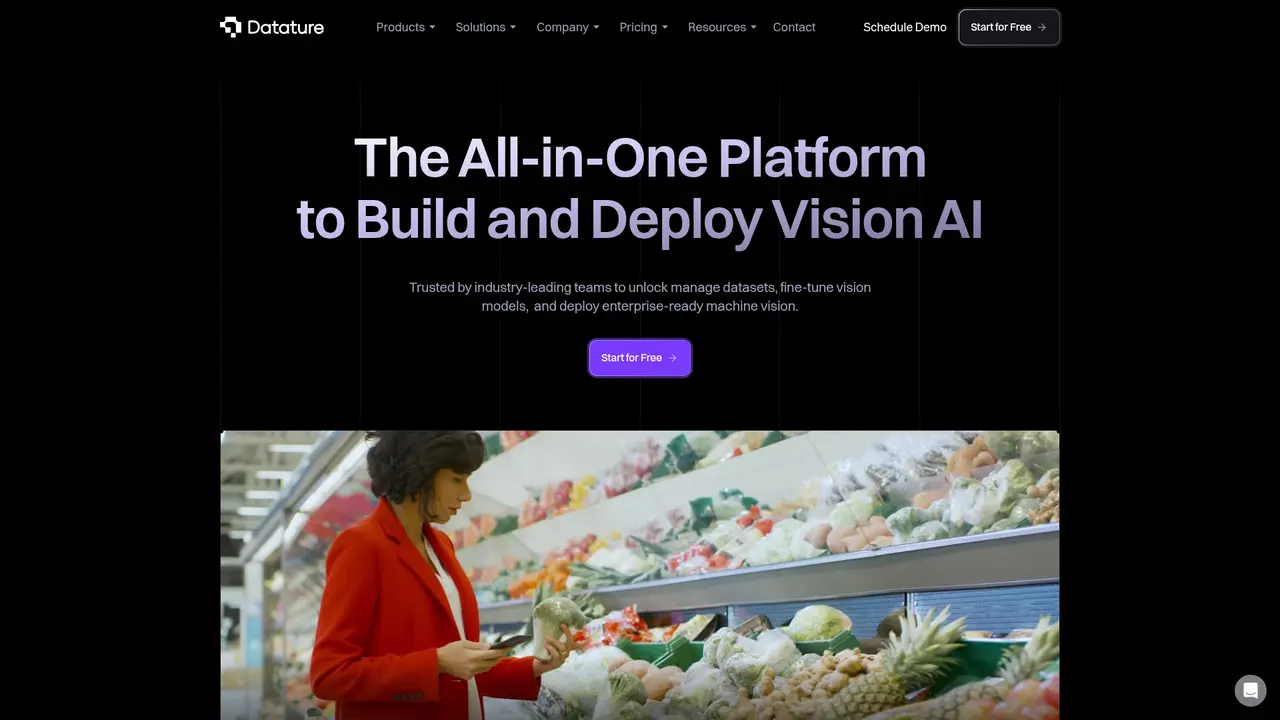
Datature changes this equation entirely. We're an end-to-end Vision AI platform that enables your team to build, train, and deploy production-grade computer vision models without writing a single line of code. From annotating your images and videos to training neural networks and shipping them to production, everything happens in one unified platform.
What makes Datature different is our focus on the entire ML workflow, not just individual pieces. While other tools might help with labeling or only with training, we've built a complete solution that handles data annotation, model training, dataset management, and deployment in one place. This means your team moves faster and avoids the integration headaches that come with stitching together multiple tools.
The platform has earned the trust of over 6,000 teams worldwide, including innovative companies across healthcare, manufacturing, retail, and smart city applications. On G2, we've been recognized as a Data Labeling High Performer and MLOps Platforms High Performer, reflecting our commitment to delivering enterprise-grade capabilities that actually work in real-world scenarios.
Security matters when you're handling sensitive visual data. That's why Datature maintains SOC2 Type 2 compliance and HIPAA compliance, with the ability to sign Business Associate Agreements for healthcare customers. All your data is encrypted both at rest and in transit, and we run regular security assessments to keep your projects protected.
:::card{type="summary" title="TL;DR"}
- Trusted by 6,000+ enterprise teams worldwide
- Complete no-code platform: from annotation to deployment in one workflow
- SOC2 Type 2 and HIPAA certified for sensitive data handling
- G2 recognized as Data Labeling and MLOps High Performer :::
---
Core Features That Actually Move the Needle
AI-Powered Data Annotation
Your annotation quality directly determines model performance, but manual labeling is painfully slow. Datature accelerates this with IntelliBrush, our AI-driven segmentation tool that delivers pixel-level precision in seconds rather than hours. You can create precise masks for semantic and instance segmentation, draw bounding boxes for object detection, and even work with 3D point cloud data.
Beyond the annotation tools themselves, we've built collaborative workflows right into the platform. Internal and external labelers can work simultaneously, with built-in approval and consensus mechanisms that ensure everyone stays aligned on quality standards. Real-time progress tracking lets project managers see exactly where bottlenecks are before they become problems.
For teams that need to attach additional context to their data, you can add custom metadata like GPS coordinates, patient IDs, or any domain-specific information that helps your models learn relevant patterns.
No-Code Model Training
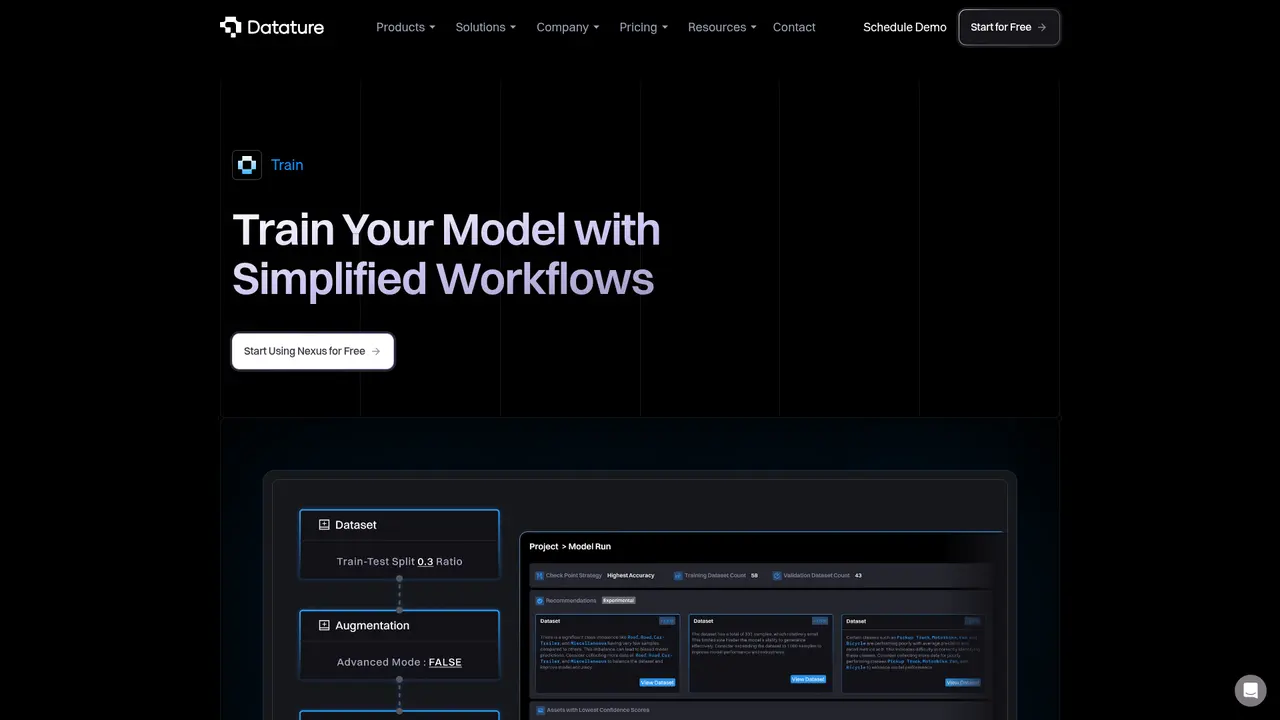
Training a vision model traditionally requires writing PyTorch or TensorFlow code, configuring environments, and managing GPU resources. Datature eliminates all of that. Our visual workflow builder lets you construct training pipelines by dragging and dropping components, selecting from state-of-the-art architectures like FasterRCNN and YOLOX.
You have full control over hyperparameters—batch size, learning rate, number of epochs, and model architecture choices—all through intuitive interfaces rather than code. The platform handles the underlying infrastructure, including multi-GPU training for faster iteration. We also include built-in data augmentation capabilities that help your models generalize better without you needing to become an augmentation expert.
One thing that surprises many users: you can start with pre-trained models and fine-tune them on your specific data. This transfer learning approach dramatically reduces the amount of labeled data you need and accelerates your path to production-quality models.
Flexible Deployment Options
Getting models into production is where many AI projects die. Datature gives you multiple paths forward. Deploy to our cloud infrastructure with GPU-accelerated inference for real-time or batch processing. Or push models to edge devices for on-premises processing where latency or connectivity is a concern.
All deployments expose REST APIs that integrate seamlessly with your existing applications. For Professional and Enterprise customers, we offer auto-scaling so your inference infrastructure grows with your traffic. We also support ONNX export and other standard formats, giving you flexibility if you need to run models in other environments.
The platform even supports continuous improvement through active learning workflows, where model predictions help identify which new data would be most valuable to label and retrain on.
Enterprise-Grade Dataset Management
Your data is an asset that needs proper organization. Datature provides structured dataset management with custom labeling taxonomies, metadata support, and version control. Whether you're working with standard images and videos or medical imaging formats like DICOM and NIFTI, the platform handles your format natively.
Advanced search and filtering let you find exactly the data you need for specific training runs or evaluations. Export capabilities support multiple formats, making it simple to use your labeled data across different tools or share with collaborators.
Collaboration That Scales
From the Startup plan onward, you can invite team members and external collaborators to work on projects. Role-based access control gives you fine-grained permissions—whether you need basic read access or advanced administrative controls over projects and billing.
For teams that want programmatic access, our Python SDK enables automation of common workflows. Connect Datature to your CI/CD pipelines, trigger training runs from other systems, or build custom integrations that match your existing processes.
Model Evaluation That Actually Helps
Training is only useful if you know how your model performs. Datature's interactive dashboards visualize precision, recall, F1 scores, and other metrics that matter. You can see exactly where your model excels and where it struggles through intuitive visualizations that compare predictions against ground truth annotations.
::::grid :::card{type="advantages"}
- Complete workflow: Everything from labeling to deployment in one platform—no tool switching
- AI-assisted annotation: IntelliBrush dramatically speeds up pixel-precise segmentation
- No coding required: Build production models through visual interfaces
- Flexible deployment: Cloud GPU, edge devices, or export in standard formats
- Enterprise security: SOC2 Type 2 and HIPAA compliant with full encryption
- Multiple data formats: Native support for images, videos, DICOM, and NIFTI ::: :::card{type="disadvantages"}
- Learning curve: Advanced features require time to master for teams new to ML
- Limited offline support: Core functionality requires internet connectivity
- Customization limits: Very specialized architectures may need custom solutions beyond the platform ::: ::::
:::card{type="tip" title="💡 Choosing the right features"} If you're just starting out, focus on AI-assisted annotation and pre-trained model fine-tuning. These two features alone can cut your project timeline significantly. Save advanced hyperparameter tuning for iteration two or three, once you've established baseline performance. :::
---
Who Uses Datature
Healthcare and Medical Imaging
Medical institutions face unique challenges: they need to analyze vast quantities of imaging data while meeting strict compliance requirements. Datature supports DICOM and NIFTI formats natively, and our HIPAA-compliant infrastructure means you can work with sensitive patient data without compromising security.
Macro Insight, one of our healthcare customers, built a clinical decision support system that helps physicians analyze medical images faster and more accurately. By removing the technical barriers to building vision models, their team focused on what matters most—improving patient outcomes rather than wrestling with infrastructure.
If you're in healthcare, the platform's compliance certifications and audit capabilities make it straightforward to meet regulatory requirements while still moving quickly.
Manufacturing and Construction
Quality control in manufacturing and construction is expensive and often inconsistent. Computer vision can inspect products at scale, catching defects that human reviewers might miss—especially on repetitive tasks where attention fades.
Trendspek uses Datature to train models that detect concrete cracks in high-resolution infrastructure images. Their models help inspectors identify problems before they become safety issues. Similarly, Ingroth developed an industrial AI system for automated barrel defect detection, catching quality issues at production speed.
For manufacturing and construction teams, the key value is consistent, scalable inspection that works 24/7 without the costs and variability of manual review.
Retail and E-Commerce
Retailers sit on mountains of visual data—from shelf inventory photos to customer behavior footage—but often lack the tools to extract actionable insights. Datature helps you build models that automate inventory tracking, analyze store layouts, and even understand customer patterns.
The platform's ability to handle both images and video means you can work with whatever visual data you already collect. Rather than guessing about stock levels or customer flow, you get objective, data-driven insights that improve operations.
Smart City Infrastructure
City planners and utility managers deal with massive visual datasets from traffic cameras, surveillance systems, and infrastructure sensors. Building models that analyze this data helps optimize traffic flow, improve public safety, and maintain infrastructure more efficiently.
Datature's support for large-scale datasets and efficient training makes it practical to build models that process thousands of images daily. Whether you're analyzing traffic patterns or monitoring public spaces, the platform scales to your needs.
Agriculture
Modern agriculture generates enormous amounts of visual data from drones, sensors, and automated monitoring systems. Building vision models helps optimize crop monitoring, predict yields, and identify problems before they spread.
If you're working on agricultural technology, Datature's flexible deployment options mean you can run models on edge devices in the field, even with limited connectivity. Process images locally and sync results when connections are available.
Utilities and Energy
Maintaining infrastructure like power lines, pipelines, and treatment facilities requires constant inspection. Traditional inspection methods are costly and sometimes dangerous. Vision models can automatically analyze inspection imagery, flagging issues that need human attention.
The platform's ability to work with high-resolution imagery and support for edge deployment makes it practical to deploy models directly to inspection teams in the field.
:::card{type="tip" title="💡 Finding your fit"} Not sure which scenario matches your situation? Consider this: if your team has labeled data and needs to move to production quickly, Datature handles the entire journey. If you're still figuring out whether computer vision solves your problem, start with our Free plan to validate your use case with minimal investment. :::
---
Getting Started Fast
Setting Up Your Environment
The first step is straightforward: visit datature.io and create your account. We support regional server deployment across North America, Europe, and Asia, so you can choose the location that minimizes latency for your team.
Once logged in, you create a workspace and then a new project. You'll choose your task type—classification, object detection, semantic segmentation, instance segmentation, or pose estimation—based on what you need your model to do.
Preparing Your Data
You have options for getting data into the platform. The simplest is direct upload of images or videos. For larger datasets, connect directly to external storage buckets: S3, Google Cloud Storage, and Azure Blob are all supported natively.
You'll also define your dataset ontology—the labeling schema for your project. We support basic, advanced, and custom ontology configurations depending on how complex your labeling needs are.
Annotation That Doesn't Take Forever
This is where Datature really shines. Launch the annotation interface and you'll find IntelliBrush available for segmentation tasks. Instead of tracing object boundaries manually, you click and the AI generates precise masks instantly. You can refine edges if needed, but the heavy lifting is done.
For object detection, draw bounding boxes and the platform can suggest additional detections based on what it learned from your existing annotations. This dramatically speeds up the labeling process.
All annotations go through your configured workflow—whether that's simple approval or multi-stage consensus review. Quality metrics help you identify annotation issues before they propagate to training.
Training Your First Model
With annotated data ready, you're ready to train. Select a pre-trained foundation model—we recommend starting with YOLOX for detection tasks or FasterRCNN if you need the flexibility of a two-stage detector.
Configure your training parameters through the visual interface. Start with sensible defaults, then experiment with epochs, batch size, and augmentation strategies as you learn what works for your specific data.
The training dashboard shows real-time progress including loss curves and validation metrics. You'll see exactly how your model is learning and can interrupt training if you spot problems early.
Deployment That Matches Your Needs
When your model performs well on your validation set, export it in your preferred format. ONNX works across most deployment scenarios. For cloud deployment, our API infrastructure handles the scaling. For edge scenarios, export to your device and run inference locally.
If you're on Professional or Enterprise plans, you can take advantage of auto-scaling and dedicated infrastructure options that match production traffic patterns.
Free Plan Limitations
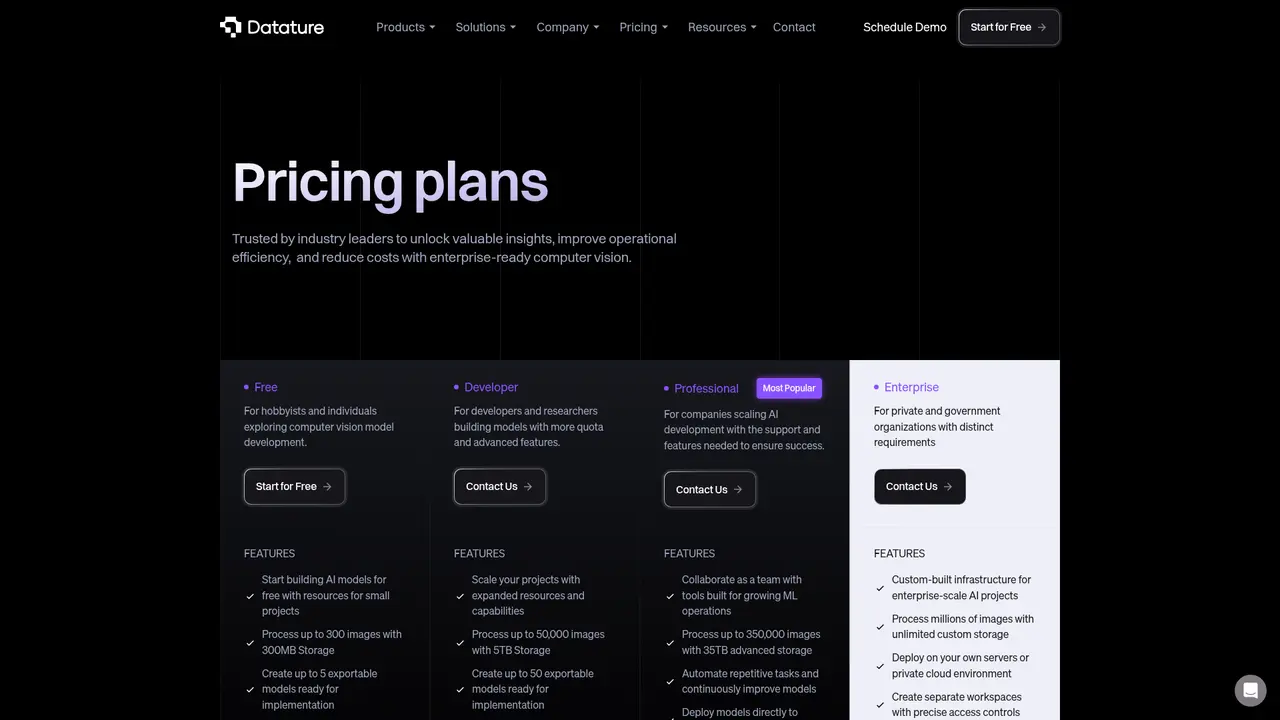
Starting with Datature is free, but there are constraints worth knowing. The Free plan includes 300 images, 300MB storage, 300 AI-assisted annotation tokens per month, 300 training minutes, and 5 model exports. These limits let you validate use cases and learn the platform before committing to a paid plan.
:::card{type="tip" title="💡 Best practices for new users"} Start small: use the Free plan to validate your specific use case with a few hundred images before investing in larger data collection. This approach confirms computer vision actually solves your problem before you build out full datasets. Second, leverage pre-trained models—even with limited labeled data, transfer learning typically outperforms training from scratch. :::
---
Pricing That Scales With Your Ambitions
We designed our pricing to match where you are in your AI journey. Whether you're validating an idea or running enterprise-scale production systems, there's a plan that fits.
Free Plan — Start Exploring
Perfect for individuals testing concepts and learning the platform. You get 300 images, 300MB storage, 300 AI annotation tokens monthly, 300 training minutes, and 5 model exports. With 120,000 inference minutes per month, you can run plenty of test predictions. This plan lets you validate whether computer vision solves your specific problem before investing more heavily.
Startup Plan — Growing Teams
For teams ready to move beyond proof-of-concept. Capacity jumps to 50,000 images and 5TB storage. AI annotation tokens increase to 30,000 monthly, with 3,000 training minutes and 50 model exports. You can invite collaborators, unlock smart annotation tools, and access dedicated inference infrastructure. This plan supports real projects with meaningful datasets.
Professional Plan — Production Ready
Designed for teams running computer vision in production. 350,000 images and 35TB storage provide substantial capacity. 100,000 AI tokens and 20,000 training minutes monthly support intensive development cycles. 500 model exports give you flexibility in deployment strategies.
Professional customers gain cloud plus on-premises deployment options, custom SLAs, and dedicated success managers who help you maximize platform value. A 14-day Production Pilot Plan trial lets you validate the full professional feature set before committing.
Enterprise Plan — At Scale
For organizations with massive vision AI initiatives. Capacity exceeds one million images with customizable storage and compute. Unlimited workspaces eliminate project silos. Full cloud and on-premises deployment options, custom SLA terms, and priority support ensure your specific requirements are met.
Beyond the core plans, we offer additional services: extra training minutes, additional user seats, deployment containers, implementation support, custom feature development, and academic research programs. Enterprise customers work directly with our team to build packages that match their specific needs.
| Plan | Images | Storage | AI Tokens | Training Min/Month | Best For | |------|--------|---------|-----------|-------------------|----------| | Free | 300 | 300MB | 300 | 300 | Individual testing, concept validation | | Startup | 50,000 | 5TB | 30,000 | 3,000 | Small teams, early production projects | | Professional | 350,000 | 35TB | 100,000 | 20,000 | Production workloads, multiple models | | Enterprise | 1M+ | Custom | Custom | 50,000+ | Large organizations, custom requirements |
:::card{type="tip" title="💡 Making the right choice"} Not certain which plan fits? Start with Free to validate your use case. When you need to scale beyond 300 images or want AI-assisted annotation, upgrade to Startup. Professional becomes necessary when you're deploying to production and need custom SLAs, on-premises options, or dedicated support. :::
---
Frequently Asked Questions
:::card{type="faq" title="Do you offer monthly payment plans?"} Yes. Our Developer Tier provides monthly payment options. For Professional and Enterprise plans, please contact our sales team to discuss terms that match your organization's needs. :::
:::card{type="faq" title="Is there a free trial for the Professional plan?"} Absolutely. Professional customers receive a 14-day Production Pilot Plan trial that lets you experience the full feature set—including cloud and on-premises deployment, custom SLAs, and dedicated support—before making a commitment. :::
:::card{type="faq" title="What data types and model architectures do you support?"} We support multiple data formats: standard images and videos, plus medical imaging formats DICOM and NIFTI. For model tasks, we cover classification, object detection, semantic segmentation, instance segmentation, and pose estimation. Our architectures include FasterRCNN and YOLOX, with pre-trained weights you can fine-tune on your data. :::
:::card{type="faq" title="How does AI-assisted annotation work?"} Starting with the Startup plan, you get access to model-assisted labeling. The platform uses fine-tuned models to automatically generate initial labels for your data. You review and refine these predictions rather than starting from scratch, dramatically accelerating your annotation workflow. The more you label, the smarter these models become on your specific data distribution. :::
:::card{type="faq" title="What payment methods do you accept?"} We process secure online payments through Stripe, supporting major credit and debit cards. For Enterprise customers, we also accommodate wire transfers and other payment arrangements. Stripe meets PCI Service Provider Level 1 standards, ensuring your payment data is handled securely. :::
:::card{type="faq" title="How do you ensure data security?"} Security is foundational to our platform. We maintain SOC2 Type 2 certification and HIPAA compliance (with BAA availability for healthcare customers). All data is encrypted both at rest and in transit. Sensitive information receives application-layer encryption before database storage. We perform regular backups (intervals up to 12 hours), run ongoing security scans, conduct penetration testing, and perform red team exercises. Vulnerabilities are tracked through Vanta within our compliance framework. Our infrastructure includes Cloudflare CDN-level DDoS protection and fail2ban measures against brute-force access attempts. :::
Related Content
Copy.ai Review 2026: AI Copywriting Made Easy
Our honest Copy.ai review for 2026. We test Content Agents, AI Workflows, pricing ($29-$249/mo), and compare it to Jasper and Writesonic. Find out if it's worth it for your marketing team.

Rytr Review 2026: Is This Budget AI Writer Worth It?
Our hands-on Rytr review for 2026. We test features, pricing, content quality, and compare it to Jasper & ChatGPT. Find out if Rytr is the best budget AI writing tool.

Word Changer - Free AI tool to rewrite and improve your writing instantly
Writing always using repetitive words or need to avoid plagiarism? Word Changer is a free AI writing assistant that instantly rewrites any text with richer vocabulary and appropriate tone. Get multiple versions with one click, adjust formality level, check readability - all for free!

Unite - AI-powered platform for romantic fantasies and dream couple moments
Explore romantic fantasies and create special moments for your dream couple. This AI-powered platform lets you generate personalized romantic content and experience exclusive AI-created romantic experiences.
Comments