


Cradle - AI-powered protein engineering platform for scientists
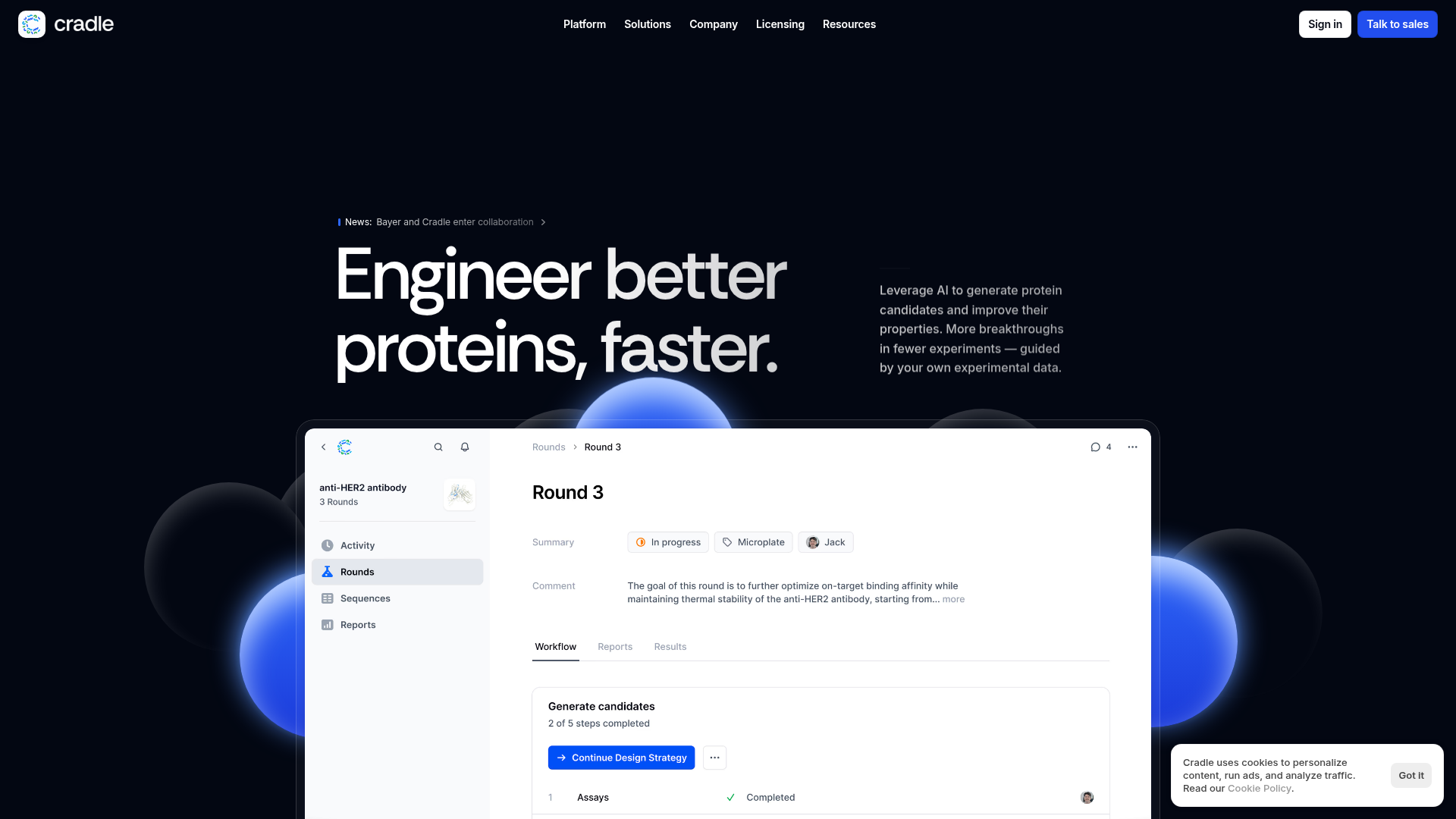
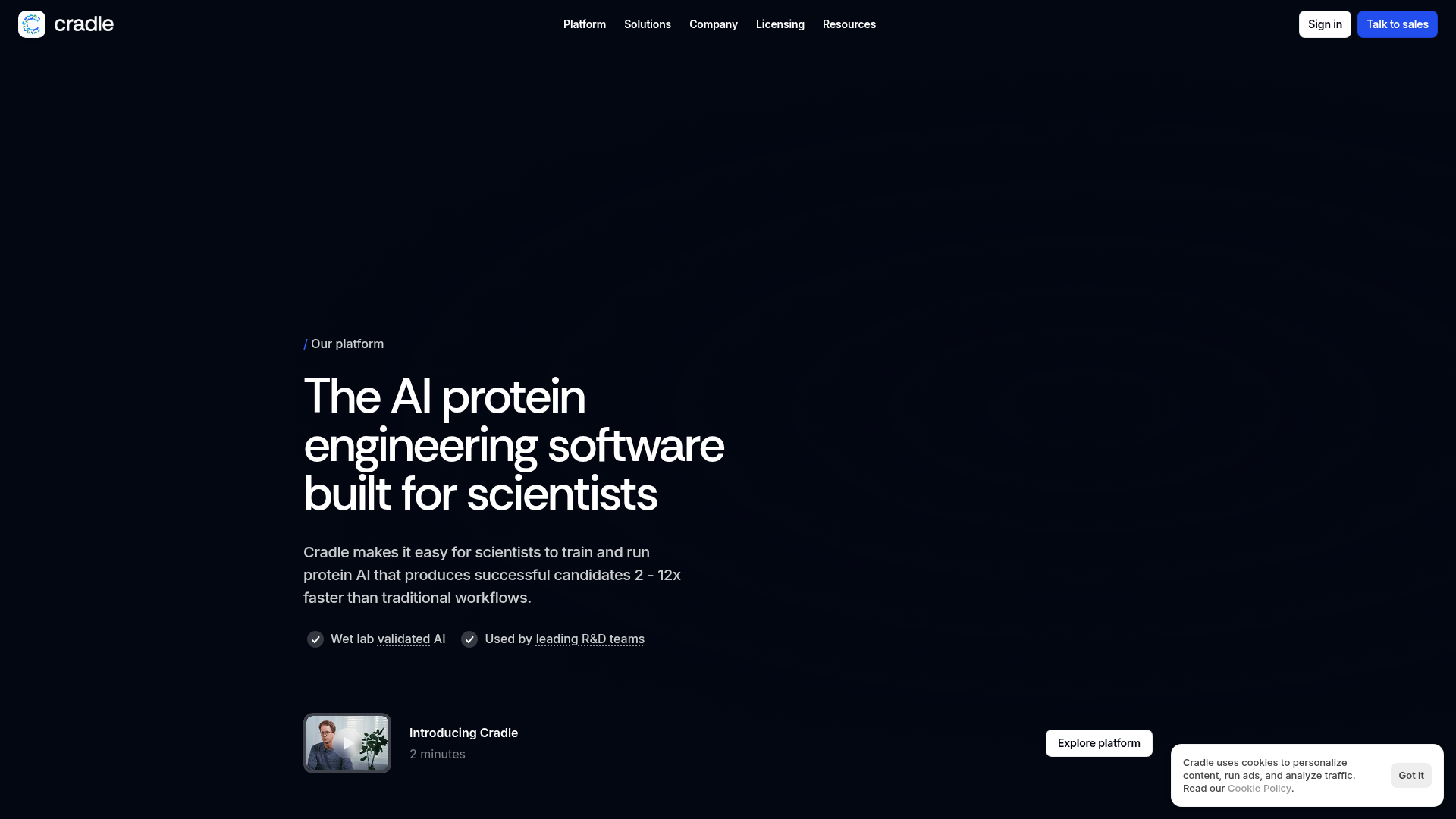
Launched on Feb 23, 2025Cradle is an AI-powered protein engineering platform that helps scientists design protein candidates and improve their properties. By combining machine learning with experimental data, the platform accelerates R&D by 2-12x. Designed for biopharma companies, industrial biotechnology, and academic research.
What is Cradle
If you've ever worked in protein engineering, you know the frustration. Traditional approaches to developing new proteins—whether for therapeutics, industrial enzymes, or vaccines—rely heavily on trial and error. You'd design dozens or hundreds of variants, run wet lab experiments, analyze results, and then start the cycle again. This process can take months or even years, consuming significant resources with no guarantee of success.
That's exactly the challenge Cradle was built to solve.
Cradle is an AI-powered protein engineering platform that helps scientists accelerate their R&D from concept to candidate. Instead of relying solely on exhaustive screening, you can leverage machine learning models trained on both public datasets and your own experimental data to predict which protein designs are most likely to succeed. The result? 2 to 12 times faster development timelines, with candidates that scientists consistently rate 8 out of 10 for performance.
What sets Cradle apart is its ability to simultaneously optimize multiple protein properties—activity, stability, expression level, binding affinity, and more—in a single design round. Rather than trading off one attribute for another, the platform finds solutions that balance all your targets. And because the models learn from your specific experimental data, they get smarter the more you use them.
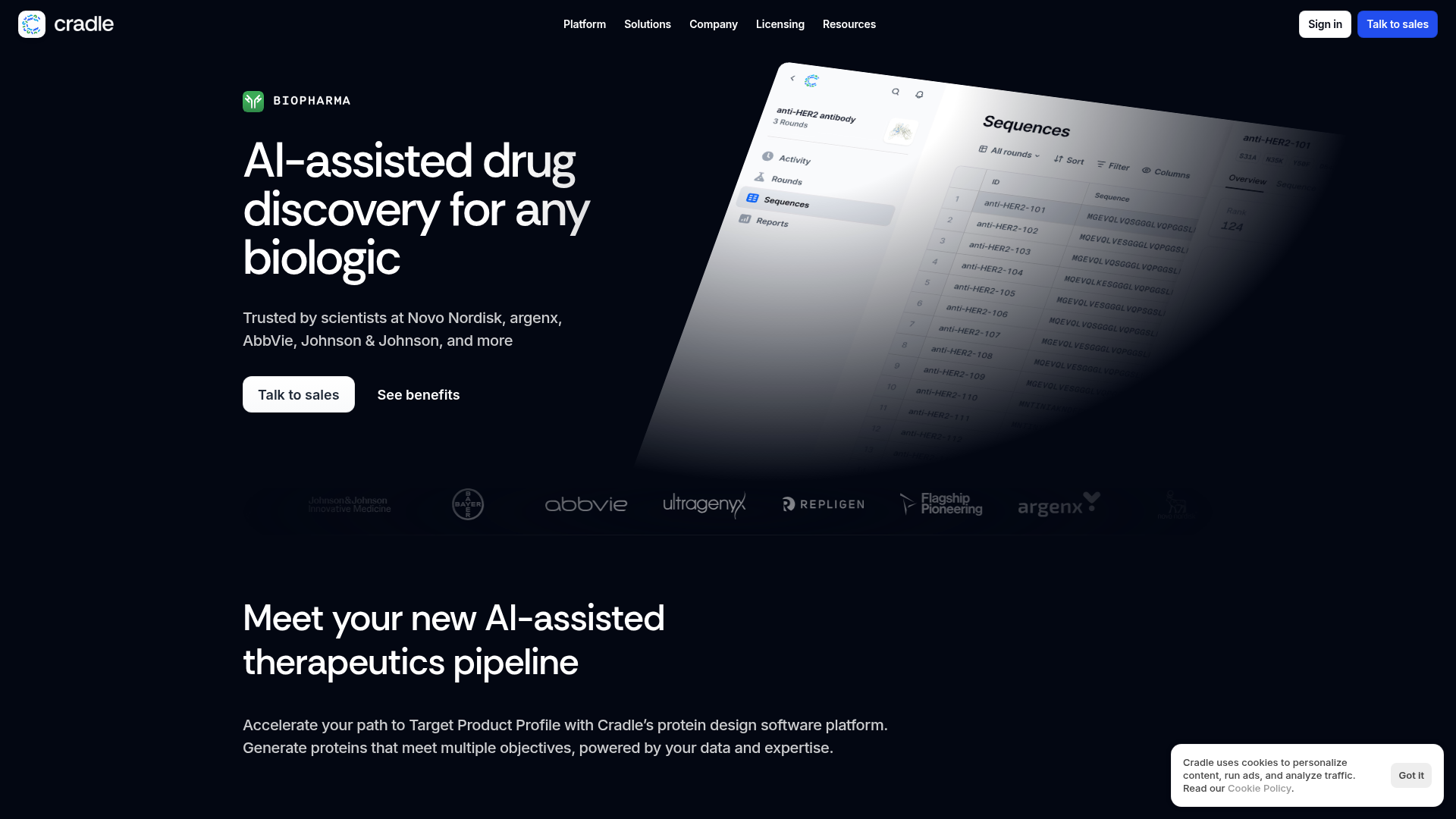
Over 50 projects have validated these acceleration results, and Cradle is now trusted by leading organizations including Novo Nordisk, Novonesis, Bayer, argenx, AbbVie, Johnson & Johnson, Immunai, and Pfizer. Whether you're a biopharma company developing next-generation antibodies or an industrial biotech firm engineering robust enzymes, Cradle gives your team a powerful edge in bringing better proteins to market faster.
:::card{type="summary" title="TL;DR"}
- AI-driven protein design: Machine learning models generate and optimize protein candidates in weeks, not months
- Multi-property optimization: Simultaneously balance activity, stability, expression, and binding affinity
- Wet lab verified: Every feature tested in Cradle's own Amsterdam laboratory before release
- Enterprise security: SOC 2 Type II certified with full IP protection and EU data residency :::
---
Core Features That Accelerate Your Protein Engineering
What makes Cradle genuinely useful isn't just the AI technology—it's how that technology translates into real workflow improvements for scientists and R&D teams. Here's what you can actually do with the platform.
Multi-Property Optimization
You can use this feature to simultaneously improve multiple protein attributes in a single design cycle. Instead of optimizing for binding affinity and then separately addressing stability, Cradle's optimization engine balances all your target properties together. This is particularly valuable for antibody affinity maturation, where you need to improve binding strength while maintaining developability and avoiding immunogenicity. For enzyme engineering, it means you can push catalytic activity higher without sacrificing thermal stability or expression yields.
Automated Model Finetuning
Every time you upload experimental results from your lab, Cradle automatically fine-tunes its models to better understand your specific protein of interest. You don't need machine learning expertise—the platform handles the technical work. Starting from a single sequence or a small dataset is perfectly fine; the system uses public pre-training data as a foundation and then adapts to your molecular context. As your experimental database grows, the models become increasingly精准 (precise) at predicting what will work in your specific system.
Intelligent Plate Design
Rather than randomly testing hundreds of variants, you can rely on Cradle's intelligent selection process. The platform runs thousands of virtual simulations to identify the most promising candidates from millions of possible designs, then constructs an optimized experimental plate that maximizes your chance of success. This approach has earned consistently high marks from scientists—those 8 out of 10 ratings we mentioned? They reflect real-world performance in the lab, not just computational predictions.
Advanced Sequence Design Controls
When you need precise control over where mutations occur, Cradle delivers. You can define template sequences, block specific mutations, constrain changes to particular protein regions, and set custom optimization objectives. This level of control matters when you're working with known structural domains that shouldn't be modified, or when you need to avoid certain sequence motifs entirely. The platform supports enzymes, antibodies, and peptides across virtually any protein modality.
Data and Workflow Management
Your laboratory data is valuable, and Cradle helps you manage it properly. The platform offers flexible data management with custom schemas that match your lab's existing workflows, complete audit trails for compliance, and full API access for integration with your other tools. Whether you're working across multiple teams or preparing for regulatory audits, the infrastructure supports your operational needs.
Enterprise-Grade Security
For organizations concerned about IP protection, Cradle provides comprehensive security controls including SSO integration with Google and Microsoft, multi-factor authentication, role-based access permissions, and the robust protections you'd expect from enterprise software. More importantly, your data stays yours—we'll cover this in detail in the security section, but the core principle is straightforward: your intellectual property remains yours with no royalty obligations.
::::grid :::card{type="advantages"}
- 2-12x faster timelines: Proven across 50+ client projects
- Simultaneous multi-property optimization: Balance activity, stability, expression, and binding in one run
- Learns from your data: Models improve as you upload experimental results
- Wet lab verified: Every feature validated in Cradle's Amsterdam laboratory
- Flexible design controls: Precise control over mutation positions and types
- Full API access: Integrate into existing workflows and automation pipelines ::: :::card{type="disadvantages"}
- API integration required: Some advanced workflows benefit from programmatic access
- Enterprise tier needed: Advanced security features require business licensing
- Technical familiarity helpful: Users benefit from basic protein engineering knowledge ::: ::::
---
Who Is Using Cradle
Cradle serves a diverse range of organizations across biopharma, industrial biotechnology, food technology, and academic research. Understanding how others use the platform can help you identify whether it's the right fit for your team.
Biopharma and Antibody Drug Discovery
If you're working in antibody discovery, you likely face the challenge of balancing binding potency with developability. Traditional approaches rely on large screening campaigns that are time-consuming and expensive. With Cradle, you can start from a single sequence or an existing antibody dataset and use AI to generate optimized candidates through affinity maturation. The platform simultaneously considers developability risks—immunogenicity, aggregation potential, post-translational modification sites—so your candidates aren't just potent they're also ready for downstream development.
Enzyme Engineering for Industrial Applications
Industrial enzymes need to perform under challenging conditions: high temperatures, extreme pH levels, or the presence of solvents. You can't afford to sacrifice activity for stability or vice versa. Cradle's multi-property optimization is particularly valuable here, allowing you to find the sweet spot between catalytic performance and environmental robustness. Companies like Novonesis use this capability to develop enzymes for applications ranging from biofuel production to food ingredient manufacturing.
Vaccine Antigen Design
Designing vaccine antigens involves its own unique balance—you need proteins that are stable enough to manufacture and store, yet immunogenic enough to trigger protective immune responses. Cradle helps teams optimize both stability and immunogenicity simultaneously, accelerating the path from antigen identification to candidate selection.
Multi-Specific Antibody Development
Developing bispecific or multi-specific antibodies adds another layer of complexity: you need to optimize binding for multiple targets at once while maintaining proper molecular architecture. Cradle supports virtually all antibody formats—VHH, scFv, Fab, IgG, and bispecific configurations—giving you the flexibility to explore multiple modalities.
Protein Developability Optimization
One of the most frustrating outcomes in protein engineering is investing months developing a candidate only to discover developability issues late in the process. Cradle helps you avoid these costly failures by screening for developability risks early: immunogenicity, aggregation propensity, glycosylation sites, and other liabilities that often surface during late-stage CMC (chemistry, manufacturing, and controls) work.
Academic and Research Applications
Even if your team is just starting out with limited data, Cradle provides value. You can initiate projects from a single sequence, leveraging the platform's pre-trained public models while building your own proprietary dataset. This makes it accessible for academic research groups exploring novel protein engineering challenges without extensive historical data.
:::card{type="tip" title="💡 Choosing Where to Start"} If your team needs to optimize multiple protein properties simultaneously—like improving binding affinity while maintaining stability—we recommend starting with the multi-property optimization feature. It delivers the broadest impact and establishes a foundation you can refine with more advanced controls later. :::
---
Technical Architecture and Capabilities
Understanding what's under the hood helps you appreciate why Cradle performs the way it does—and whether it will integrate smoothly with your existing infrastructure.
Cloud Infrastructure
Cradle is built on Google Cloud Platform with data centers located in the Netherlands (europe-west4 region), ensuring your data stays within the EU. This matters for regulatory compliance and data sovereignty requirements. The infrastructure is fully managed—you never need to worry about provisioning GPUs, managing model training pipelines, or maintaining servers. Cradle handles all of that, updating AI models every two weeks so you always benefit from the latest improvements.
Multi-Property Optimization Engine
The core optimization engine can handle any measurable protein attribute you want to improve. Whether it's enzymatic activity, thermal stability, binding kinetics, expression yield, or something more specialized, the system models how these properties relate to each other and finds candidates that meet all your targets simultaneously. This isn't a simple trade-off calculator—it uses sophisticated machine learning to understand complex relationships between sequence and function.
Modular Task System
When you need to explore multiple hypotheses in parallel, Cradle's modular task system lets you run several training and generation configurations simultaneously. This accelerates discovery by allowing your team to compare different approaches without sequential bottlenecks.
Wet Lab Verification
Here's something that distinguishes Cradle from purely computational tools: we maintain our own wet laboratory in Amsterdam where every platform feature gets tested before release. This means when Cradle generates a design, it's not just a computational prediction—it's been validated under real experimental conditions. Your team benefits from this verification without needing to run your own preliminary tests.
API-First Design
For teams with sophisticated automation needs, Cradle offers comprehensive API access covering the entire workflow. You can programmatically submit design requests, retrieve results, integrate with laboratory information management systems (LIMS), and build automated pipelines that combine AI design with high-throughput experimentation. This makes Cradle suitable for organizations looking to scale their protein engineering operations beyond manual workflows.
Continuous Learning
Unlike static software, Cradle improves continuously. Each time you upload experimental results, the models incorporate that feedback, becoming more accurate for your specific protein family and experimental context. This learning effect compounds over time—one of the most compelling reasons to adopt the platform early and build your proprietary dataset.
::::grid :::card{type="advantages"}
- European data residency: GDPR-compliant storage in Netherlands Google Cloud
- Fully managed infrastructure: No hardware or ML ops requirements for customers
- Rapid model updates: AI models refreshed every two weeks
- Wet lab validated: Real experimental verification before feature release
- Full workflow API: Programmatic access from design through analysis
- Continuous learning: Models improve with your experimental data ::: :::card{type="disadvantages"}
- Biological knowledge required: Users should understand basic protein engineering concepts
- Experimental validation still needed: AI predictions require lab verification (though success rates are high)
- Learning curve: Teams benefit from time to learn platform capabilities thoroughly ::: ::::
---
Security and Compliance
If you're evaluating enterprise software for scientific R&D, security and intellectual property protection are likely top of mind. Here's exactly how Cradle handles these concerns.
Data Protection
Your data is encrypted both at rest (AES-256) and in transit (TLS 1.2+). Cradle maintains SOC 2 Type II certification and is fully GDPR compliant. Critically, your experimental data is never used to train models for other customers—each organization gets logically isolated model environments. Your data trains only your models.
Data Location
All customer data is stored in Google Cloud's Netherlands region (europe-west4), with automatic replication to other EU regions for redundancy. If your organization has specific data residency requirements, this EU-centric architecture addresses them directly.
Intellectual Property
You retain full ownership of all intellectual property generated through the platform. Cradle charges a software subscription fee only—there are no royalty obligations or IP licensing concerns. Your designs, your candidates, your breakthroughs: 100% yours.
Access Controls
The platform supports enterprise identity management through SSO integration with Google and Microsoft, plus multi-factor authentication (MFA) and passkey support. Role-based permissions let administrators control exactly what each team member can access, view, or modify.
Trust and Transparency
Cradle publishes a trust center with detailed security documentation, vulnerability reporting procedures, and clear policies. If your organization requires vendor security assessments, the team can provide supporting documentation and answer questions directly.
:::card{type="summary" title="Your Security Guarantees"}
- Data sovereignty: All data stored in EU (Netherlands), never leaves Europe without your consent
- IP protection: You retain 100% ownership; no royalties, no shared models
- Certified security: SOC 2 Type II and GDPR compliant with independent verification
- Enterprise controls: MFA, SSO, role-based access, complete audit trails :::
---
Frequently Asked Questions
:::card{type="faq" title="How does Cradle protect my intellectual property?"} Your data is used exclusively to train models for your organization—it is never shared with other customers or used for any purpose beyond your specific projects. All models are stored in completely isolated environments. Cradle holds SOC 2 Type II certification and is GDPR compliant. You retain full IP ownership of all designs and discoveries generated through the platform, with no royalty requirements. :::
:::card{type="faq" title="I don't have much experimental data. Can I still use Cradle?"} Absolutely. You can start a project from a single protein sequence. Cradle's models are pre-trained on extensive public and proprietary datasets, giving you a strong starting point without requiring your own historical data. As you run experiments and upload results, the models continuously improve to reflect your specific molecular context. :::
:::card{type="faq" title="What types of proteins does Cradle support?"} Cradle supports virtually any protein modality: monoclonal antibodies, bispecific and multi-specific antibodies, enzyme therapeutics, vaccine antigens, peptides, and more. If you can measure a property of the protein, Cradle can optimize for it. :::
:::card{type="faq" title="How is Cradle different from a traditional CRO?"} Cradle is a software platform, not a contract research organization. We provide AI-powered design and analysis tools—you run the experiments in your own laboratory or partner with a CRO of your choice. The platform generates predictions and designs, but you maintain full control over the experimental validation. :::
:::card{type="faq" title="How can I trust that AI-generated candidates will work in the lab?"} Every feature on Cradle's platform is verified in our own wet laboratory in Amsterdam before release. Our intelligent plate design process runs thousands of virtual simulations to maximize success probability. Customer feedback consistently shows that 8 out of 10 AI-generated candidates meet expected performance targets in experimental validation—significantly higher than traditional screening approaches. :::
:::card{type="faq" title="What is the pricing model?"} Cradle charges a straightforward software subscription fee with no royalty obligations. Specific pricing depends on your organization's needs and scale. The team recommends scheduling a demo to discuss your use case and find the right plan for your team. :::
:::card{type="faq" title="Where is my data stored?"} All data is stored in Google Cloud's Netherlands region (europe-west4), with redundant copies maintained across other EU regions. This architecture ensures data residency within the EU while providing reliable disaster recovery. :::
Related Content
Copy.ai Review 2026: AI Copywriting Made Easy
Our honest Copy.ai review for 2026. We test Content Agents, AI Workflows, pricing ($29-$249/mo), and compare it to Jasper and Writesonic. Find out if it's worth it for your marketing team.

Rytr Review 2026: Is This Budget AI Writer Worth It?
Our hands-on Rytr review for 2026. We test features, pricing, content quality, and compare it to Jasper & ChatGPT. Find out if Rytr is the best budget AI writing tool.

Word Changer - Free AI tool to rewrite and improve your writing instantly
Writing always using repetitive words or need to avoid plagiarism? Word Changer is a free AI writing assistant that instantly rewrites any text with richer vocabulary and appropriate tone. Get multiple versions with one click, adjust formality level, check readability - all for free!

Unite - AI-powered platform for romantic fantasies and dream couple moments
Explore romantic fantasies and create special moments for your dream couple. This AI-powered platform lets you generate personalized romantic content and experience exclusive AI-created romantic experiences.
Comments