


CopilotKit - AI-powered framework for in-app copilots
Launched on Feb 18, 2025CopilotKit is an open-source framework for building AI-powered in-app copilots and agentic applications. It provides streaming-first architecture, supports 10+ agent frameworks and LLM providers, and offers an enterprise-grade platform with the AG-UI protocol. Developers can build contextual, action-oriented AI assistants that integrate seamlessly with React, Next.js, and Vue applications.
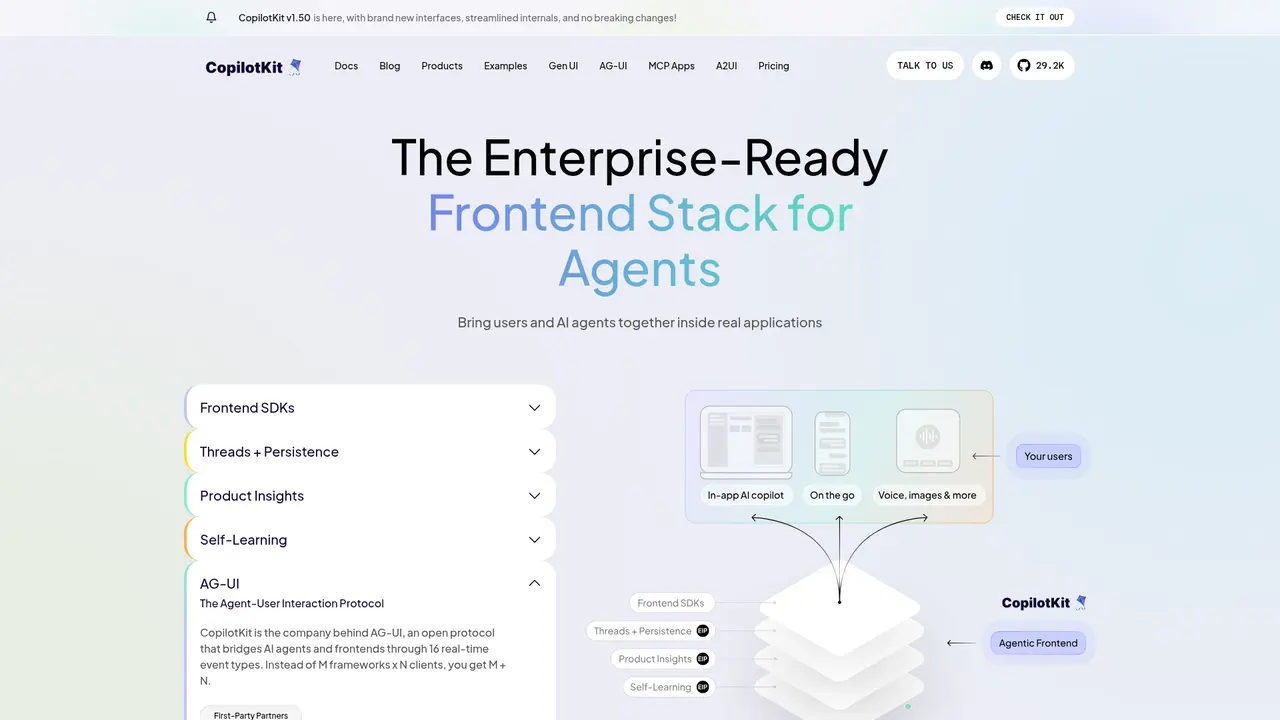
CopilotKit: The Enterprise-Ready Frontend Stack for In-App AI Copilots
Application developers building AI assistants face a fundamental challenge: the complexity of creating a unified frontend infrastructure that can connect diverse AI agents to user-facing applications. Traditional approaches require significant investment in custom engineering to handle real-time streaming, state synchronization, and multimodal interactions. CopilotKit addresses this gap as an open-source AI Agent frontend framework designed specifically for building production-ready in-application copilots.
The framework provides a comprehensive building stack that handles the entire lifecycle of AI copilot development—from real-time streaming responses to persistent conversation threads and generative user interfaces. Built with a streaming-first architecture, CopilotKit enables developers to create responsive AI experiences that maintain bidirectional state synchronization between the application and AI agents. This architectural decision ensures that users receive low-latency feedback while the AI maintains real-time context awareness throughout the interaction.
CopilotKit has achieved significant market traction with over 100,000 developers using the framework and 29.2k GitHub stars. The platform powers production deployments at more than 10% of Fortune 500 companies, including enterprise leaders such as Cisco, Deloitte, DocuSign, TripAdvisor, UKG, Oracle, Alibaba, AWS, and Google. This widespread adoption demonstrates the framework's ability to meet rigorous enterprise requirements while maintaining developer-friendly abstractions.
:::card{type="summary" title="TL;DR"}
- Open-source framework under MIT License with enterprise-grade capabilities
- Creator and maintainer of the AG-UI open protocol for Agent-User interaction
- Native support for 10+主流 Agent frameworks including LangGraph, LlamaIndex, and CrewAI
- Active community of 100,000+ developers with enterprise production deployments :::
CopilotKit's Core Features
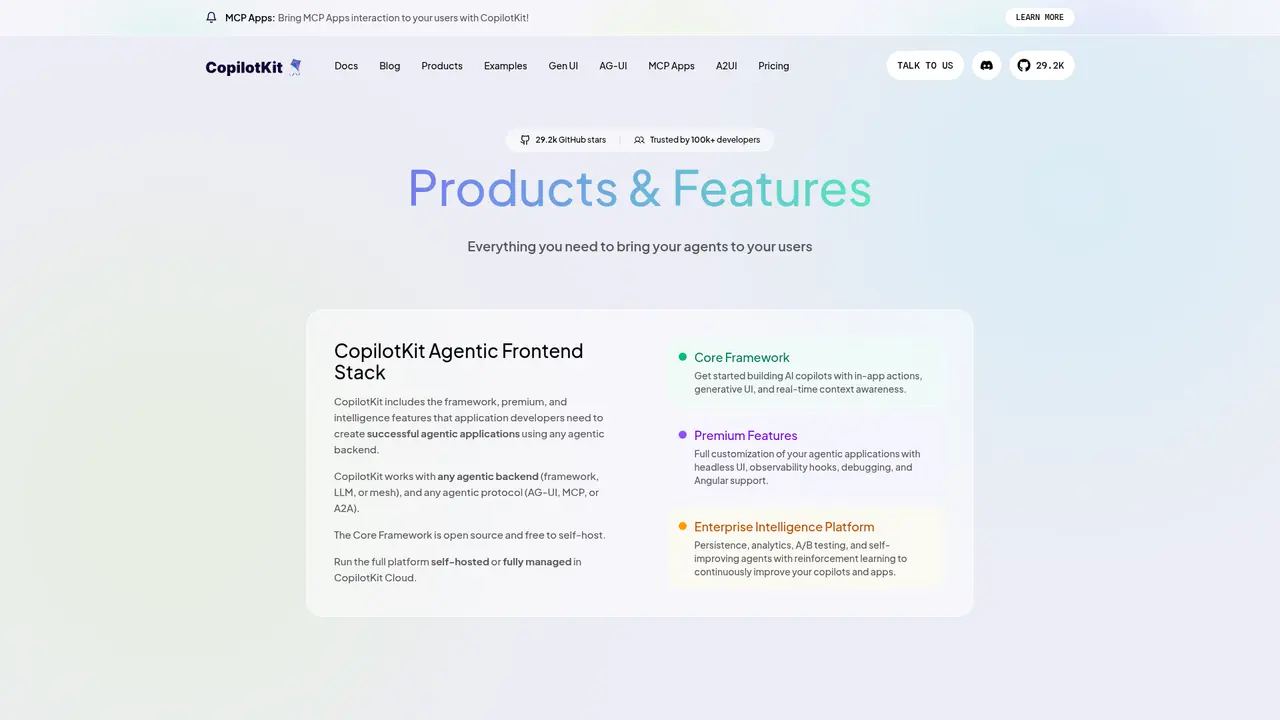
CopilotKit provides four foundational capabilities that enable developers to rapidly build sophisticated AI copilots. Each feature addresses specific technical challenges in the AI application development lifecycle, from UI implementation to persistent state management.
Frontend SDKs offer developers flexible implementation options. The framework provides pre-built, customizable components for rapid deployment alongside a fully headless mode for complete code-level control. SDKs are available for React, Next.js, and Vue, with Angular support in the enterprise edition. This modular approach allows teams to balance development speed against customization requirements based on project needs.
Threads + Persistence transforms conversation management beyond simple text exchanges. The system maintains persistent interaction threads that support five distinct generative UI styles, human-in-the-loop interventions, voice interactions, and file uploads. This comprehensive multimodal support enables developers to create rich, context-aware conversations that persist across user sessions. The architecture supports conversation branching and recovery, ensuring users can revisit and continue previous discussions seamlessly.
In-app Actions enable AI agents to execute operations directly within the application. Developers can define actions ranging from simple API calls to complex multi-step workflows. This capability bridges the gap between conversational interfaces and practical application functionality, allowing users to accomplish tasks through natural language instructions rather than manual interface navigation.
Generative UI empowers AI agents to dynamically generate and render interface components based on conversation context. Rather than limiting interactions to text-based responses, this feature enables agents to create rich, interactive visual experiences. The generative approach adapts the interface to each user's specific needs, delivering personalized experiences that evolve with the conversation.
:::card{type="summary" title="Key Capabilities"}
- Streaming-first architecture for real-time, low-latency responses
- Modular SDK design supporting multiple frontend frameworks
- Bidirectional state synchronization between application and AI agents
- Comprehensive multimodal interaction support including voice and file handling :::
Technical Architecture and Core Capabilities
The technical foundation of CopilotKit rests on three architectural pillars that differentiate it from alternative solutions: streaming-first design, protocol-based connectivity, and framework-agnostic flexibility.
Streaming-first Architecture represents the core design philosophy. Unlike traditional request-response patterns, CopilotKit maintains persistent connections that deliver AI responses in real-time. This approach provides immediate user feedback, reducing perceived latency and creating more natural conversational flows. The bidirectional state synchronization ensures that both the application UI and the AI agent maintain consistent context throughout the interaction, enabling features like live suggestion updates and collaborative editing.
AG-UI Protocol serves as the connective tissue between AI agents and user-facing applications. CopilotKit created and maintains this open protocol, which has gained industry adoption from partners including Google, Oracle, Alibaba, AWS, and Microsoft. The protocol standardizes how agents communicate with applications, enabling interoperability across different agent frameworks and LLM providers. This standardization reduces integration complexity and future-proofs applications against framework evolution.
The framework demonstrates exceptional flexibility through its broad support matrix. Agent frameworks supported include LangGraph, LlamaIndex, Agno, Mastra, Google ADK, AWS Strands, Microsoft Agent Framework, Pydantic AI, CrewAI, Vercel AI SDK, and AG2. Similarly, LLM providers supported include OpenAI, Anthropic, Gemini, Grok, and Ollama. This vendor-neutral approach prevents lock-in while enabling organizations to leverage existing infrastructure investments.
Protocol compatibility extends to emerging industry standards including AG-UI, MCP (Model Context Protocol), and A2A (Agent-to-Agent). This multi-protocol support ensures applications can integrate with diverse agent ecosystems without custom integration code.
::::grid :::card{type="advantages"}
- Open-source core: MIT Licensed framework with full source code availability
- Framework flexibility: No vendor lock-in, supports 10+ Agent frameworks and 5+ LLM providers
- Enterprise support: Dedicated support channels, SLA guarantees, and enterprise-grade security features
- Protocol leadership: AG-UI protocol creator with industry partner adoption ::: :::card{type="disadvantages"}
- Frontend expertise required: Teams need React/Next.js/Vue development experience for optimal implementation
- Angular limitation: Angular support requires Enterprise edition licensing
- Self-hosting complexity: Full on-premises deployment requires DevOps expertise for production environments ::: ::::
Use Cases and Application Scenarios
CopilotKit serves three primary use cases, each addressing distinct user needs and interaction patterns. Understanding these scenarios helps developers identify the most relevant implementation approach for their applications.
SaaS Copilot addresses the complexity challenge in traditional software interfaces. Conventional SaaS applications often require users to learn multiple操作方式和界面导航 patterns. CopilotKit enables intent-oriented interfaces where AI understands user goals from natural language descriptions and executes corresponding operations. This approach dramatically reduces the learning curve while improving user efficiency. Complex multi-step workflows become simple conversational requests, transforming how users interact with enterprise software.
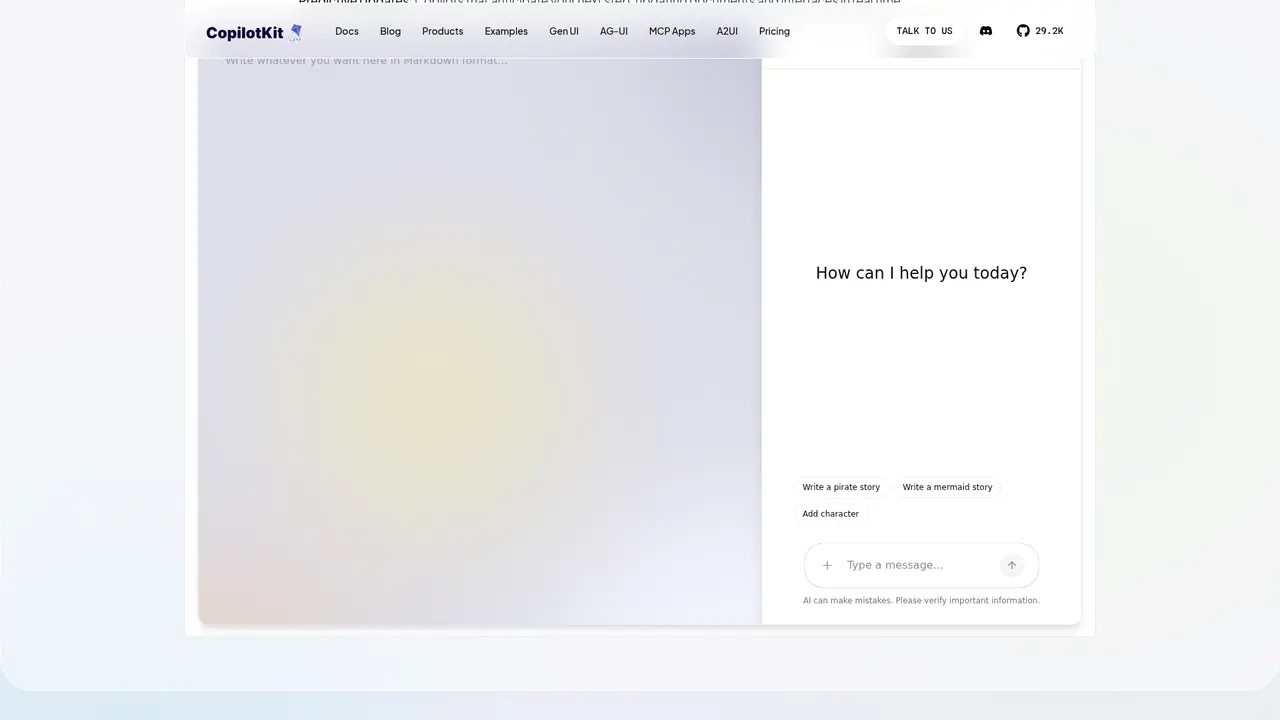
Co-Creation Copilot positions the AI agent as an active collaborator in content creation processes. Rather than simply generating content based on prompts, the copilot works alongside users to produce better outputs more efficiently. This pattern applies to document creation, code generation, design work, and any domain where human creativity combined with AI capabilities exceeds either alone. The persistent context and bidirectional feedback enable true collaborative workflows rather than one-way generation.
Enterprise Agentic Applications solve the transparency challenge in autonomous agent deployments. When agents operate entirely in background processes, users lack visibility into agent actions and cannot intervene when needed. CopilotKit's AG-UI protocol implementation creates transparent, reliable Agent-User interactions where users continuously understand what the agent is accomplishing. Human-in-the-loop capabilities enable intervention at any point, ensuring appropriate oversight for high-stakes enterprise workflows.
:::card{type="tip" title="💡 Selection Guidance"} For small projects and prototyping, start with the open-source Developer edition to evaluate framework capabilities. Teams requiring production deployment with moderate user volumes should consider the Team edition for dedicated support and higher usage limits. Organizations with strict security requirements or complex deployment scenarios should engage directly with CopilotKit's enterprise team for customized solutions. :::
Pricing Plans
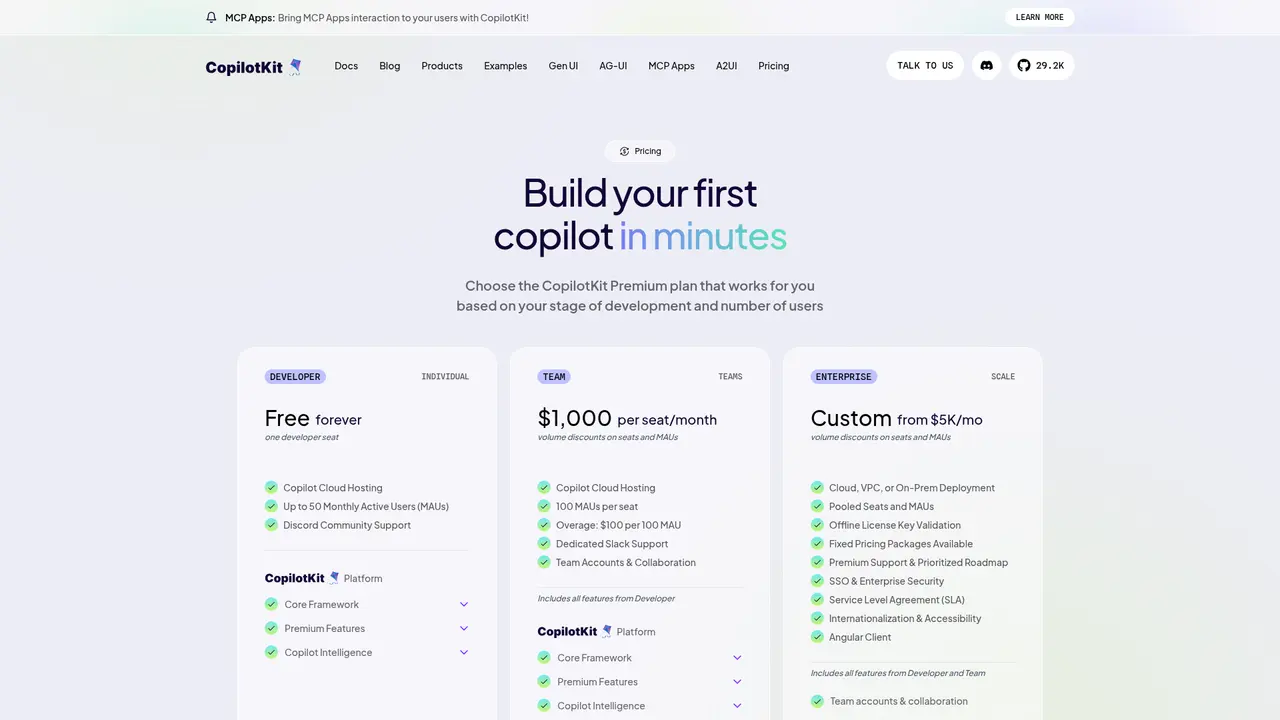
CopilotKit offers a structured three-tier pricing model designed to serve developers, growing teams, and enterprise organizations. Each tier provides increasing capabilities while maintaining flexibility for different deployment requirements.
| Plan | Price | Key Features | Target Users | |------|-------|--------------|---------------| | Developer | Free (permanent) | Copilot Cloud托管, up to 50 MAUs, Discord社区支持 | Individual developers, hobby projects, evaluation | | Team | $1,000/seat/month | Copilot Cloud托管, 100 MAUs per seat, $100/100 MAU overage, Slack support | Growing teams, startups, production apps | | Enterprise | Custom, from $5,000/month | Cloud/VPC/On-Prem deployment, pooled seats and MAUs, offline license validation, SSO, SLA, Angular client | Large organizations, regulated industries |
The Developer plan provides permanent free access ideal for individual developers exploring the framework or building hobby projects. With up to 50 monthly active users and community support through Discord, developers can fully evaluate framework capabilities before committing to paid tiers.
The Team plan at $1,000 per seat monthly supports production deployments with higher usage requirements. Each seat includes 100 monthly active users with straightforward overage billing at $100 per additional 100 users. Dedicated Slack support provides faster issue resolution than community channels.
The Enterprise plan begins at $5,000 monthly with full deployment flexibility including cloud, VPC, or on-premises installations. Enterprise features include offline license validation for air-gapped environments, SSO integration for corporate identity management, SLA service level agreements, and Angular client support. Organizations with specific security, compliance, or deployment requirements can work with CopilotKit's team for customized solutions.
An open-source option remains available for organizations preferring self-hosted deployments. The core framework operates under MIT License, enabling full customization and deployment in any infrastructure environment.
Frequently Asked Questions
:::card{type="faq" title="What is the difference between AG-UI, MCP, and A2A protocols?"} These protocols address different layers of Agent communication. AG-UI defines the interaction layer between users, applications, and Agents—controlling how Agents communicate with user-facing interfaces. MCP (Model Context Protocol) handles context management and model communication, ensuring Agents have access to relevant data and tools. A2A (Agent-to-Agent) manages coordination and communication between multiple Agents, enabling multi-Agent systems to collaborate effectively. :::
:::card{type="faq" title="How does AG-UI differ from A2UI?"} A2UI (Agent-to-User Interface) is a generative UI specification developed by Google that allows Agents to deliver UI widgets and components. AG-UI provides broader functionality as a complete bidirectional runtime connection between any Agentic backend and user-facing applications. While A2UI focuses specifically on UI generation, AG-UI handles the full spectrum of Agent-User interaction including state synchronization, action execution, and real-time streaming. :::
:::card{type="faq" title="Which frontend frameworks does CopilotKit support?"} The framework provides native SDKs for React, Next.js, and Vue. Angular support is available in the Enterprise edition. All SDKs maintain feature parity for core capabilities, with enterprise features like Angular support reserved for paid tiers. The headless mode enables custom implementations for other frameworks when needed. :::
:::card{type="faq" title="Can I use my own LLM with CopilotKit?"} Yes. CopilotKit is vendor-neutral and supports any LLM provider including OpenAI, Anthropic, Gemini, Grok, and Ollama. The framework does not mandate specific providers, allowing organizations to use preferred models or switch based on performance, cost, or capability requirements. Integration follows standard interfaces without custom adapter development. :::
:::card{type="faq" title="Is self-hosting supported?"} Yes. The core CopilotKit framework is open-source under MIT License, enabling complete self-hosted deployments. Organizations can run the framework in their own infrastructure without CopilotKit Cloud services. Self-hosting requires appropriate DevOps expertise for production environments. Enterprise plans offer additional deployment options including VPC and on-premises installations with dedicated support. :::
Related Content
Copy.ai Review 2026: AI Copywriting Made Easy
Our honest Copy.ai review for 2026. We test Content Agents, AI Workflows, pricing ($29-$249/mo), and compare it to Jasper and Writesonic. Find out if it's worth it for your marketing team.

Rytr Review 2026: Is This Budget AI Writer Worth It?
Our hands-on Rytr review for 2026. We test features, pricing, content quality, and compare it to Jasper & ChatGPT. Find out if Rytr is the best budget AI writing tool.

Word Changer - Free AI tool to rewrite and improve your writing instantly
Writing always using repetitive words or need to avoid plagiarism? Word Changer is a free AI writing assistant that instantly rewrites any text with richer vocabulary and appropriate tone. Get multiple versions with one click, adjust formality level, check readability - all for free!

Unite - AI-powered platform for romantic fantasies and dream couple moments
Explore romantic fantasies and create special moments for your dream couple. This AI-powered platform lets you generate personalized romantic content and experience exclusive AI-created romantic experiences.
Comments