


Alan AI - Build adaptive context-aware voice assistants into your apps
Launched on Feb 23, 2025Alan AI is an enterprise-grade AI application platform that enables you to build adaptive, context-aware voice assistants directly into your apps. Powered by proprietary Three-Layer AI architecture, it transforms month-long development cycles into minutes.
What is Alan AI
If you've ever tried to use a traditional voice assistant to navigate complex enterprise software, you know the frustration: you ask a simple question, and the assistant either doesn't understand the context or can only perform basic tasks like setting reminders. That's because most voice assistants are designed as standalone devices—they live outside your applications and can't access the APIs, data, or workflows that power your business.
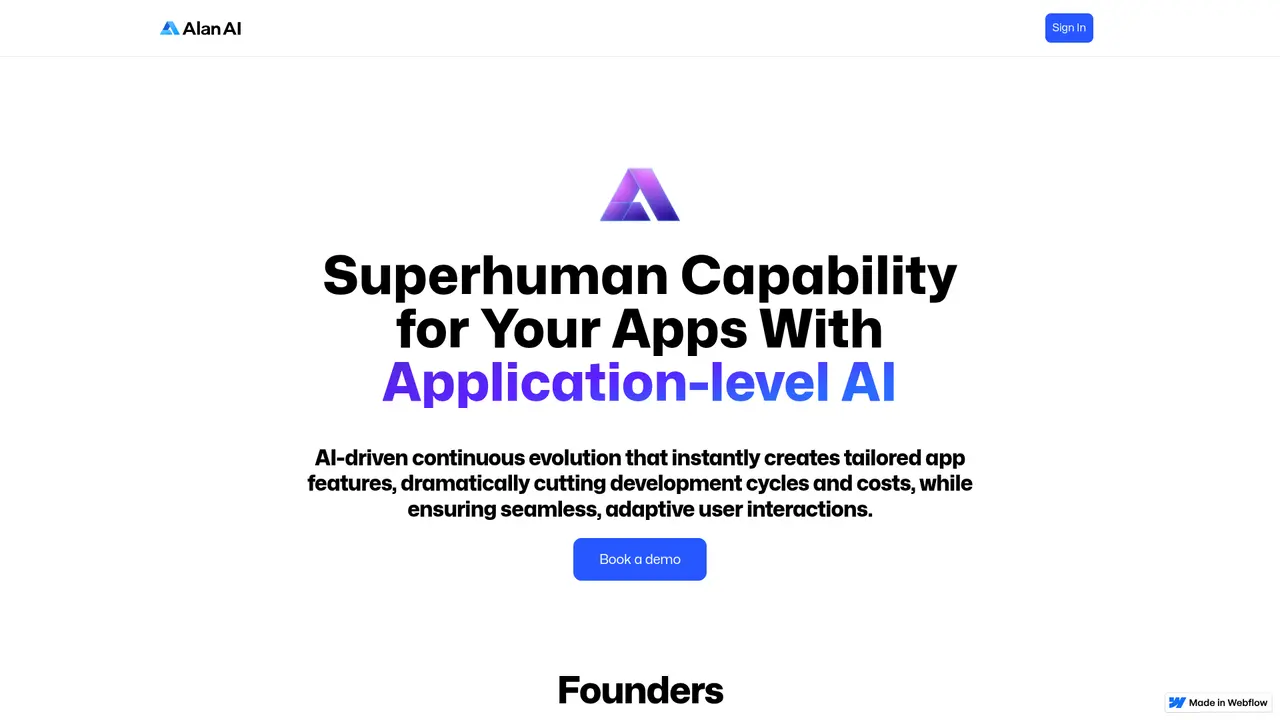
Alan AI takes a fundamentally different approach. It's an Application-Level AI platform, meaning the voice interface lives directly inside your applications. Instead of asking users to switch between your app and a separate voice device, Alan AI understands your APIs, your data structures, and your users' behavior. When someone asks "Show me last month's sales figures" or "Create a support ticket for the server outage," Alan AI executes those commands within your application in real time.
Under the hood, Alan AI is powered by its proprietary Three-Layer AI (3LAI) architecture. This innovative framework builds what Alan AI calls an Ideal Synthetic Environment—a controlled, verified constraint system that generates algorithmically verifiable code. The result? Voice interactions that don't just sound smart—they actually work reliably, every single time.
The platform has earned the trust of over 60,000 registered users and serves more than 18 million end users across Healthcare, Energy, Education, E-commerce, Government, and Transportation industries. Notable clients include Save the Children, MediKarma, Murphy Oil Corp, OrgaTech, and Incture Technologies. Murphy Oil Corp's implementation even reached the SAP Innovation Award finals—a testament to the platform's enterprise-grade capabilities.
:::card{type="summary" title="TL;DR"}
- Application-Level AI embeds voice interface directly inside your applications
- Three-Layer AI (3LAI) architecture with Ideal Synthetic Environment ensures reliable, verifiable code generation
- 26,000+ self-service deployments with 60,000+ registered users
- 18,000,000+ end users across 6 major industries
- Trusted by enterprises like Save the Children, MediKarma, and Murphy Oil Corp :::
---
Alan AI's Core Features
What can Alan AI actually do for your team and your users? Here's how the platform translates cutting-edge AI technology into real-world value.
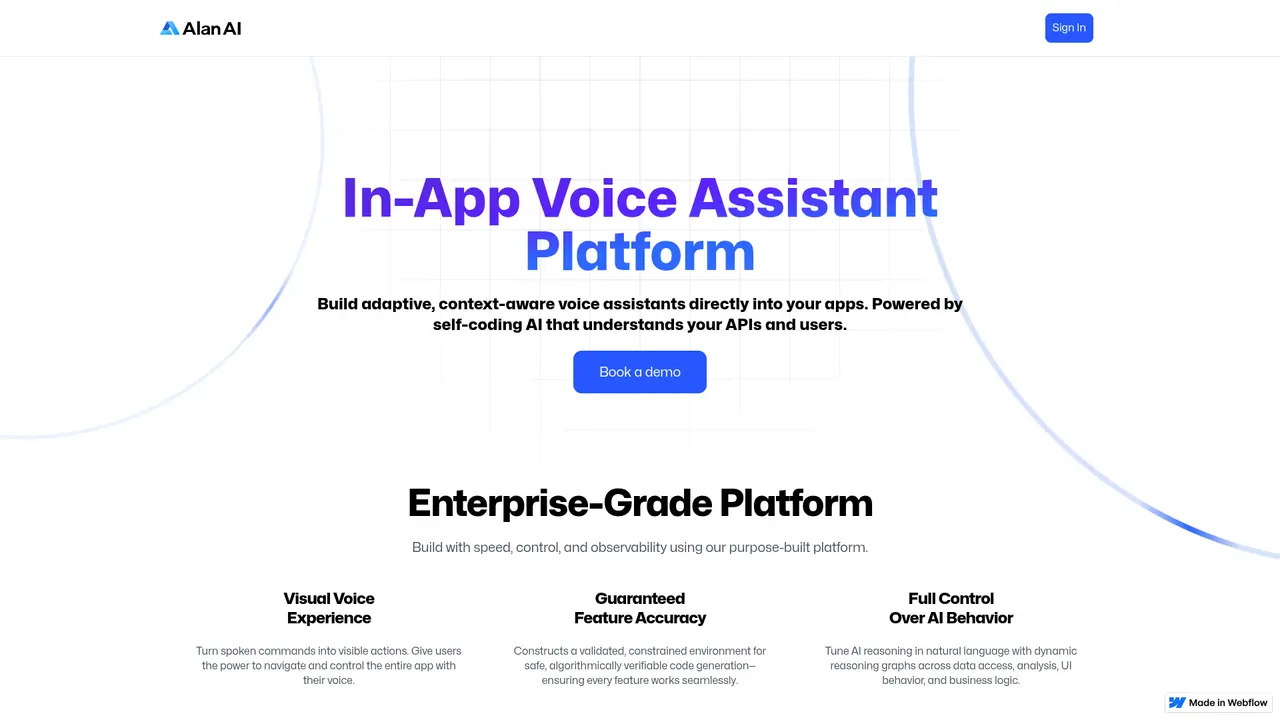
Visual Voice Experience transforms how users interact with your applications. When users speak commands, Alan AI converts those voice inputs into visible, actionable elements on screen—menus highlight, data populates, forms complete. Your users can navigate and control the entire application through voice alone, without ever touching a keyboard or mouse.
Guaranteed Feature Accuracy addresses one of the biggest challenges in AI-powered applications: reliability. Alan AI builds a verified constraint environment where every possible voice command maps to tested, working code paths. This isn't experimental AI—it's a system that guarantees each feature runs correctly. When your users ask for something, they get the right result.
Full Control Over AI Behavior gives your development team unprecedented flexibility. Through natural language, you can tune dynamic reasoning graphs that govern data access, analytics, UI behavior, and business logic. If the AI isn't responding exactly as needed, you can adjust its behavior without rewriting code.
Enterprise Privacy & Security recognizes that different organizations have different compliance requirements. Alan AI supports SaaS deployment for fast setup, VPC deployment on AWS, GCP, or Azure for enhanced isolation, and fully on-premise or VMWare Private AI installations for complete data sovereignty. Your data stays where you need it to stay.
Immersive User Experience integrates seamlessly into your existing interface. The SDK is lightweight—it doesn't require a complete UI redesign or force users to learn a new workflow. Voice functionality appears naturally within your application's current look and feel.
Multi-LLM Support means you're not locked into a single AI provider. Alan AI works with OpenAI, Anthropic, DeepSeek, Mistral, Llama, and other models. As AI technology evolves, you can switch or combine models based on performance, cost, or capability requirements.
Alan AI Studio provides a visual development environment that dramatically speeds up Agentic Interface design. Your team can prototype, test, and deploy voice interfaces without writing extensive code.
Alan AI Analytics delivers actionable insights into user behavior. You'll understand how users interact with your voice interface, what commands are most popular, and where friction points exist—data that helps you continuously improve the experience.
::::grid :::card{type="advantages"}
- Guaranteed reliability: Algorithmically verified code generation eliminates the "AI hallucination" problem
- Flexible deployment: From SaaS to fully on-premise, security requirements are met your way
- Future-proof: Multi-LLM architecture means you're not locked into today's technology
- Fast time-to-value: Visual Studio environment accelerates development cycles ::: :::card{type="disadvantages"}
- Initial learning curve: Teams new to voice interface design need time to think differently about user interactions
- Customization required: Enterprise deployments typically require configuration to match specific security and compliance needs ::: ::::
:::card{type="tip" title="💡 Getting Started"} If you're new to Alan AI, start with Alan AI Studio's visual development environment. Most teams complete basic integration within a week and iterate from there. The Playground apps (available on iOS and Android) let you test the experience before committing to development. :::
---
Technical Architecture and Features
For technical teams evaluating Alan AI, understanding the architecture behind the platform is essential—and it's where Alan AI truly differentiates itself.
The Three-Layer AI (3LAI) architecture is the foundation. Unlike monolithic AI systems, this three-layer design separates concerns: the first layer handles voice input and natural language understanding, the second layer manages reasoning and context, and the third layer executes actions within your application. This separation is what enables the platform to guarantee feature accuracy—the system knows exactly what each voice command should trigger because it controls the entire pipeline.
The Ideal Synthetic Environment is perhaps the most innovative aspect. Alan AI doesn't just generate code and hope it works—it builds a controlled environment where every possible input-output relationship is verified. When the AI generates code to handle a user request, that code has already been validated against known constraints. This is fundamentally different from prompt-based AI that produces different outputs each time.
The Actionable AI Tech Stack encompasses multiple capabilities: Question Answering for conversational interfaces, Semantic Search for finding relevant information across your data, Reporting for analytics and data visualization, Private Data Sources for secure enterprise data access, and Actions in apps for executing tasks beyond just providing information. This isn't a chatbot—it's a voice-powered interface that can actually do things.
Context Awareness enables Alan AI to understand not just individual commands but conversational flow. If a user asks "Show me our Texas locations" and follows up with "Which one has the most capacity?", the system understands the second question refers back to the first context. This makes conversations feel natural rather than robotic.
The SDK support covers the full spectrum of modern development frameworks. On the web side, React, Angular, Vue, Ember, JavaScript, and Electron are all supported. Mobile development is covered for iOS, Android, Flutter, Ionic, React Native, and Apache Cordova. Whatever your team uses to build applications, Alan AI fits in.
The deployment architecture follows a Platform-as-a-Service (PaaS) model, giving you flexibility in how and where the platform runs. SaaS offers the fastest path to value. Virtual Private Cloud (VPC) deployment on AWS, GCP, or Azure provides dedicated infrastructure. On-premise deployment via Helm Charts puts everything in your data center. VMWare Private AI extends this to private cloud environments.
::::grid :::card{type="advantages"}
- Verified code generation: Ideal Synthetic Environment ensures every AI-generated action is reliable
- Full-stack flexibility: PaaS model with support for every major deployment option
- Enterprise-ready SDKs: Battle-tested integrations across web and mobile frameworks
- Context-aware conversations: Understanding flow, not just individual commands ::: :::card{type="disadvantages"}
- Architecture complexity: The three-layer design, while powerful, requires understanding during implementation
- On-premise overhead: Fully self-hosted deployments require significant operational investment ::: ::::
:::card{type="tip" title="💡 Deployment Selection"} Enterprise customers with strict security requirements should consider VPC or On-Premise deployment from the start. While SaaS offers the fastest onboarding, the additional isolation may be necessary for compliance with healthcare (HIPAA), financial services, or government regulations. :::
---
Who Uses Alan AI
Understanding who already uses Alan AI can help you determine whether the platform fits your use case. Here are the most common scenarios.
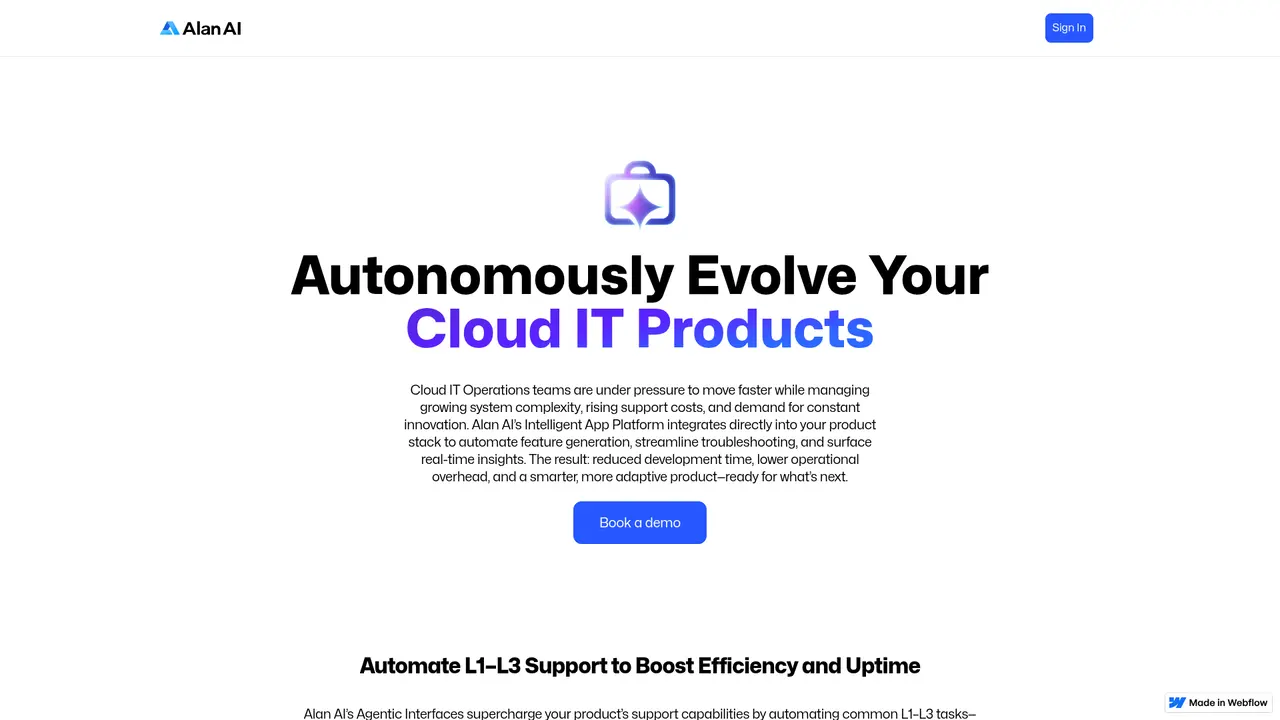
IT Operations teams face ever-increasing system complexity, rising support costs, and constant pressure to innovate. By integrating Alan AI into their product stack, these teams automate feature generation, simplify troubleshooting, and gain real-time operational insights. The result is faster development cycles, lower operational overhead, and products that adapt more quickly to changing requirements.
Enterprise Application teams working on modernizing legacy systems or building new applications benefit enormously from Alan AI's Three-Layer AI architecture. What typically takes months of development can be accomplished in minutes—the platform's Ideal Synthetic Environment generates the code needed to connect voice commands to application functions automatically. This isn't just faster development; it's a fundamentally different approach to application building.
Higher Education institutions are using Alan AI to transform teaching and learning. AI-driven adaptive learning interfaces personalize the educational experience for each student, adjusting difficulty, suggesting resources, and providing instant feedback—all through conversational voice interaction. This level of personalization was previously impossible at scale.
Cloud IT Operations teams managing AWS, GCP, or Azure environments use Alan AI to dramatically improve L1-L3 support efficiency and reduce Mean Time to Resolution (MTTR). The AI analyzes logs, knowledge bases, and telemetry data in real time, identifying root causes and either suggesting or executing fixes. Engineers spend less time on repetitive issues and more time on innovative work.
FinOps teams struggling with cloud cost visibility use Alan AI to gain real-time, actionable insights across workloads, nodes, and even individual Pods. The platform automatically detects inefficiencies, enforces cost policies, and identifies waste—transforming cloud spending from a guessing game into a managed, optimized process.
Healthcare organizations like MediKarma are using Alan AI to drive patient engagement and improve health management efficiency. AI-guided personalized health journeys help patients navigate care plans, understand medications, and stay on track with wellness goals—demonstrating how voice AI can improve health outcomes, not just operational efficiency.
:::card{type="tip" title="💡 Choosing the Right Version"} Enterprise Application teams and organizations with complex compliance requirements should strongly consider the Enterprise version. The additional features—including Human In The Loop, Reasoning Graphs, and custom UI capabilities—provide the control and flexibility needed for mission-critical deployments. :::
---
Ecosystem and Integration
Alan AI doesn't exist in isolation—it integrates into your existing technology ecosystem and gives you choices at every layer.
The SDK platform support is comprehensive. Web developers can integrate using React, Angular, Vue, Ember, JavaScript, or Electron. Mobile teams have options across iOS, Android, Flutter, Ionic, React Native, and Apache Cordova. Every major development framework is supported, which means your team won't need to learn new tools or abandon existing investments.
LLM flexibility is a core design principle. While some platforms lock you into a single AI provider, Alan AI supports OpenAI, Anthropic, DeepSeek, Mistral, Llama, and others. This matters because AI technology is evolving rapidly—what's optimal today may change. With Alan AI, you can switch models, run A/B tests across providers, or use different models for different use cases within the same application.
Deployment options match your security and compliance requirements. Choose SaaS for speed, VPC (AWS, GCP, or Azure) for dedicated infrastructure, On-Premise via Helm Charts for full data center control, or VMWare Private AI for private cloud environments. Each option provides the same core functionality with different levels of isolation and control.
Developer tools accelerate your time to value. Alan AI Studio provides the visual development environment. Playground apps let you experience the platform before integrating. API Explorer helps you understand available capabilities. CI/CD support means voice interfaces integrate smoothly into your existing development pipelines.
Community resources connect you with other developers and the Alan AI team. Join the Slack community, explore GitHub for examples and templates, subscribe to the YouTube channel for tutorials, or follow along on LinkedIn and Twitter. The community is active and responsive—you're not building alone.
The company behind the platform brings credibility. Headquartered in Sunnyvale, California, with an additional office in Hyderabad, India, Alan AI was founded by Ramu Sunkara (CEO) and Andrey Ryabov (CTO). The team includes veterans from Oracle, Microsoft, Google, and Skype—people who understand enterprise software and have built systems at scale. The company pioneered the Application-Level AI category, a distinct market segment that addresses the limitations of traditional voice assistants.
:::card{type="tip" title="💡 Quick Start Path"} Developers curious about Alan AI should download the Playground apps (iOS or Android) and explore the experience immediately. Then, when you're ready to build, choose the SDK that matches your current tech stack—most teams are productive within the first week. :::
---
Alan AI Pricing
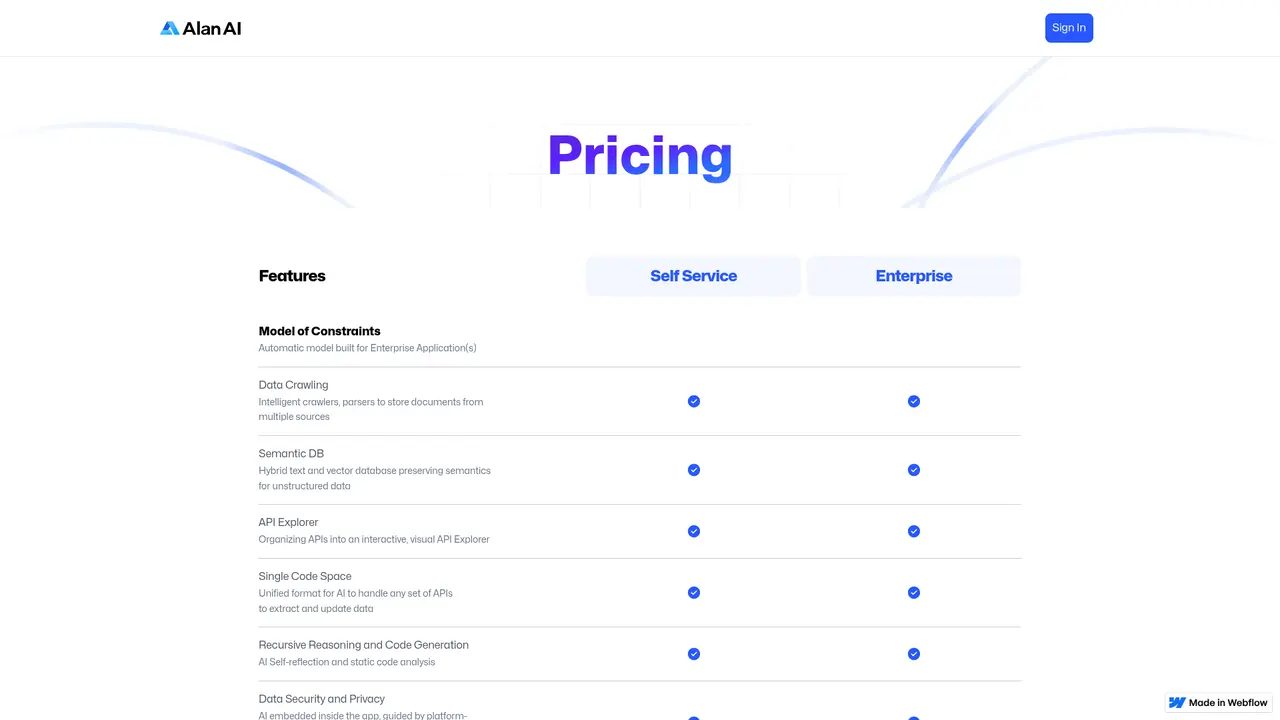
Alan AI offers two pricing tiers designed to serve different organizational needs—from individual developers to large enterprises.
Self Service Plan
The Self Service plan is designed for individual developers, startups, and small teams ready to build voice-powered applications. It includes everything needed to get started:
- Auto Model Building for quick setup
- Semantic Database for organizing knowledge
- API Explorer for understanding capabilities
- Single Code Space for development
- Recursive Reasoning and Code Generation
- Web and Mobile SDKs
- Playground for testing
- Analytics for basic insights
- CI/CD integration support
- Community support
Enterprise Plan
The Enterprise plan provides the complete Alan AI experience for organizations requiring advanced capabilities, dedicated support, and unlimited scale. It includes everything in Self Service, plus:
- Enterprise Auto Model Building for large-scale deployments
- Data Crawling for comprehensive data integration
- Smart Crawlers and Parsers for automated data preparation
- Human In The Loop for human oversight when needed
- Reasoning Graphs for complex decision flows
- Tunable Reasoning for fine-tuned AI behavior
- Agentic Interface for advanced automation
- Custom UI for branded experiences
- Unlimited Application数量
- Dedicated Account Team
- 24x7 Priority Support
| Feature | Self Service | Enterprise | |---|---|---| | Auto Model Building | ✓ | ✓ (Advanced) | | Semantic Database | ✓ | ✓ | | API Explorer | ✓ | ✓ | | Code Generation | ✓ | ✓ | | Web/Mobile SDKs | ✓ | ✓ | | Analytics | Basic | Advanced | | Support | Community | 24x7 Priority | | Application Limit | 1 | Unlimited | | Custom UI | — | ✓ | | Human In The Loop | — | ✓ | | Dedicated Account Team | — | ✓ |
Note that deployment method (SaaS, VPC, On-Premise, or VMWare Private AI) affects final pricing. Organizations with specific security, compliance, or infrastructure requirements should contact the Alan AI sales team for a customized quote.
:::card{type="tip" title="💡 Choosing Your Plan"} Individual developers and small teams can accomplish a great deal with Self Service—most features are included. If you're building enterprise applications, need unlimited apps, require custom UI options, or need dedicated support, the Enterprise plan delivers significantly more value. Many organizations start with Self Service to explore the platform, then upgrade as their needs grow. :::
---
Frequently Asked Questions
:::card{type="faq" title="How is Alan AI different from traditional voice assistants like Alexa or Siri?"} Traditional voice assistants are designed as standalone devices or consumer products—they exist outside your applications and can't access your APIs, data, or business logic. Alan AI is Application-Level AI: the voice interface embeds directly inside your software, understands your specific APIs, and can execute actions within your application. When a user asks Alan AI to "approve this expense report," it doesn't just understand the words—it actually approves the report in your system. :::
:::card{type="faq" title="What deployment options are available?"} Alan AI supports four deployment models: SaaS (fastest setup, shared infrastructure), VPC on AWS, GCP, or Azure (dedicated virtual private cloud), On-Premise via Helm Charts (full data center deployment), and VMWare Private AI (private cloud). Each option provides the same core functionality with different levels of isolation, control, and compliance readiness. :::
:::card{type="faq" title="How is my data protected?"} Security is built into Alan AI's architecture, not added as an afterthought. For organizations with strict requirements, the platform supports fully isolated private environment deployment where all data remains on your infrastructure. You choose where data is stored and processed. The platform supports compliance with industry regulations including HIPAA for healthcare and other sector-specific requirements. :::
:::card{type="faq" title="Which Large Language Models does Alan AI support?"} Alan AI is model-agnostic and supports multiple LLM providers including OpenAI, Anthropic, DeepSeek, Mistral, and Llama (including open-source variants). You're not locked into a single provider—this flexibility lets you optimize for cost, performance, or specific capability requirements as AI technology evolves. :::
:::card{type="faq" title="How difficult is it to integrate Alan AI?"} Integration is designed to be straightforward. The SDK is lightweight and embeds directly into your existing UI without requiring a redesign. Alan AI Studio provides a visual development environment that accelerates the process. Most teams complete basic integration within a week. The learning curve is manageable, especially if your team has experience with modern web or mobile development frameworks. :::
:::card{type="faq" title="What is the pricing model?"} Alan AI offers two tiers: Self Service (for individual developers and small teams) and Enterprise (for organizations needing advanced features, unlimited applications, custom UI, and dedicated support). Deployment method affects final pricing—contact sales for customized quotes for VPC, On-Premise, or VMWare Private AI deployments. :::
Related Content
Copy.ai Review 2026: AI Copywriting Made Easy
Our honest Copy.ai review for 2026. We test Content Agents, AI Workflows, pricing ($29-$249/mo), and compare it to Jasper and Writesonic. Find out if it's worth it for your marketing team.

Rytr Review 2026: Is This Budget AI Writer Worth It?
Our hands-on Rytr review for 2026. We test features, pricing, content quality, and compare it to Jasper & ChatGPT. Find out if Rytr is the best budget AI writing tool.

Word Changer - Free AI tool to rewrite and improve your writing instantly
Writing always using repetitive words or need to avoid plagiarism? Word Changer is a free AI writing assistant that instantly rewrites any text with richer vocabulary and appropriate tone. Get multiple versions with one click, adjust formality level, check readability - all for free!

Unite - AI-powered platform for romantic fantasies and dream couple moments
Explore romantic fantasies and create special moments for your dream couple. This AI-powered platform lets you generate personalized romantic content and experience exclusive AI-created romantic experiences.
Comments