


ChatBotKit - AI Platform for Building Autonomous Agents
Launched on Feb 23, 2025ChatBotKit is a comprehensive AI platform for developers to build conversational chatbots and autonomous agents. Supporting GPT-4o, Claude, Mistral and custom LLMs, it features multi-agent MCP architecture, RAG pipelines, and seamless integration with Slack, Discord, WhatsApp, and more. Perfect for businesses of all sizes.
What is ChatBotKit
Building custom AI chatbots has become a critical competitive advantage for businesses across industries, yet the technical complexity of assembling multi-vendor solutions—coordinating language models, vector databases, messaging platforms, and agent frameworks—often overwhelms development teams. ChatBotKit addresses this challenge as a vertically integrated AI platform designed specifically for agentic engineers who need to deploy production-ready conversational AI without navigating fragmented tooling ecosystems.
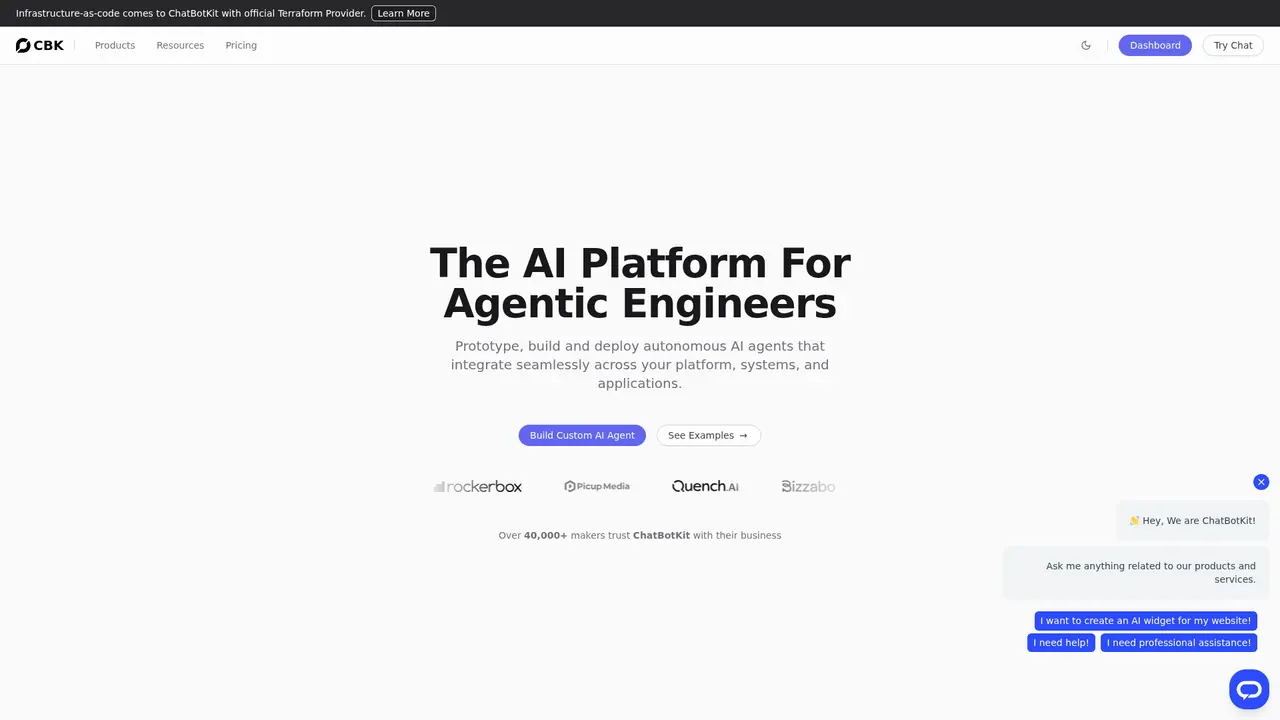
ChatBotKit positions itself as "The AI Platform For Agentic Engineers," offering a comprehensive suite that spans from simple FAQ chatbots to sophisticated multi-agent systems capable of complex enterprise workflows. The platform supports multiple leading language models including OpenAI's GPT-4o and GPT-4o-mini, Anthropic's Claude series, Mistral, and allows organizations to bring their own custom models. This multi-model flexibility enables teams to select the optimal balance of capability, latency, and cost for their specific use cases.
The platform has achieved significant market traction, with over 40,000 makers utilizing ChatBotKit to build AI solutions. Operational metrics demonstrate substantial real-world usage: the platform processes more than 10 million messages monthly across more than 1 million conversations. This scale validates the platform's reliability and performance characteristics for production deployments.
ChatBotKit's integration ecosystem connects deeply with mainstream workplace and communication platforms including Slack, Discord, WhatsApp, Messenger, Telegram, Notion, and Zapier. This extensive integration network enables organizations to deploy conversational AI where their users and teams already work, reducing adoption friction and maximizing practical utility.
:::card{type="summary" title="Key Takeaways"}
- Vertically integrated AI solution suite eliminating multi-vendor complexity
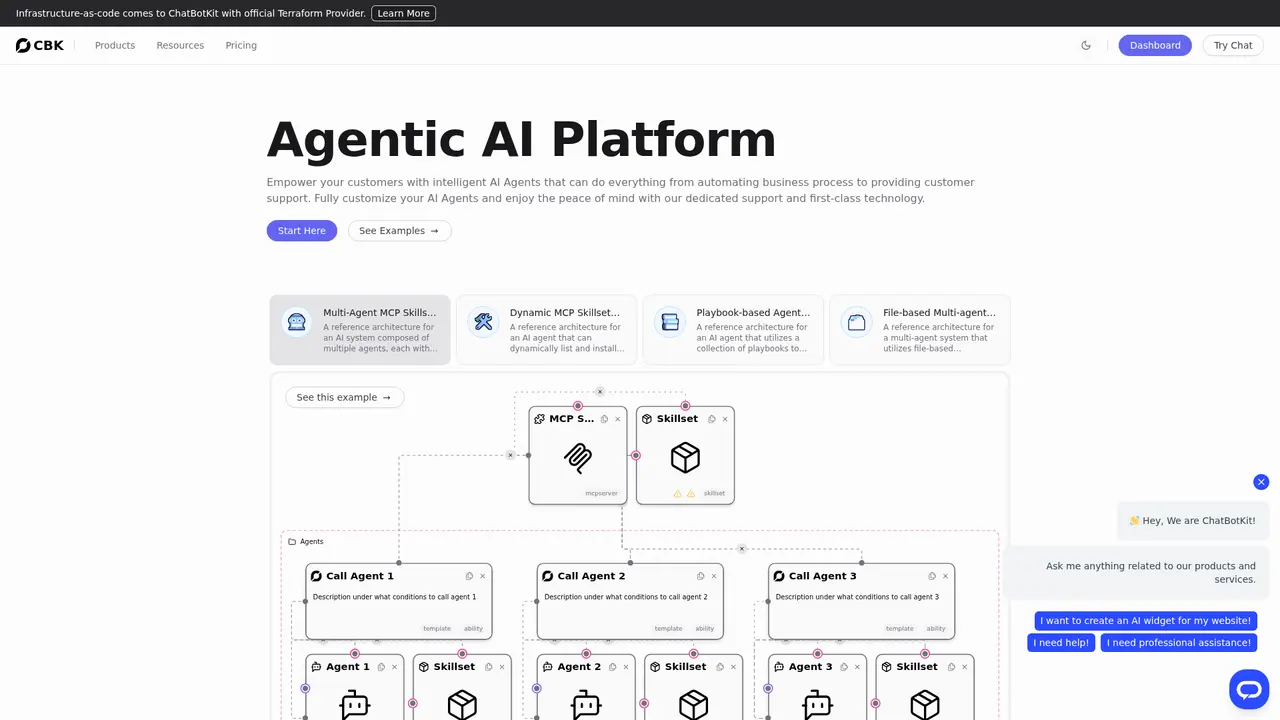
- Multi-Agent MCP Skillset Architecture supporting dynamic skill installation
- Full-channel integration with Slack, Discord, WhatsApp, Telegram, and enterprise platforms
- Proven scale: 40,000+ developers, 1M+ monthly conversations, 10M+ monthly messages :::
---
ChatBotKit's Core Features
The platform delivers its capabilities through a modular architecture that enables developers to assemble precisely the functionality their applications require. Each core feature represents a building block that can be combined flexibly to address specific use cases.
AI Agents leverage the Multi-Agent MCP Skillset Architecture to orchestrate complex workflows. Each agent operates with independent skill sets coordinated through MCP (Model Context Protocol) servers, enabling sophisticated task decomposition and execution. The Dynamic MCP Skillset Architecture allows AI agents to dynamically enumerate and install skillsets from a directory at runtime, providing unprecedented flexibility for evolving business requirements. Organizations deploying AI Agents for customer service automation have reported reducing manual客服 workload by up to 70% while maintaining response quality.
AI Widgets provide the fastest path to production deployment through the Widget SDK. These embeddable chat interfaces can be integrated into any website or application within minutes, supporting full customization of branding, styling, and behavior. The Widget handles file uploads, asset management, and conversation state automatically, allowing developers to focus on bot logic rather than UI implementation.
AI Messaging unifies multi-channel customer engagement across Slack, Discord, WhatsApp, Messenger, Telegram, Microsoft Teams, Google Chat, and Twilio SMS. A single backend manages all channels, ensuring consistent responses and centralized conversation history regardless of where users engage.
AI SDKs serve developers who prefer programmatic control. The platform provides native Node.js and Go SDKs alongside the Widget SDK and Terraform Provider for infrastructure-as-code deployments. The complete REST API supports authentication, streaming responses, and comprehensive error handling. Developers report achieving production deployments within hours rather than weeks compared to building conversational AI systems from scratch.
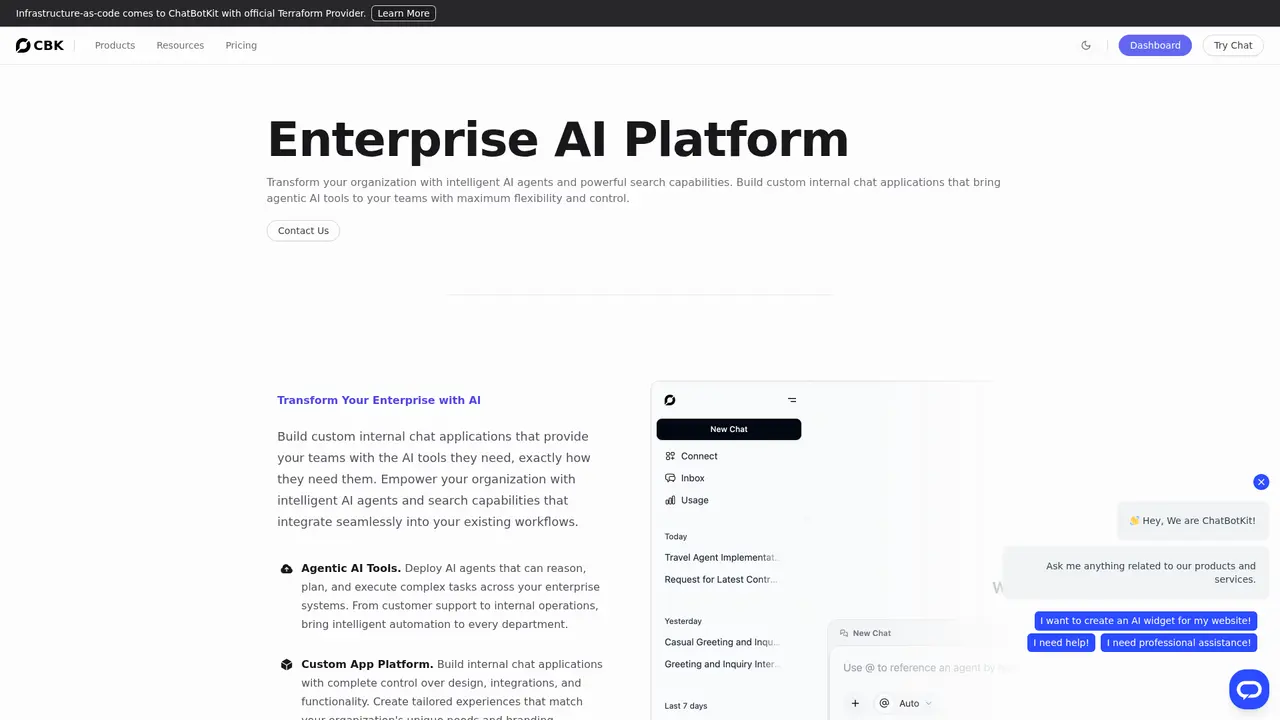
AI Enterprise delivers the security, compliance, and deployment flexibility required by large organizations. Custom internal chat applications can be built with AI-powered semantic search capabilities. Deployment options include both cloud and on-premise configurations to satisfy data residency requirements. Advanced security features include GDPR and CCPA compliance, content moderation, data encryption, and audit trails with configurable 90-day retention.
Datasets and Skillsets form the knowledge foundation for intelligent responses. Datasets support ingestion from multiple sources including website sitemap crawling (up to 1,000 pages per execution on Pro plans), Notion integration, and direct file uploads. The RAG (Retrieval Augmented Generation) pipeline employs vector similarity search with Ada Sprout and Ada Loom embeddings, enhanced by Re-rankers algorithms that optimize result accuracy through secondary ranking.
::::grid :::card{type="advantages"}
- Vertical Integration: Single platform eliminates orchestration complexity across multiple vendors
- Multi-Agent System: Sophisticated workflow automation with dynamic skill installation
- Rich SDK Ecosystem: Node.js, Go, Widget, Terraform Provider, and comprehensive REST API
- Enterprise-Ready: GDPR/CCPA compliance, audit trails, on-premise deployment options ::: :::card{type="disadvantages"}
- Learning Curve: Advanced features require understanding of MCP architecture and RAG pipelines
- Pro Tier Requirement: Advanced capabilities including 100 datasets, custom domains, and audit trails require Pro plan ($65/month) ::: ::::
---
Who is Using ChatBotKit
ChatBotKit serves a diverse range of users from individual developers building hobby projects to large enterprises deploying organization-wide AI assistants. Understanding which use cases align with your requirements helps determine whether the platform fits your needs.
Customer Service Automation represents the most common deployment pattern. Organizations deploy AI chatbots to handle frequently asked questions, provide instant responses, and triage inquiries before human intervention. The measurable impact is substantial: teams report reducing customer service workload by 70% while improving response times from hours to seconds. This enables support teams to focus on complex issues requiring human judgment while the AI handles high-volume routine queries.
Internal Knowledge Management addresses the challenge of information fragmentation across enterprise systems. Companies build AI search assistants that connect to internal knowledge bases, documentation, and databases. Employees retrieve accurate information instantly rather than searching through multiple systems or waiting for colleagues. This use case particularly benefits organizations with large internal documentation repositories or complex product catalogs.
Multi-Channel Marketing Engagement serves teams managing presence across multiple platforms. Rather than maintaining separate bot implementations for each channel, ChatBotKit provides unified management through a single dashboard. Marketing teams deploy consistent brand experiences across Slack communities, Discord servers, WhatsApp business accounts, and other platforms while maintaining centralized conversation analytics.
Developer API Integration targets technical teams building custom AI applications. The SDKs and REST API enable integration into existing products and workflows without rebuilding conversational AI infrastructure from components. Development timelines compress from months to hours for basic implementations, allowing smaller teams to deliver AI-enhanced experiences without dedicated AI engineering expertise.
SaaS Product Enhancement enables software companies to add conversational AI capabilities to their offerings. The Widget SDK provides embeddable chat that can be white-labeled and customized to match host product branding. This accelerates time-to-market for AI features without significant engineering investment.
E-commerce Product Consultation deploys product assistant chatbots that help shoppers find products, answer questions about specifications, and provide personalized recommendations. These assistants operate 24/7, handling consultation volume that would require significant human staffing, directly improving conversion rates through instant engagement.
:::card{type="tip" title="Selection Guidance"} For individual developers exploring conversational AI, start with the Free plan to understand platform capabilities. Small to medium projects with moderate usage benefit from the Basic plan at $25/month. Professional projects requiring advanced features, custom domains, and audit trails should select the Pro plan at $65/month. Enterprise deployments with on-premise requirements, custom SLAs, and unlimited scale contact sales for custom pricing. :::
---
Quick Start
Getting from account creation to a working chatbot requires minimal steps, though familiarizing yourself with core concepts accelerates productive use.
Prerequisites: Create a ChatBotKit account at chatbotkit.com and generate an API key from the dashboard. The platform supports Node.js 18+ and Go 1.20+ environments for SDK integration.
Core Concepts: Understanding four fundamental abstractions enables effective platform use. Bots represent the conversational AI entities that process messages and generate responses. Datasets contain the knowledge base that provides contextual information for RAG-powered responses. Skillsets define bot capabilities and behavioral patterns through configurable instructions. Integrations connect bots to external channels and platforms.
Minimal Example: Using the Node.js SDK, create a basic chatbot in approximately 20 lines of code:
```javascript import { ChatBotKitClient } from '@chatbotkit/sdk';
const client = new ChatBotKitClient({ apiKey: 'your-api-key' });
const { sessionId } = await client.session.create();
const response = await client.chatbot.chat(sessionId, { message: 'Hello, how can you help me?' });
console.log(response.reply); ```
Deployment Options: The Widget embeds into any website with a simple JavaScript snippet. Platform integrations for Slack, Discord, and other channels configure through the dashboard and require minimal setup beyond standard OAuth authentication flows.
:::card{type="tip" title="Best Practices"} Before deploying to production, review the Multi-Agent MCP Architecture documentation to understand skill orchestration patterns. For knowledge-intensive applications, study the RAG Pipeline documentation to optimize retrieval accuracy through proper dataset structuring and re-ranker configuration. :::
---
Technical Architecture and Features
The architectural decisions underlying ChatBotKit reflect deep understanding of production AI system requirements. This section details the technical capabilities that enable reliable, scalable conversational AI deployments.
Multi-Agent MCP Skillset Architecture represents the platform's foundation for complex task handling. Multiple AI agents operate concurrently, each possessing independent skill sets optimized for specific task types. The MCP (Model Context Protocol) server infrastructure coordinates agent interactions, enabling sophisticated task decomposition where complex requests flow through appropriate specialized agents. This architecture supports enterprise workflows requiring multiple distinct capabilities—from product recommendation to order status查询 to refund processing—without monolithic bot logic.
Dynamic MCP Skillset Architecture extends flexibility to runtime. AI agents can enumerate available skillsets from a directory and install new capabilities without deployment cycles. This enables scenarios where bots acquire temporary skills for specific customer interactions, then release those resources afterward. The architectural pattern supports rapidly evolving business requirements where bot capabilities must adapt faster than traditional development cycles.
Blueprint Designer provides visual design capabilities for multi-agent systems. Technical teams can construct complex AI architectures through a drag-and-drop interface, defining agent relationships, skill assignments, and conversation flows without coding. Real-time preview and debugging tools accelerate the design-validate-iterate cycle.
RAG Pipeline delivers the knowledge grounding essential for accurate, contextual responses. The retrieval system employs vector similarity search using Ada Sprout and Ada Loom embeddings, optimized for semantic matching accuracy. Re-rankers apply secondary algorithms to refine initial results, improving answer precision for complex queries. The pipeline integrates seamlessly with dataset sources including website crawling (supporting up to 1,000 pages per execution), Notion workspaces, and file uploads.
Security and Compliance address enterprise requirements systematically. Data transmission uses TLS encryption; data at rest employs encryption appropriate to deployment region. The platform maintains GDPR and CCPA compliance with configurable data retention policies. Content moderation systems filter harmful inputs and outputs automatically. Audit trails (available on Pro plans) retain operational logs for 90 days with comprehensive event tracking.
::::grid :::card{type="advantages"}
- Native MCP Protocol: First-class support for Model Context Protocol enabling advanced agent orchestration
- Dynamic Skills: Runtime skillset installation provides unprecedented flexibility for evolving requirements
- Visual Design: Blueprint Designer enables complex system construction without coding expertise
- Enterprise Compliance: GDPR/CCPA compliance, audit trails, and content moderation built-in ::: :::card{type="disadvantages"}
- On-Premise Limited: Local deployment requires Enterprise plan with custom pricing, not available on self-service tiers ::: ::::
---
Frequently Asked Questions
:::card{type="faq" title="Which language models does ChatBotKit support?"} ChatBotKit supports multiple leading models including OpenAI GPT-4o and GPT-4o-mini, Anthropic Claude series (including Claude 3.5 Sonnet), and Mistral. Organizations can also bring their own models (BYOM) for specialized requirements or proprietary deployments. All supported models are accessible through unified API interfaces, enabling model switching without code changes. :::
:::card{type="faq" title="How does ChatBotKit ensure data security and privacy?"} Security implements multiple layers: data in transit uses TLS encryption, data at rest employs encryption mechanisms appropriate to the deployment region. The platform maintains GDPR and CCPA compliance with configurable data retention. Pro plans include audit trails with 90-day retention covering all operational events. Content moderation systems automatically detect and filter harmful content before processing. :::
:::card{type="faq" title="What is the difference between Free and Pro plans?"} The Free plan provides 50,000 credit tokens monthly, 100 conversations, 500 messages, with limitations of 3 datasets, skillsets, and integrations. The Pro plan at $65/month delivers 2,000,000 tokens (approximately 60 million gpt-4o-mini tokens or 96,000 book pages), 10,000 conversations, 50,000 messages, 100 datasets/skillsets/integrations/files, advanced website crawling (1,000 pages per execution), custom domain support, white-label widget branding removal, privacy protection features, and 90-day audit trails with event logging. :::
:::card{type="faq" title="Does ChatBotKit support on-premise deployment?"} On-premise deployment is available exclusively through the Enterprise plan. This option suits organizations with strict data residency requirements, internal security policies, or infrastructure constraints that prohibit cloud deployment. Enterprise plans include custom contract terms, dedicated support, and SLA guarantees. :::
:::card{type="faq" title="How do I integrate ChatBotKit into existing systems?"} Integration occurs through multiple mechanisms depending on requirements. The Node.js SDK and Go SDK provide programmatic access for application integration. The Widget SDK enables embeddable chat interfaces. The Terraform Provider supports infrastructure-as-code deployments. The complete REST API with authentication, streaming, and error handling enables integration with any HTTP-capable system. Pre-built integrations for Slack, Discord, WhatsApp, and other platforms require only dashboard configuration. :::
:::card{type="faq" title="How does the RAG functionality work?"} RAG (Retrieval Augmented Generation) operates through a pipeline that first indexes knowledge sources—website sitemaps (up to 1,000 pages per Pro execution), Notion workspaces, and uploaded files. The system generates vector embeddings using Ada Sprout or Ada Loom. Query processing retrieves semantically similar content through vector similarity search, then applies Re-rankers algorithms to optimize result ordering before passing to the language model for response generation. This approach grounds responses in your actual data rather than model training knowledge. :::
---
Pricing and Plan Selection
ChatBotKit offers four pricing tiers designed to match usage requirements from hobby projects to enterprise deployments. All plans include access to the core platform features, with capability differences reflecting actual operational needs at each scale.
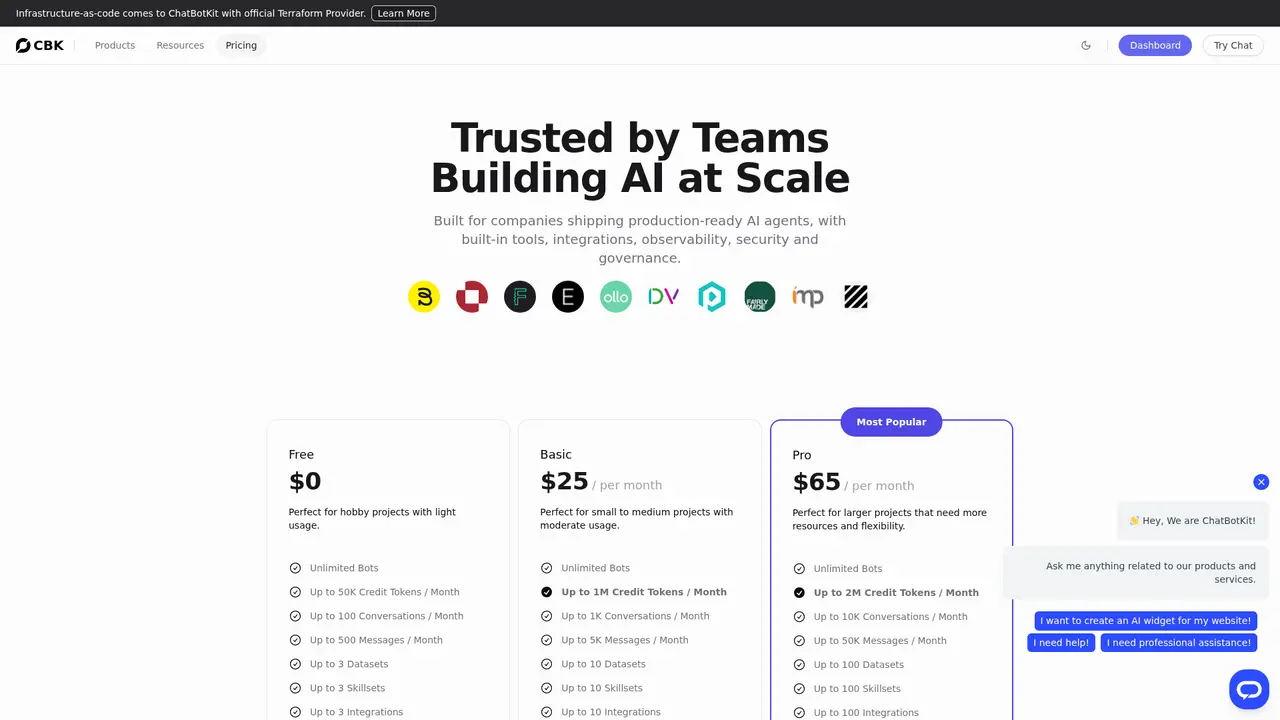
| Feature | Free | Basic | Pro | Enterprise | |---------|------|-------|-----|------------| | Price | $0/month | $25/month | $65/month | Custom | | Monthly Tokens | 50K Credits | 1M Credits | 2M Credits | Unlimited | | Monthly Conversations | 100 | 1,000 | 10,000 | Unlimited | | Monthly Messages | 500 | 5,000 | 50,000 | Unlimited | | Datasets/Skillsets/Integrations/Files | 3 each | 10 each | 100 each | Unlimited | | Website Crawl Pages | 10 | 200 | 1,000 | Unlimited | | Platform Language Models | Limited | Full Access | Full Access | Full Access | | Bring Your Own Model | ❌ | ✅ | ✅ | ✅ | | Custom Domain | ❌ | ❌ | ✅ | ✅ | | White-label Widget | ❌ | ❌ | ✅ | ✅ | | Audit Trails | ❌ | ❌ | 90 days | Custom | | On-Premise Deployment | ❌ | ❌ | ❌ | ✅ | | Support | Community | Basic | Priority | Dedicated + SLA |
The Free plan serves developers exploring conversational AI capabilities or building hobby projects. The generous limitations (50,000 tokens, 100 conversations, 500 messages monthly) exceed typical experimentation needs while providing full platform access for learning.
The Basic plan at $25/month suits small to medium projects with moderate usage requirements. The 1,000,000 tokens (approximately 30 million gpt-4o-mini tokens or 480,000 book pages) accommodate production workloads for growing applications. Full platform language model access and BYOM support enable capability optimization.
The Pro plan at $65/month delivers the features most requested by professional deployments. The 2,000,000 tokens, 10,000 conversations, and 50,000 messages support substantial production scale. Advanced capabilities including 1,000-page website crawling, custom domains, white-label widget branding, and 90-day audit trails satisfy enterprise requirements without enterprise pricing.
The Enterprise plan provides unlimited scale with custom contract terms. Organizations requiring on-premise deployment, custom SLAs, dedicated support, and unlimited everything should contact sales for tailored arrangements.
:::card{type="summary" title="Selection Summary"}
- Free: Hobby projects and learning ($0/month)
- Basic: Production small-to-medium applications ($25/month)
- Pro: Professional deployments with advanced features ($65/month)
- Enterprise: Unlimited scale with on-premise options (Custom pricing) :::
Related Content
Copy.ai Review 2026: AI Copywriting Made Easy
Our honest Copy.ai review for 2026. We test Content Agents, AI Workflows, pricing ($29-$249/mo), and compare it to Jasper and Writesonic. Find out if it's worth it for your marketing team.

Rytr Review 2026: Is This Budget AI Writer Worth It?
Our hands-on Rytr review for 2026. We test features, pricing, content quality, and compare it to Jasper & ChatGPT. Find out if Rytr is the best budget AI writing tool.

Word Changer - Free AI tool to rewrite and improve your writing instantly
Writing always using repetitive words or need to avoid plagiarism? Word Changer is a free AI writing assistant that instantly rewrites any text with richer vocabulary and appropriate tone. Get multiple versions with one click, adjust formality level, check readability - all for free!

Unite - AI-powered platform for romantic fantasies and dream couple moments
Explore romantic fantasies and create special moments for your dream couple. This AI-powered platform lets you generate personalized romantic content and experience exclusive AI-created romantic experiences.
Comments